

Lean in the printing industry: a case study

This article shows the implementation of manufacturing cells in a printing company, replacing the linear layout with the cellular layout, in which a “pilot cell” was designed and implemented for the notebook assembly process.
Implementing a manufacturing cell as a “pilot project”
The company studied in this case has a production system with characteristics of the classic Taylorist-Fordist model, easily identified by aspects such as: use of a linear layout, specialized (single-task) operators, inflexible production capacity in the face of demand variation, large-lot production and quality control on the finished product.
The items produced are grouped into four families: standardized printed forms, tax ledgers, continuous forms and notebooks.
The process is divided into five manufacturing stages, namely: printing, preparation (of covers and standardized printed forms), cutting, tax ledger assembly and notebook assembly. For the purposes of this article, only the last stage described will be considered.
The notebook assembly line
The notebook consists of the following items: cover, inner pages, spiral, sticker and plastic wrap. The assembly process consists of executing a sequence of operational steps (Figure 1) performed on an assembly line (Figure 2). This line occupies an area of 155.13m2 and produces an average daily volume of 2,647 units in a single 8-hour shift, with a workforce of 9 people (direct labor).
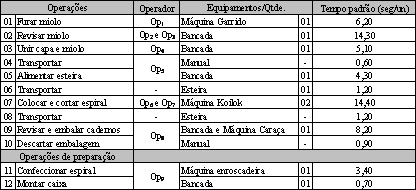
Figure 1 – Operations of the notebook assembly process – linear physical layout
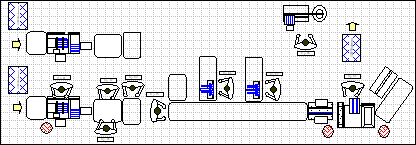
Figure 2 – Layout: linear physical arrangement
In the linear physical layout (Figure 2) the operators work seated, on a single-task basis; the arrangement of the workstations makes it difficult to group operations, contributing to underutilization of labor (Figure 3); the production flow is irregular due to unbalanced resources; and internal work-in-process inventories (WIP) contribute to increasing the product's manufacturing lead time.
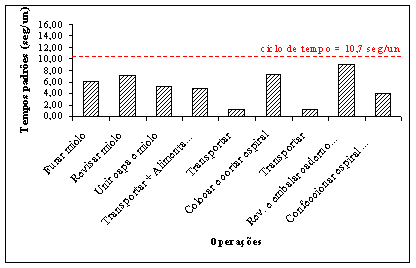
Figure 3 – Grouping of operations applied to the linear physical layout
Figure 3 shows that the operators have a large amount of idle capacity relative to Takt time (time cycle), which results in the build-up of material inventories between operations (WIP); these in turn directly increase the product's throughput time in the production process, quantitative overproduction and the waiting of lots in the resource queue.
Implementing the proposed cellular layout
Based on customer orders (sales), a demand of 2,700 units/day was determined for the products processed in the notebook assembly cell. The time cycle (takt time), which is the quotient of available hours/day by required production/day (MONDEN, 1984), was determined to be 10.7 seconds/unit produced.
Thus, we have:

Next, a systematic analysis of the operations was carried out with the aim of creating the “operational value stream” and increasing the utilization rate of labor and equipment. To this end, the following actions were taken:
- Grouping of the operations “drill inner pages” and “make spiral”;
- Grouping of the operations “inspect inner pages” and “join cover and inner pages”;
- Grouping of the operation “assemble box” with the operations “inspect and pack notebooks” and “discard packaging”;
- Separation of manual and machine elements in the operation “insert and cut spiral” (JIDOKA concept).
This analysis resulted in a new operational sequence (Figure 4) through which we observed the following improvements:
• Reduction in labor;
• Reduction in standard time;
• Reduction in equipment;
• Reduction in operations;
• Elimination of transportation.
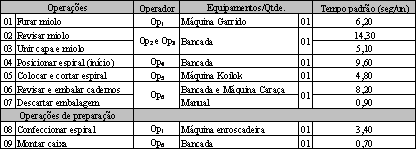
Figure 4 – Operations of the notebook assembly process
In this way, a more balanced process was observed (Figure 5), with operations balanced and close to the time cycle (takt time). This new grouping made it possible to establish and maintain a constant pace of work through continuous flow and enabled monitoring throughout the work shift, ensuring that the demand pulled by the customer was met daily.
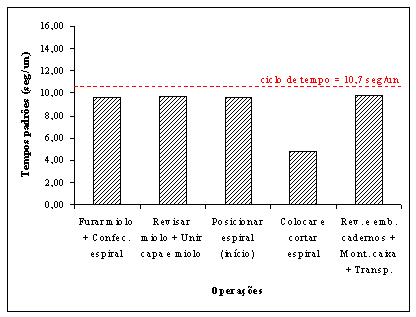
Figure 5 – Grouping of operations applied to the cellular physical layout
Labor, equipment and floor-space resources were optimized, since the workstations were brought closer together and arranged in a “u” configuration. Figure 6 shows the new physical layout occupying an area of 102.27m2.
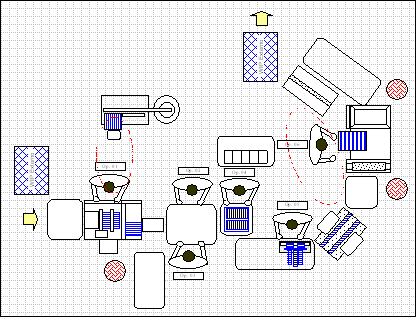
Figure 6 – Cellular physical layout
After the proposals for operation balancing and cellular physical layout were drawn up, implementation began. At this stage, the adjustments needed for the system to work perfectly were made, including adapting equipment, creating devices and multifunctional training of employees.
Once the adjustments were made, the cell became part of the production process under normal working conditions, and was evaluated through the indicators put in place.
Analysis of results
Figure 7 presents a comparison between a line and the notebook assembly cell, based on the chosen indicators. The indicators themselves behave as follows: labor productivity increased from 36.8 to 52.1 notebooks/man-hour, representing an improvement of 41.6%. Floor-space productivity also grew, going from 17.4 to 26.4 notebooks/m2, representing an increase of 51.7%.
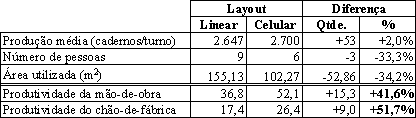
Figure 7 – Comparison of linear layout X cellular layout
Other gains could also be perceived when the cell was implemented, some of them tangible and others intangible. Although they were not the subject of this study, it is important to mention them.
In quantitative terms, there was a reduction in the inventories between workstations, which went, with the exception of the first operation (drill inner pages), to a single-piece lot; throughput time was also reduced thanks to the elimination of intermediate lots, waiting and movement; and electricity consumption and maintenance costs were reduced due to the removal of some equipment from the process. In qualitative terms, an increase in employee motivation could be observed as a result of job enrichment; the perceived quality of the final product was better and the area's housekeeping also improved considerably.
Feasibility of Lean implementation
Based on the experience presented, lived by the author, it can be concluded that the indicators chosen to underpin the comparative analysis (labor and floor space), although they do not fully assess the efficiency of the cellular layout, do to some extent reflect the benefits generated by this approach in the production process.
References:
CORRÊA, Henrique L. & GIANESI, Irineu G. N. (1993) - Just In Time, MRP II e OPT: um enfoque estratégico. São Paulo: Atlas.
GHINATO, P. (2000) - Published as 2nd chapter of the book Produção & Competitividade: Aplicações e Inovações, Ed.: Adiel T. de Almeida & Fernando M. C. Souza, Edit. da UFPE, Recife.
KARLSSON, C. & AHLSTRÖM , P. (1996) – Assessing changes towards lean production. International Journal of Operations & Production Management. Vol. 16, n.2, p. 24-41.
MONDEN, Yasuhiro (1984) – Produção sem estoques: uma abordagem prática do Sistema de Produção da Toyota. São Paulo: IMAM.
OHNO, Taiichi (1997) - O Sistema Toyota de Produção: além da produção em larga escala. Porto Alegre: Bookman.
TUBINO, Dalvio Ferrari (1999) – Sistemas de Produção: a produtividade no chão de fábrica. Porto Alegre: Bookman.





