

The five missing elements in your standardized work
The five missing elements in your standardized work.
So, how is the implementation of your standardized work (SW) going? The answers to this question usually paint a bleak picture. Here is what I often hear.
“We just don't have the discipline Toyota has to make standardized work work”.
“We implemented it, but people don't follow it”.
“We have trouble transferring good SW from one workplace to another”.
“We're good at determining the One Best Way, but people always insist on doing things their own way”.
“People just don't want to follow it. They like to do things their own way”.
“We put it into an audit process, but the auditors don't follow that process”.
I like to say that the Toyota way is a socio-technical system on steroids. One test for all our lean systems is the question of how competent we are at integrating people with process (the social with the technical). The best way to achieve that integration is through standardized work and kaizen.
By this, I mean much more than simply pointing out that our corporate lean initiatives should involve both the Engineering and Human Resources departments, each of them launching programs to raise the technical and social dimensions of work. I am talking about the way in which the design of the work incorporates both dimensions at the macro level simultaneously. When a worker bolts in a seat belt in the plant or an administrative employee processes an order in the office, the work will be driven by the technical and social aspects of the job definition.
Leaders, be aware: you cannot simply dictate this from above. You will be in trouble as soon as you find yourselves chasing compliance in pursuit of standardized work. You are chasing your own tails and will never catch them. Instead of policing the details of compliance, examine why the worker is not following or cannot follow the standardized work. Ask, "Why can't you follow the standardized work?" The answer to that question – asked not in an accusatory way, but in a spirit of pure inquiry – will invariably lead you to unexpected places, usually very far from the employee.
I will explore five neglected, misunderstood or forgotten aspects of standardized work. Next, we will explore how to think about standardized work for non-standard work, in areas such as service sectors, knowledge workers, creative work and management. Finally, I will provide a kind of "primer" that can serve as a guide for you to reflect on establishing standardized work in your organization, centered around these five neglected aspects of standardized work:
- Don't confuse standardized work with work standards.
- Don't confuse standardization with uniformity.
- Don't try to impose standardized work without also providing a structured improvement process, and a clearly defined and unambiguous way of making improvements (kaizen).
- Practice, practice, practice...
- Don't forget the fundamental role of the leader/manager.
Five neglected aspects of standardized work
- Don't confuse standardized work with work standards.
As a practical way to get started with standardized work, you must first clarify your work standards. Never confuse work standards with standardized work. The terminology generally used for "work standards" includes quality standards, specifications, engineering specifications or quality specifications.
Work standards are established during product and process development. They encompass the work that must be done for the product to be produced in a way that successfully achieves the design intent of the product or service. Changes to work standards require a review of the engineering design, so manufacturing companies usually have some kind of "Engineering change request" in place (and, by the way, this is also a process that is usually riddled with problems and waste, and a good process to choose as one of your first business process kaizen efforts). As part of standardized work, Toyota usually calls them “Quality Standards”.
Some examples include:
- Assembly - apply xx pounds of torque
- Processing - use heat treatment at xxx degrees for x hours
- Healthcare - administer medication xx using a dose of xx
- Coffee - xx seconds to pull an espresso
- Journalism - a weekly column of xxx words
For each of the items above, kaizen (improvement) is also possible, but through a process different from the typically incremental improvements of standardized work and a suggestion system.
These are the work standards.
Toyota-style standardized work for the front-line production operator is a matter of three basic elements: (1) timing, (2) sequence, and (3) a standard quantity of the element in process at any given moment.
a. Takt time and cycle time (TT vs. C/T)
- In other words, timing - the timing demanded by the customer and the time constraints of processing capacity
b. Sequence (including layout and man-machine combination with process capacity sheets and standardized work combination table)
- In other words, determining the optimal sequence for producing the product or service – first do A, then B and then C
c. WIP
- In other words, the quantity of the "element" in process that is required, no more, no less. This element may be material, parts or information.
With these norms established, the operator has the basic elements that make it possible (with training, practice and support) to complete their work successfully. From there, they can easily learn to identify problems. And, from there – with the proper training and support – they can solve problems and make improvements. With standardized work in place, the operator can now do PDCA.
Toyota's "Mr. Standardized Work", Isao Kato, has been insisting on this point for many years: "Before you can start standardized work, you must clarify your work standards". All too often, this statement falls on deaf ears or ears that are not ready to hear it. This distinction is completely institutionalized in Toyota's production operations, so the company's operations people rarely need to worry about it. In your company, you probably need to do a lot of detailed work to make the distinctions clear, and you may need to add the "required outcome" to the list as a fourth basic element.
- Don't confuse standardization with uniformity.
Standardization means that a given operation has established a standard practice, a routine that can be followed, a baseline for comparison that the person doing the work can use to distinguish normal from abnormal. With this baseline, a foundation for PDCA is established, making improvement possible.
On the other hand, uniformity simply means that a given operation is performed the same way everywhere. This is where the concern with "best practice" and the search for the "one best way" arise. Toyota calls this yokoten. For example, an assembly job that involves fastening a seat belt by inserting bolts, or the process for communicating a schedule change in a dental office – uniformity means performing these tasks in exactly the same way in every location by every worker.
Our goal with standardized work is the former: establishing a starting point (or baseline) for the operation, from which improvement is possible. Certainly there are many occasions on which uniformity is also desirable. But the real prize here is when we can get everyone to follow their own SW, so that every time they perform the work the same way, establishing a baseline that can then be observed for correctness, for easy identification of abnormalities and immediate generation of improvements.
As a leader, if you can achieve this across all your operations, you should be very happy. Then you may also want to pursue uniformity as needed. But I bet that once you have every worker committed to seeking improvements in their own SW, you will find that your dissatisfaction with the fact that different workers may do similar jobs in slightly different ways becomes much less of a concern.
Many companies let this concern become an excuse for not setting their employees free with kaizen, for not encouraging them to make suggestions to improve their own work. Such managers prefer to worry about monitoring and communicating "best practice".
My bet is that if you really unleash your people's creativity, you will quickly stop worrying about the fact that worker A in plant B performs the operation slightly less efficiently than worker B in plant A.
- Don't try to impose standardized work without also providing a structured improvement process, and a clearly defined and unambiguous way of making improvements (kaizen).
You will have little or no success with standardized work unless you also institute some kind of suggestion system, or process (whether or not it is formally called a “suggestion system”) that gives the individuals who perform the standardized work a way of making suggestions on how to improve the work – that is, kaizen. The essence of kaizen lies in the people who do the work making suggestions in how to improve it. In other words,
- You cannot do standardized work without kaizen.
- And you cannot do kaizen without standardized work.
What is standardized work? What is kaizen?
They are two sides of the same coin - if you try to have one without the other, you will run into one of two kinds of very serious problems. To explain and explore:
A. Standardized work without kaizen
- Employee motivation is buried, and human creativity is wasted
- Problems recur constantly, without being identified and solved
- Employees don't take the initiative, improvements stop
Operations – like economies, companies, cultures, species – either progress or decline.
B. Kaizen without standardized work
- Chaotic change, a back-and-forth effect of progress and backsliding
- Problems recur, PDCA is not followed, there is no root cause analysis
- It is impossible to identify progress, improvements stop
Kaizen – as an expression of the scientific method - needs a baseline for comparison.
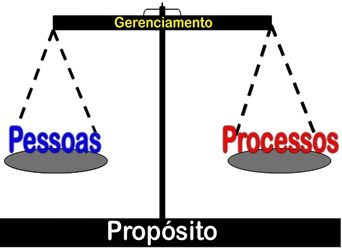
Which brings us back to the thesis I have been insisting on in this space for months, that the technical/process side and the social/people side of the equation are equally important. Separate them and get ready to run into problems.
4. Practice, practice, practice...
For some reason, most of us almost always see our everyday work as something trivial. I believe it is because we do it every day.
But does it have to be that way? Craftspeople do their work every day. Artists paint or sculpt every day. Athletes run or swim every day. Musicians play every day. But we choose to put our daily work in a different, lower category. The focus that lean thinking places on front-line work changes our attitude toward work. It elevates itto a higher level of visibility and importance. In my recent column on Starbucks, I suggested "…think of the best waiter/waitress you have ever seen. Remember admiring the way he or she could take orders coming from every direction without missing a beat".
Mastery of any skill requires diligent practice. When I worked at Toyota, there was usually a sequence in which workers would first master one job, then move on to the upstream and downstream jobs, to finally master every job on the team. When I was at the Takaoka Plant, the process of learning each of the roughly five jobs on a team took many years.
In the book Outliers, author Malcolm Gladwell explains that there is strong evidence to support the argument that mastery of any skill requires about 10,000 hours of practice. Musicians, athletes, craftspeople, artists, professionals in any discipline can be seen as requiring this 10,000-hour barrier. Gladwell provides several examples that reminded me of some of my favorites:
- Tiger Woods, working with a coach to relearn his swing from scratch after his first Masters win, arguably the greatest victory in golf.
- Michael Jordan may be considered the most talented player of all time, but every observer and the athlete himself emphasize that the factor that really set him apart was that he practiced harder than everyone else and was the best prepared.
- Sonny Rollins, after (in fact AFTER, in capital letters) achieving stardom as one of the greatest saxophonists in the jazz world, took a three-year break to take his playing to a new level. Practicing alone every day on the Williamsburg Bridge in New York City, he blended his notes with the noise of the traffic, so that no one heard his new sound until he felt he was ready. His song and album "The Bridge" became instant classics.
There is a Japanese saying: "Three years on a rock", which means that it takes about three years to learn deeply any relevant subject.
-- When I was at Toyota, there was a belief that it was possible to understand the basic concepts of TPS in three hours, to learn to "explain" the basic concepts of TPS in three days, and to become proficient at "actualizing the concepts" of TPS in three years.
- In Toyota's engineering and R&D world (very independent from the rest of the company, even with its own separate Human Resources Development Department!), it was commonly said that "it takes 10 years to make an engineer".
- For a quick reference, Gladwell's 10,000 hours would commonly translate into about four years of essentially full-time effort, or longer at a more moderate pace.
Certainly, the specific numbers that Toyota (or Malcolm Gladwell) attaches to these things are interesting, but not exactly the point. The point is … what do you think?
- What is the fundamental reasoning regarding skill development that underlies your organization's approach, system and methods for developing people??
(Toyota's training, especially for employees who work on or around the front lines, is heavily based on the Training Within Industry (TWI) program they learned from the US after World War II. I will say a little more about TWI in the next section, but if you are not familiar with this program, learn it!)
5. Don't forget the fundamental role of the leader/manager
When I come across managers struggling to firmly establish standardized work, their questions and concerns always revolve around the worker, about how to get the worker to follow the standardized work. However, bigger problems are usually always found well before reaching the worker, often starting with the role of the leader, especially the immediate front-line supervisor.
The front-line supervisor will not change their behavior from compliance enforcer to supporter of success unless (1) the new expectations are clarified, (2) the required training is provided and, last but not least, (3) time allocation is provided. What is certainly logical is standardized work for the supervisor.
My first contact with standardized work came in January 1984 at Toyota's Takaoka Plant. I was lucky enough to gain experience in production positions with six weeks of learning in each of the main automotive processes: stamping - body welding - paint - final assembly (followed by time in the production control offices learning kanban calculations, observing training, and learning other similar support operations). All my leaders/mentors were extraordinary, patiently (and, most of the time, calmly) teaching me each job. It was in final assembly that I had my most intense experience with standardized work and with the role of the team leader.
I was too tall for the job I had been assigned on the Corolla assembly line at Toyota. I was over 1.80 m, and Toyota's guidelines in Japan would normally have placed me in other jobs instead of getting in and out of a Corolla 500 times a day. However, an exception was made in my case, since I only had to do that specific job for one week, and it was a job being prepared for the NUMMI trainees who would start arriving in a few months.
In addition to being relatively tall, my legs are long for my height. So I found it hard to do the job exactly as I had been instructed, which was to get in and out of the vehicle in the highly specific, proven, safe and effective way - rear end first. So I soon found a workaround, which was to put my right leg in first. Putting my right leg in first was no problem, but it meant my legs would end up in an awkward position. It seemed reasonable to me, and it was "easier" or preferable to doing it the prescribed way. (All this falls under the heading of "knack". When Toyota teaches standardized work, in addition to stipulating the sequence of work elements - as noted earlier under the three elements of SW - the individual work elements are taught using the TWI Job Instruction methodology, in which many work elements require a certain "knack" to be performed satisfactorily. People usually assume that "knack" is something individual that should not be specified. But TWI and the SW approach emphasize that the "knack" can and should be standardized, and can therefore be improved.)
My team leader watched what I was doing. He stood looking for a moment, gradually frowned, and soon asked me why I couldn't do it as I had been instructed. I explained that it was easier to do it my way. He listened, unconvinced, and watched me some more. He asked me to try the "correct" way again, explaining that he feared I would hurt myself if I kept doing my improvised movement over and over, day after day. Perhaps My Way seemed easier to me at the time, but the position I was holding to do the job would certainly cause excessive strain that would injure me over time. I obeyed his instructions and tried again to do the job the standard way, but, as I expected, I found it very hard to do the job that way. So I explained that I really would have to go back to doing it My Way. He said that was fine for now, but once again clearly skeptical, his face showing concern, he again stood there watching me as I did the job.
Then, as I did the job and he watched, I began to notice his observation, and my awkward work slowly drew a crowd. Before long, the group leader (my team leader's boss), some neighboring team leaders, and others I didn't know were all standing there, watching me work. I had no time to worry about that. My takt time and cycle times were about 56 seconds (on average; the passing vehicles had different option packages, so some required well over 56 seconds, others less - the vehicles were arranged in a sequence - a heijunka sequence - that ensured that two vehicles with a lot of content never followed one another; there would always be a vehicle with less content requiring less time between them), and I usually had no extra time to chat or divert my attention as I did my work.
Next, I noticed that the group of observers huddled, like an American football formation, holding an intense discussion. Then, as the huddle broke up, my team leader tapped me on the shoulder, instructed me to step aside, and took over my job. He and the others had created a NEW way of doing the job, neither the original standardized work method nor my improvised method, which they all agreed would injure me if I kept doing it. My team leader tried out the new procedure as I joined the others in observing. When the New Method seemed to work to his satisfaction and that of the others (many heads nodding in approval, but still many furrowed brows - this was something important), he asked me what I thought. I tried his suggestion. Sure enough, the new procedure worked for me, and to the satisfaction of the improvised task force. The other observers included, I later found out, a safety specialist.
So safety comes first, and there are aspects to the design of a successful job that do not necessarily appear on the various standardized work sheets. Simply put, the team leader (front-line supervisor) must understand the work, deeply. Even more importantly, let's first observe the work closely, making it safe and effective. Then, let's work on efficiencies, improvements and solving other problems. And, from start to finish, let's ...
observe the work ... very ... very closely.
More on leaders ...
I have been discussing the central role of the front-line supervisor, but there is also a role here for senior leadership. All too often, standardized work is seen as one of those trivial aspects that is not truly valued. People assume that SW is working and, if it isn't, well, people just do their jobs better.
But everyone has a role to play here. Engineering needs to design work that is easy to perform in a standardized way, and easy to improve. Middle management needs to support the front-line supervisor, so that he or she has the TIME available that is needed to support the workers. When I worked at the Corolla plant in Toyota City, about half of the team leader's time was made available to help the members of his team when they ran into problems. And he only had about five workers to support. So here you should be asking yourself: "Do we provide this kind of support to our workers ... ?"
As I visit companies, it is very rare to see this kind of commitment to supporting the front-line supervisor in supporting the worker.
Senior managers need to set aside some time to understand what SW really is and how it is nothing if not a mechanism to enable them to achieve their corporate objectives. At some point, every high-level objective becomes a question of how someone on the front lines does their work. This, as the saying goes, is where the rubber meets the road. Until it is reflected in someone's standardized work, any corporate objective or initiative is just talk or words on a piece of paper.
So let's take responsibility for ensuring that the worker learns, is supported and is given every opportunity to succeed in completing the standardized work EVERY time they perform it. It is the leader's job to provide that support: Much less policing compliance to ensure SW; much more supporting to enable success.
Standardizing non-standard work
Now that we have established a baseline for understanding basic Toyota-style standardized work for production workers, what about standardized work for non-standard work??
This topic has less to do with "here is how Toyota does it" and is more a matter of exploring together. I think of SW at three levels (this is similar to, but different from, Toyota's view):
a. Level 1 - repetitive work of the kind done in production
- › This is the one we are exploring in this column
b. Level 2 – supporting repetitive work
- › I discussed this point briefly in Neglected Aspect Number Five – the role of the leader.
c. Level 3 – knowledge-based or service or project work
- › Even for these types of work, success is still a matter of
- Timing
- Sequence and content (including the "knack")
- How much "stuff" we need to do to complete the work
- Outcome
- › SW/kaizen versus creative or knowledge work
Standardized work is ALL about PDCA, establishing the conditions under which PDCA is possible, and then carrying out structured cycles of learning and improvement. This is called science, the scientific method. Do we think science is not creative? Ah – perhaps it often isn't, but it should be!
So what…
Where should we take this discussion of standardized work? Two motivations led me to write somewhat broadly about standardized work. First, SW, the single most important foundational element of any lean system, unfortunately remains misunderstood, misapplied and often disregarded. I believe one reason it is neglected relates to my second motivation.
I would like to emphasize that well-designed standardized work will recognize all the social factors involved in generating good quality in a reproducible way. Inadequate job design could easily have led to worker error and subsequent quality failure. Job design must produce the required outcome, as defined by the technical requirements, the specifications, and as specified by the product's engineering design. That comes first. But job design must also include the "human factors" considerations that make it possible to do the work the right way, and even difficult to do it the wrong way.
Which brings us back to the thesis that the technical/process side and the social/people side of the equation are equally important. At the end of the day, you can't really separate them.
Analyze your standardized work and structured improvement process (kaizen) - this is where you will find your culture!Part 3
A simple primer on the Purpose, Process and People of Standardized Work
In the last two columns, I introduced the five neglected aspects of standardized work. Several people quickly requested a column on exactly what standardized work (SW) is. Here is a quick introductory primer, following LEI's three-P framework of Purpose, Process and People. Incorporate these elements as you begin to establish standardized work.
Purpose
i. - Baseline for improvement.
ii. - Ways to achieve organizational objectives on the front lines, where the organization's real work takes place.
iii. - Ways to engage the people who do the work.
In other words, remember what you want it for:
- Commitment, not compliance
- Improvement, not a steady state
There is no steady state! - Creativity, innovation, problem solving, improvement, not following rules
- Initiative, not following orders
Process
i. - Work standards
ii. - Safety, quality, performance
iii. - Observation and study of processes
iv. - Three basic elements of SW
a) Takt time and cycle time (TT vs. C/T)
- In other words, timing - the timing demanded by the customer and the time constraints of processing capacity
b) Sequence (including layout and man-machine combination with process capacity sheets and standardized work combination table)
- In other words, determining the optimal sequence for producing the product or service – first do A, then B and then C.
c) S-WIP
- In other words, the quantity of the "element" in process that is required, no more, no less. This element may be material, parts or information.
v. -Standard process for making changes (for example, Suggestion System)
People
i. Ways of engagement, involvement, accountability
ii. Every worker as an entrepreneur
iii. QC and SS
iv. Training
1) TWI - Training Within Industry
- If you are not familiar with this program, learn it.
- Job instruction, job methods and job relations
(In Toyota's case, standardized work and kaizen training replaced JM, but companies are also advised to consider starting with JM, and then consider Toyota-style SW later)
2) Skills matrix
- A plan for every person!
3) Practice, practice, practice
v. SW for non-standard work
a. Three levels of SW
i. Level 1 - repetitive work of the kind done in production
ii. Level 2 – supporting repetitive work
iii. Level 3 – knowledge-based or project work
b. SW kaizen versus creative or knowledge work
i. PDCA (Lean Product and Process Development by Al Ward)
vi. Coaching, questioning (the right questions), not telling, getting people to think and take responsibility
vii. Assigning more and more responsibility
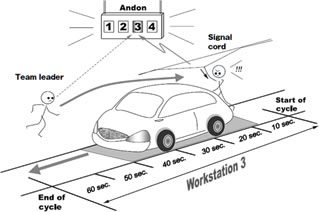
In Kaizen Express, Chapter Four: Toyota calls this the "Fixed-Position Stop System". The line does not stop immediately when the worker pulls the cord. Instead, it continues until it reaches a "fixed position", where it will stop unless the supervisor pulls the cord again to restart it. Here is how it works. When the worker sees a problem, he notifies the supervisor by pulling the cord, which lights up a light on the andon board. The supervisor responds by moving quickly and immediately (within the worker's work cycle) to the station experiencing the problem and makes a set of decisions. The first is to let the vehicle continue to its "fixed position", at which point the line will stop. This is because if the line stopped immediately, the work of every worker on the line would have been interrupted, creating quality and safety problems, among others. Therefore, the work of every worker on the assembly line is linked, choreographed to start and stop at the same time.
Analyze your standardized work and structured improvement process (kaizen) - this is where you will find your culture!







