

Serious about strategy
We were attending a very clear strategy presentation at a third-generation company. There were strategic goals, key objectives, battles that needed to be won and action plans. It followed the classic strategic model based on Drucker's management by objectives thinking. To deepen our understanding, we discussed what the expected gains were - what benefits the company was seeking with these battles and how likely it was to achieve them. As the discussion progressed, however, it became evident that the key results they needed were in the hands of other stakeholders.
Imagine a family-owned food company. Some of the main drivers of sales and profit include:
- The weather (due to the nature of its product).
- The distributor.
- The marketing agency that supports the brand.
- The machine manufacturer that agrees (or not) to build more flexible and robust machines (important for the food company to cope with large variations in demand).
- The people needed to work in production.
As we talked, it became clear that the "OKRs", objectives and key results, depended on people and processes over which the company had no control. We began discussing how the current owner's grandfather had started the business and the various agreements he had to make to turn a craft workshop into an industrial operation - some good, some not so good, some terrible (specifically, those with the bankers). He would never have thought about strategy in terms of goals, objectives, and so on. He would have thought about it in terms of agreements. Not surprisingly, this is exactly how the entrepreneurs we know who started their own businesses think. So why were we sitting there listening to a presentation based on the premise that the company could control its own destiny? To get to that, we need to take a small detour into learning theory, so please bear with us.
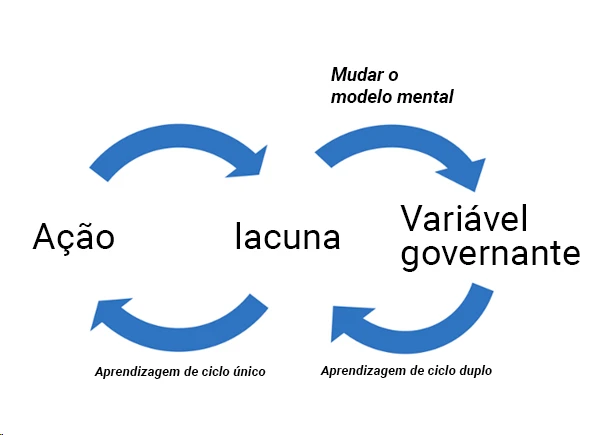
Mental models are incredibly resilient. They are the mental maps of the world that we mobilize to make sense of things, especially invisible things, such as the future, or intangibles such as organizations and relationships. Most of what we experience as learning is "single-loop learning": we see the difference between reality and our expected view of it and try to correct it. In practice, we try to change real life to defend our mental status quo. We fix our minds on a few governing variables related to what we think we want and react to events accordingly to keep them as stable as possible.
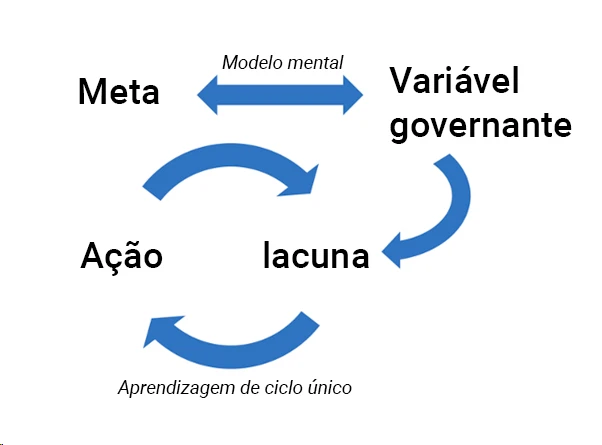
However, true learning is "double-loop learning". It comes into play when we realize that, to achieve the success we truly want, we need to change our governing variables; and it is necessary to turn our mental model upside down and start thinking and acting differently. When we see where our actions are truly taking us in practice, compared with our objectives, we are rarely compelled to change our mental models and redefine the governing variables of our actions. These rare "moments of insight" are hard to come by and often hard to manage, because they involve changing our map of a situation and our understanding of the world. In Lean, a typical example is the shift from the governing variable of mass production - maximizing local output through larger, faster, single-product machines - to lean production - maximizing flexibility to improve global output through pull and flow. Instead of governing by increasing output, you shift to increasing flexibility and quality.
Returning to the presentation we were witnessing, the goals -> objectives -> actions model we saw implies that the company is in a position of dominance - or seeks dominance to assert power. This is Porter's American strategy model taught in MBA courses. It also implies stability. But what if you are not dominant and operate in an unstable environment, like the company we visited (which is completely dependent on access to distribution channels and on the weather for its sales)?
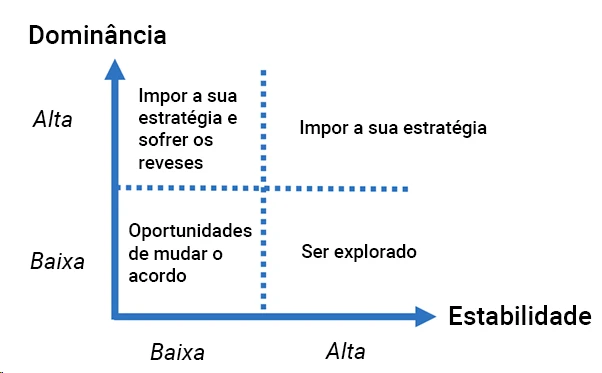
In a context of low dominance and low stability, we can change our mental models and view strategy as agreements with the parties on which we are completely dependent. These agreements can improve, remain stable or deteriorate. In fact, we can analyze each agreement in Masaaki Imaï's lean terms:
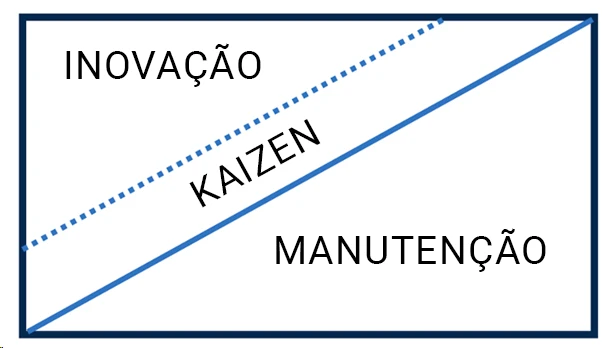
When analyzing each critical agreement that sustains our business, we can think in terms of:
- Are we maintaining the agreement?
- What continuous improvements (kaizen) are we making to the agreement?
- Are we exploring innovation opportunities?
Following this line of thinking, we can adopt Toyota's view of looking at a value network rather than a supply chain. The supply chain is a construct that implies we are all like Apple, that is, that our organization is in a position of market stability and complete dominance, where all the other players in the supply chain are completely dependent on us. However, this is not the case for most companies. But if we adopt a value network perspective and combine it with Imai's approach, we can conceive a framework like this:

This simple framework completely redefines our strategic vision, as well as the key skills we need to develop to succeed. For example, it places persuasive communication, negotiation and conflict management at the center of managerial skills - which is no surprise when you think about it, but how many executives formally develop their competence in these areas as opposed to calculating, organizing and controlling (the skills they normally need in an environment of dominance)?
Thinking in terms of agreements completely changes our perspective on the situations we face. Instead of imagining the ideal future state (for us) and the implementation path to reach it (regardless of what everyone says), we need to look at things differently:
- What is the mutually agreed space for win-win and the opportunities to be explored for mutual gain, as well as the lose scenarios we both want to avoid in our current business situation?
- What is the discussion process, and how are the invitation for new information and ideas, the organization of physical spaces for discussion (such as obeyas or reviews) and the facilitation of difficult conversations handled?
- Emotions and egos must be considered as facts that are part of the agreement - identity roles ("I'm an IT manager, how do you expect me to know about distribution?"), emotional outbursts and motivational ups and downs are an integral part of the robustness of the agreement. Cultivating the relationship is as important as the object of the agreement under discussion and involves a clear give and take - to achieve this, I must give gladly.
Lean practitioners will be familiar with these elements (which are part of any people-centered approach), but they are rarely explored explicitly as tools for achieving better results. Thinking in terms of agreements means shifting our view from "who does what to make things happen" to "who talks to whom to move things forward?
Following this path to its logical conclusion, management can be seen as the constructive organization of solutions to inherent conflicts between stakeholders, which, as it turns out, is Herbert Simon and James March's definition of organizations in the 1950s: "Organizations are systems of coordinated action among individuals and groups whose preferences, information, interests, or knowledge differ. Organization theory describes the delicate conversion of conflict into cooperation, the mobilization of resources, and the coordination of effort that facilitate the joint survival of an organization and its members." (From the 1958 book Organizations)
Once we abandon dominance as a governing variable (which of us is dominant, unless you work for a multinational?), we can discover completely new and more effective ways of thinking about strategy - and indeed, Lean strategy - in terms of creating a communication structure that supports kaizen and teaches people to solve problems in a way
- Is the agreement improving or deteriorating?
- Is the communication structure (such as just-in-time) supporting a better agreement?
- Are people trained in collaborative problem solving?
Our minds believe what they understand; this is a feature, not a bug. Something easy to understand is easy to believe, which is why exploring new thinking is so difficult. Our minds demand that we return to the old thinking we are comfortable with, no matter how wrong it seems in terms of fitting the facts. Every small company we know has adopted the strategy of dominant multinationals:
- Define our financial objectives.
- Turn them into operational objectives.
- Draw up action plans.
- Get our managers to implement these plans.
But this thinking has deeply hidden assumptions, such as:
- Define our financial objectives - we have complete control of our markets.
- Turn them into operational objectives - we know completely how operations turn into profit.
- Draw up action plans - we know and make all the right decisions.
- Get our managers to implement these plans - our managers have the power and the skill to implement them.
If these hidden assumptions are made explicit, the seemingly splendid strategy does not look so promising after all - most of the time, companies are in the situation of having little control over markets, little knowledge of how operations turn into profit, make good and bad decisions, and have managers with little power and average skills. So it is not an encouraging picture.
If we apply Lean Thinking to the strategic framework, we can propose an alternative view of strategy:
- Look at the people who hold the key to our success (externally and internally).
- Assess the agreement we have with them: is it improving or deteriorating?
- Draw up a maintenance/kaizen/innovation plan for each agreement.
- Teach our executives and managers collaborative problem solving to move these plans forward..
This will allow us to build success on the strategic opportunities that will arise when people think and seek opportunities together (as well as overcome obstacles together) - just as the founder of the food company did to pave a path to success.
He did not build the company through action plans, but through agreements that allowed him to sell his products, be supplied with raw materials and machines by suppliers and vendors, have people come to work for him and have banks finance his operation. Once the agreements were made, they were maintained and improved, generation after generation. The current owner and CEO is improving and maintaining these agreements to ensure the company's survival, so that it can be passed on to the next generation.
We all say that Lean is a people-centered solution, but when push comes to shove, we all make the mistake of looking at the mechanics of work by applying standards as rules, or at the mechanics of material flow by applying rules to logistics. But people make agreements; they do not apply rules. People-centered Lean means looking at strategy as agreements that improve or deteriorate. Since every agreement has conflicts and every person has their own needs and desires, we apply PDCA as the main way to improve agreements through collaborative problem solving and use visual management to create the areas where we can have the conversations that allow us to create these agreements and resolve conflicts. So think about it: what hidden assumptions are implicit in your strategic thinking, and which agreements are you neglecting to maintain, hesitating to renegotiate or failing to make?







