An unexpected application of TWI (Trainig within Industry)
Autism has many faces. One of them is Asperger Syndrome, a developmental disorder characterized by impaired social interaction, repetitive patterns of behavior, restricted interests and normal cognitive and language development. This condition represents a good part of my life: both my husband and my son have been diagnosed with this syndrome, and many of our friends also experience Asperger’s in their daily lives.
A few years ago, in my work as a lean management advisor to the Dutch government, I saw an opportunity to apply TWI techniques to teach my son new tasks, jobs and behaviors. When I realized there was an interesting connection there, I searched for articles on autism and lean management, but could not find any. Someone at the Lean Institute of the Netherlands then challenged me to write the first one, so here I am.
TWI was never a method used to help people with Asperger’s, but rather to enable an organization’s employees to perform tasks the right way and with great results. It was developed as a way to let people improve their performance. And people with Asperger’s, like anyone with a disability, can excel too, as long as they are challenged in the right way.
Since I discovered that TWI works very well with them, I decided to share my experience. In this way, I hope to contribute to the empowerment and emancipation of people with autism and their closest family members, and to the improvement of the care they receive.
First of all, let me say a little about this condition. People with Asperger’s notice details, but have difficulty seeing the whole. Because their brains work in a different way (they gather sensory information differently), their interpretation of what is happening may be different too. Every day, life and the world can be overwhelming for them: social situations with all their variations are complex, and emotions are even harder to understand. Change is stressful for most people with autism: that is why learning routines can help people with Asperger’s cope with their daily lives and create patterns of behavior that bring stability to their existence. Lean thinking can teach them not to struggle so hard with daily activities.
The main mission of lean is to improve the customer’s life. In hospitals, the customer is the patient, and we have learned that we can improve their lives by supporting the caregiver’s journey so that they provide a better service. In a similar way, lean helped me discover how to take better care of my son, how to empower him and allow him to improve his own life and take control of the opportunities that come along. In other words, lean helped me educate him so that he can help himself.
A little information about TWI
TWI was developed in the United States between 1942 and 1945. It consists of four elements: Job Instruction, Job Methods, Job Relations and Program Development. The elements have different focuses: Job Instruction is used to learn new jobs, and Job Methods to improve jobs. Job Relations targets the interpersonal relationships between team members and their impact on the work. Program Development focuses on what and when to train each team member.
TWI was invented to improve the performance of American industry during the war, when men were called up to the army and factories needed new workers who could replace them quickly and effectively. At a time when experienced personnel and materials were scarce, TWI brought a quantitative and qualitative increase in the productivity of many companies. After the war, this type of training was introduced in Japan. It is still provided in Toyota plants.
Job Instruction is one of the four elements of TWI. It teaches how to learn new habits and tasks and consists of these principles:
- First see the whole, then the small steps.
- Learn by seeing, understanding and then doing it yourself and trying it out.
- The structure helps you focus first on the routine of the steps, then on their key points and, finally, on the reasons behind those points.
- The first focus is on doing the task right, then on speeding up the action.
Learning to take a shower
Our 5-year-old son with Asperger Syndrome always liked taking a bath. But whenever we wanted him to take a shower he would start to panic, kicking and screaming. My husband and I had no idea why this happened or how to prevent it. To add to our stress, in the following school year, our son would have to shower after Physical Education, on his own. I began to think about how I could help him cope with something that, for most of us, seems so simple, but that, for him, seemed so frightening: taking a shower.
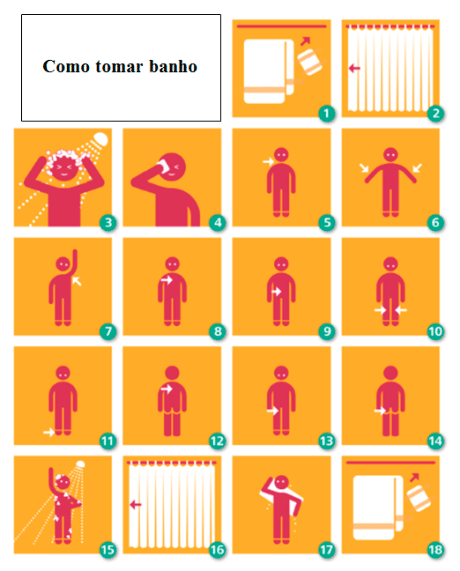 To my surprise, the task of taking a shower had 18 steps. My husband and I had different routines and, on top of that, they changed from day to day. No wonder our son would start to panic!
We had to approach this challenge as a united front. It took some time, but having one approach as parents is important in learning settings for children (even more so for children with autism). We agreed to communicate one message until he had performed the task of “taking a shower” the right way.
First of all, we determined the situations in which he would have to take a shower:
- In case of a small accident (toilet training).
- When he is visibly dirty (hands, knees, head).
- When he is smelly.
- After playing sports.
- Once every two days, so he would not have to perform this terrifying task every day and, at the same time, he would not have a way to avoid the shower simply by avoiding any activity that leads to it (my son is very smart!).
The learning had to take place somewhere both my son and I felt comfortable. I decided not to teach him in the bathroom, fearing it would be too stressful. Instead, I sat with him in the living room and explained that, when he grew up, he would need to be able to do some tasks on his own, such as making a snack or taking a shower. I told him that, next year, he would be able to shower with the rest of his class after Physical Education, suggesting that it might be useful for him to learn now. He agreed.
The first day of “training” was dedicated to explaining the reasons for taking a shower, something my son was curious about. I told him that people shower for personal hygiene and to stay healthy. A clean body allows you to look for bruises and notice how they are healing. There is also a social aspect involved, I told him: people like clean people and, after playing and getting dirty, we need to clean ourselves. I talked about it as a normal rule in our family.
The next day, I showed him 18 cards with pictures of the steps needed to take a shower. By watching and arranging the pictures in the right order, our son saw the complete process for the first time.
There were moments of laughter too, as the routine began to sound more and more logical in our minds. Wash your hair first and your back afterwards. You wouldn’t want to do it the other way around, would you? Then we discussed the key steps of the shower: how to wash your hair, the movement of the sponge on your arm, and so on. The third time we did this, we set aside some time to explain the complete routine, its key steps and the reasons for their importance.
We agreed to hang the cards in the shower as a reminder and, that night, we went to perform the task.
The shower was ready, the cards hanging on a string (visual management at its best, don’t you think?). Obviously, I was there to provide assistance. Our son confidently walked into the bathroom and then into the shower. This time, there was no screaming. He knew what to expect. He looked at the cards, named the first step with its key points and the reasons for its importance and then performed the task. After completing the first task, he turned the card over and moved on to the next step.
Following the routine, he closed the curtain. From that moment on, I could not see anything else, but I could hear him. I asked him the coaching questions. I encouraged him and congratulated him because, from what I could hear, things were going well. Then he asked: “Mom, why do I need to rinse the foam off my body now? There is no foam.”
We had forgotten a step.
We had forgotten the step “put soap on your sponge.” Normally, our son would get very upset if something unexpected happened or if he made a mistake. But this time, he just laughed. I, the instructor, had forgotten something, and he had done nothing wrong. He turned the cards back without complaining and then started again from the point where he washed his neck with soap, this time putting soap on the sponge.
An hour later, a clean boy stood there, proud, in our bathroom.
The next day, a new card was placed on the instruction string, with the step we had originally forgotten. The difficulties, frustrations and stress related to our inability to help our son with showering ended that night: within a month, he could shower on his own. Over the next six years (he is 11 now), he developed his own shower routine, with four types of shower:
- A long shower of at least 15 minutes.
- A short five-minute shower.
- A post-sports shower.
- A relaxing shower.
Why does it work?
People with Asperger’s do not pick up routines or tasks; they need to be taught explicitly. Using Job Instruction is one way of doing this. This method is based on the assumption that, if a worker (or learner) has not learned the job, it means the instructor has not taught it properly. This gives the learner more freedom to learn at their own pace.
The reason Job Instruction works is that it is designed for anyone, including someone with Asperger’s, who needs to learn repetitive tasks (such as using a telephone, packing a backpack, cleaning their room or taking a shower).
As a starting point, it uses the knowledge of the worker (or, in this case, of a person with autism). Most people with autism know how to do many things, and, by building on this knowledge, we can enable them to learn new tasks and behaviors. In our son’s case, his knowledge about taking a bath or about individual steps, such as “washing your hair,” helped teach him how to take a shower.
The structure of Job Instruction and Job Breakdown Sheets helps people with autism get a grip on the task. First, they are told when to do a certain job and why (most of the time, people forget this). The pictures also help because they are so simple that people do not get lost in the details.
The key steps answer general questions (who, what, where, when?), so there are clear instructions for each step. For people with Asperger’s, this is crucial, and, once the preparation is done, the how can also be answered. The “why” is, most of the time, obvious to people who do not have Asperger’s, but for those with this condition, the reason for something happening can be completely new. The reasons are identified to justify why a certain task is completed in a certain way.
Adding general concepts, such as health or socially accepted behaviors, to the third column of the sheet can help people with autism even more. These are extra reasons for a task to be the way it is. Connecting tasks to these larger “values” helps create a broader focus on the actions needed to complete them, which helps people with autism assess new situations more quickly.
With the success of TWI and our shower experiment in mind, we taught our son other “normal” routines, such as packing his backpack, going to the store on his own and cycling to school. Today, at 11, he has three projects underway: cleaning his room and sorting his LEGO bricks, taking the train on his own, and learning to learn new skills.
He was the one who wrote the Job Breakdown Sheet, with our help. This had the added benefit of telling us how he likes to do things and why. Ultimately, TWI increased mutual understanding in our family.
There is another element in TWI: Job Relations training. Social relationships can be extremely complex to handle for many people with Asperger’s. As Donald A. Dinero tells us, Job Relations training in a company enables employees to resolve personal problems using a non-emotional analytical method combined with some basic concepts of human relations.
When he is ready, Job Relations can help our son in his social interactions the way Job Instruction helped him with his personal hygiene. And, who knows, maybe in a few years he will be the one writing an article about how people with Asperger’s can help themselves and others using the principles and techniques of TWI.