

Applying Lean in Healthcare
Flávio Battaglia - Project Manager at Lean Institute Brasil
Interest in using lean thinking in the Brazilian healthcare system is growing and the subject is beginning to gain traction, following trends observed in the rest of the world. Today, major medical centers and cutting-edge institutions in Europe, North America and Oceania are undertaking large initiatives developing and applying lean in their hospitals, outpatient centers and entire health systems, as in the Province of Saskatchewan in Canada, where the whole health system is deployed from a single lean strategy.
Although still recent – less than fifteen years – the use of lean in healthcare has been bringing impressive, often revolutionary, results, with significant savings of resources and leaps in the quality of the services provided. The benefits of lean in healthcare include gains in process safety, the elimination of various forms of waste, faster and simpler clinical journeys and a better overall experience of the care provided. The UK health system (NHS – National Health System) and the Canadian health system have been applying lean thinking comprehensively as policies and practices throughout their entire structure for more than a decade. In the US, there are many organizations using lean. A ranking of the best hospitals in the United States created an “Honor Roll” for the best specialty hospitals. Table 1 shows the list published by “US News & World Report” in 2012: there are 17 specialty hospitals on the Honor Roll. All the hospitals on this list are going through transformation processes and have strong initiatives using lean concepts and techniques .
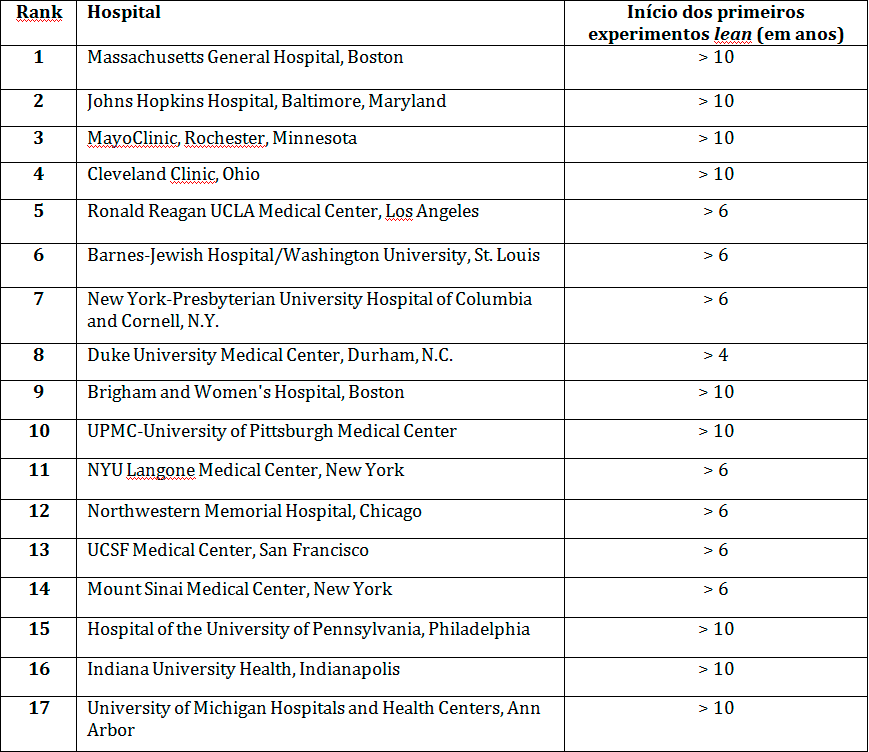
Table 1: “US News & World Report” 2012-2013 Honor Roll
of the Best Medical Specialty Hospitals in the US.
What Is Gained with Lean in Healthcare?
The most evident benefits of using lean in healthcare address precisely the most common problems of the system: long queues, rising costs and various types of recurring waste in every health system we know. Small lean initiatives are able to reduce queues; increase the agility and documentation of processes; reduce errors and indirect costs (inventory, administration, logistics); eliminate various forms of waste and optimize the use of resources. When lean becomes the organizational strategy, the transformation can be profound.
ThedaCare, a health system with four hospitals and more than five thousand employees in the state of Wisconsin, USA, is one of those organizations where the lean transformation is the basis of the organization's strategy. As a result, ThedaCare has so far generated savings of more than 27 million dollars. The collaborative care model it developed resulted in a 25% reduction in overall care costs, with 100% customer satisfaction. Likewise, by 2010, in two of its hospitals, 88% of quality and safety indicators had improved, and 85% of customer satisfaction indicators and 83% of employee satisfaction indicators had also improved. And between 2008 and 2011 ThedaCare increased the gross margin of its cash flow by almost 20% . Table 2 (below) shows the results of ThedaCare's “Collaborative Care” between 2006 and 2009.
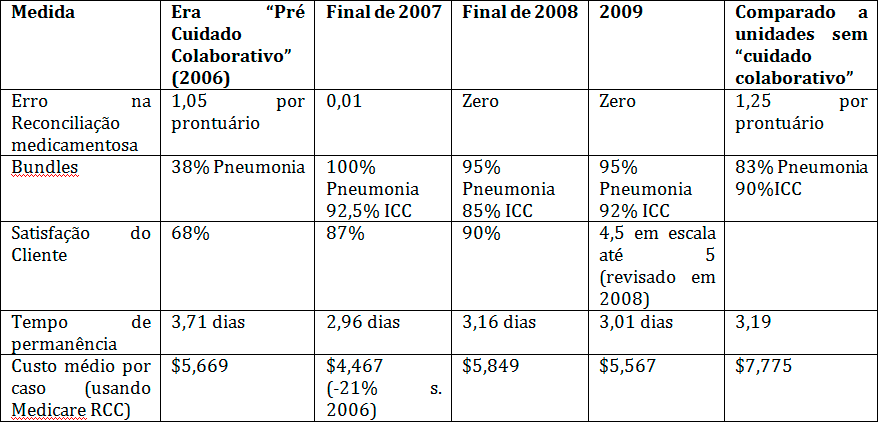
Table 2: ThedaCare's Collaborative Care
Another large North American institution, Virginia Mason Medical Center (VMMC) in Seattle, was named “Hospital of the Decade” in the US. VMMC is also a pioneer in the transformation, and a drastic transformation at that: in the early 2000s, it was a loss-making hospital in a serious institutional crisis following a traumatic “medical error” within its facilities. After years of hard work applying lean, it ranked as the best general hospital in the US for six consecutive years between 2006 and 2011 until it was chosen by the Leapfrog Group (an institution devoted to promoting quality in healthcare) as the best hospital in the US. The runner-up is also number two on the US News list, Johns Hopkins, in Baltimore. Table 3 shows some of VMMC's main results over recent years.
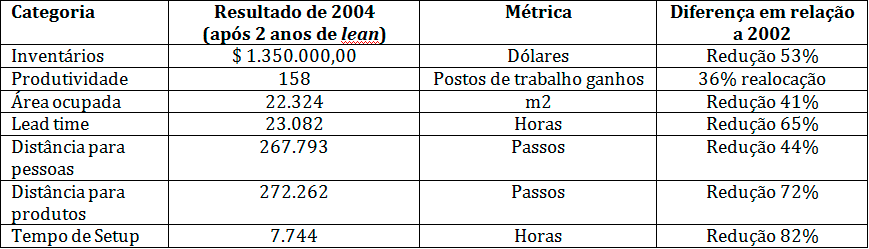
Table 3. Results of 175 Improvement Events at Virginia Mason Medical Center
Impressive results are also seen at Seattle Children's Hospital which, by redesigning its structure and gaining capacity, avoided spending US$ 180 million on expanding its physical space . St. Francis Hospital (Indianapolis) has been changing its processes at a rate of 3 to 4 thousand improvements per year, generating resource savings of more than one million dollars annually . The gains associated with lean in hospitals are not limited to resource savings; they directly impact process safety and the quality of services.
The UK health system (NHS UK) has also been using lean strategies for more than a decade, with an impact on the entire healthcare value chain; projects involving emergency hospitals today ensure that 99% of patients are seen, treated and discharged or admitted within 4 hours . Waiting times for access to specialists fell from 20 weeks to 36 hours; there was a 7.8% reduction in the average length of stay; a 33% reduction in cancellations of elective cardiothoracic surgeries; and millions of pounds saved in unnecessary investments, simply by improving care flows and processes.
Lean in Healthcare in Brazil
The understanding of how to apply lean has evolved a great deal in recent years and, especially in healthcare, this evolution has been quite consistent. The learning generated from experiences in other sectors has made it possible to accelerate the transformation process in hospitals and medical clinics, which means we are able to achieve relevant results in much shorter periods of time. But success cases in Brazil are still few and isolated, mainly because the level of awareness among managers is still low and knowledge is still scarce. There are consistent transformation initiatives, but they are still restricted to a few pioneering institutions.
Some of these Brazilian experiences were shared at the 1st Lean Summit Saúde (Healthcare), held by Lean Institute Brasil at the end of 2013 in São Paulo. The event, specially dedicated to the theme, featured international speakers and Brazilian implementation cases: Hospital São Camilo (São Paulo), Hospital São Francisco (Ribeirão Preto) and Instituto de Oncologia do Vale (IOV), whose experience and results are briefly reported below. There are also some study groups linked to universities (such as GIGs, involving USP, UNESP and UNICAMP), as well as some hospitals with projects under way. We are still at an awareness stage, in which the first initiatives are beginning to demonstrate the potential for application. To move forward, it will be necessary to connect efforts and create learning opportunities so that pioneering experiences can inspire new initiatives.
The essence of lean thinking is the continuous elimination of unnecessary activities, the waste that permeates practically every type of process, whether care, support or administrative. If we are able to eliminate unnecessary effort, there will be more time and resources available for the things that really matter. Eliminating waste means being able to stop doing what is irrelevant, freeing up work capacity to improve what really matters: patient safety and quality of care. Perhaps this is what is missing from the complex equation of becoming more agile, efficient and effective while reducing costs and improving the work environment.
Given the enormous challenges that the current state of healthcare management poses to us, we believe that lean concepts and techniques must quickly become part of the repertoire of managers and frontline teams within our hospitals and health services. If we do not drastically rethink the way we organize work, promote improvements, solve problems and develop people, the solution to all our ills will always be “more resources”. What we really need is “more management”, “more people thinking” and “less waste”.
In order to illustrate the potential for applying lean in healthcare, we have gathered some information about the experience of Instituto de Oncologia do Vale (IOV), which began its journey a few years ago and has been reaping solid results.
The Experience of the IOV Group
The IOV Group began its lean journey in 2008 and many projects have been carried out since then, with significant gains in operational capacity and efficiency. Table 4 shows IOV's main results in recent years. At the beginning of its journey, IOV performed procedures for roughly 70 patients per day. Today, it does so for approximately 200 patients per day, with practically the same amount of resources allocated. There was no expansion of facilities, staff growth was around 12%, but overtime fell by approximately 40% between 2010 and 2012. The safety of services also increased substantially, with a reduction in sentinel events of around 75% and a reduction of more than 50% in the risks associated with the procedures performed. Below is the table summarizing the results achieved at IOV since 2009.
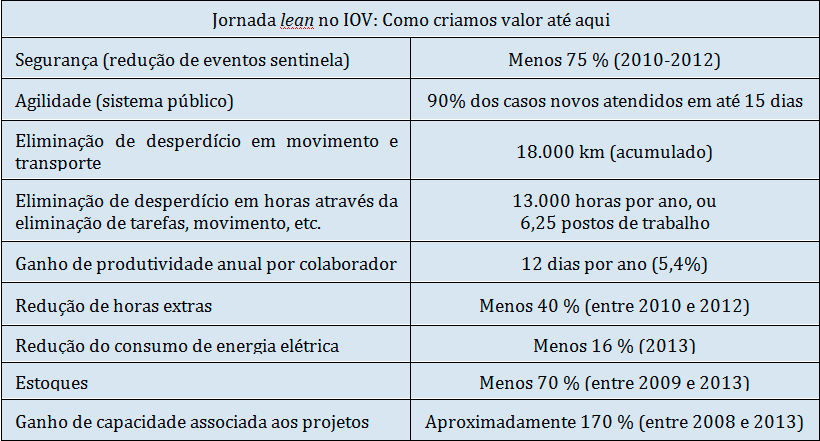
Table 4: Creating Value at IOV.
The Promise of Lean in Healthcare
Just as adapting the “Toyota Production System” into the concept of “lean manufacturing” took time and effort and has been evolving in most of the manufacturers that adopted it, the adaptation of lean to the health system has also been evolving and becoming increasingly evident as an organizational strategy and not merely a set of operational tools. The benefits of lean are easily visible in small, localized projects, as usually seen in surgical units or emergency rooms, but its real benefits emerge from integrating the organization's management system through the fundamental concepts of lean thinking applied to healthcare. Following the publication of John Toussaint's article redefining the usual lean concepts into six concepts applied to healthcare ; we created an image that seeks to convey more clearly how they work: integrated in a network, in a completely interdependent system, as in Figure 1.
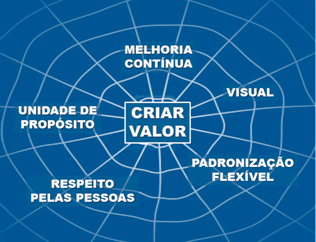
Figure 1: Six lean principles applied to healthcare
Principle 1: Create Value for the Customer
Defining value in a health service can be somewhat subjective, especially from the customer's perspective. Even if many things go “wrong” during their care process (such as hospital-acquired infections, DVT, medication and procedure errors), the patient may feel absolutely satisfied with the service provided – engaging positively with the care experience. IOV adopted the concept of the “Perfect Care Experience”, using the Six Dimensions of Care (from the Institute of Medicine, USA): care that is safe; efficient; effective; timely; customer-centered (which is one of the main contributors to the “perfect experience”); and equitable. Today, all initiatives at IOV involve the “voice of the customer” – or what really matters to them: process safety as well as the other four dimensions. The perception of value also comes from identifying what is not necessary in the process, or what is rework, or a defect, or unnecessary motion. Separating “value for the customer” from “waste in the process” not only improves the quality of care but also reduces care costs, eliminating hundreds of non-critical steps, or steps disconnected from the essential processes, that create delays, queues and dissatisfaction.
Principle 2: Continuous Improvement Attitude
There are only four reasons to change a process: to make it easier, better, faster or cheaper. And there is an order of priority. People generally do not like change, but lean is about change – change that is worth the effort. Over the years, much of what we call process improvements are just additional steps, extra costs and very few real benefits for customers, without increasing safety, without more agility or without reducing the cost of the service. If a change does not address one of the four reasons above, it is not worth it. Change for the better involves the whole organization and happens transversally: from the top to the front line. Everyone needs to be involved in eliminating defects and reprocessing, and in eliminating waste to improve the care experience. The main tool used at IOV was “Value Stream Mapping”, an adapted form of the “PDCA Cycle” aimed at identifying waste associated with the main flows of the health system: of patients; of physicians; of resources; of the environment; and of equipment, materials and medications.
Principle 3: Unity of Purpose
One of the great disappointments with improvement projects is that they “do not deliver the expected result”; sometimes we also hear this about the accreditation process. Much of this negative impression is associated with a problem of strategic alignment. An organization needs not only a strategic objective – or goal – but above all strategic direction. At IOV, no improvement project or action can be carried out unless the objective and the metric to be achieved are clear. And that objective must be aligned with at least one of the six dimensions of care. Over the years we have also developed specific alignments and goals for annual or biannual cycles – so that important initiatives that are not linked to the current cycle will not be approved. Unity of Purpose is also a way of eliminating waste. We do not allocate resources to unaligned projects, we do not spend energy on ideas that do not make the benefit clear – and this also applies to daily operations: all daily tasks must be relevant to the strategic objective; all of them must lead us to our destination. This is what in lean we call “True North”, the real objective of an organization and its people; the fundamental reason that makes us leave home early every day.
Principle 4: Respect for People
Process defects can often be generically called “medical errors”, and they can occasionally be lethal. A process that produces many errors was designed to produce many errors. 94% of errors belong to the processes; only 4% are caused by the people involved or by special variation in the processes . Respecting people means understanding that an error in a procedure or a medication is usually associated with a long sequence of small errors that were ignored or not even identified. Creating safe processes and a safe work environment is one of the pillars of lean thinking. That is where continuous improvement must begin: with everyone's safety. Creating an environment where safety is the priority involves a cultural change at every level within an organization: from general maintenance to the General Director. This means creating an environment where communication can be open and transversal, where teams can share their problems, their errors and the learning involved (continuous improvement), and where everyone is treated with respect.
Principle 5: Lean Is Visual
One of the best ways to improve a process, reduce its risks and eliminate its waste is to make problems visible. At IOV, the ability of individuals and teams to solve problems was greatly increased, making processes safer and more stable. Today, all problems are posted on a board visible to everyone at IOV: customers, employees, companions, visitors and suppliers. Since 2010, more than 700 problems have been identified and addressed, and another 400 good ideas have been adopted. Many processes also have visual aids, guides that make execution and quality of care easier.
Principle 6: Lean Is Standardization with Flexibility
One of the major problems of the health system is its instability. Emergency rooms tend to be crowded on Mondays and have significantly higher demand in autumn and winter (with flu or allergy complaints). Understanding this variability and being able to create mechanisms to stabilize and level processes is one of the greatest challenges of the system as a whole. Likewise, non-standardized services do not produce consistent results. Being able to define sustainable standards – that make sense to everyone – and at the same time create flexibility so that these standards continue to improve is the ultimate challenge. The paradox is that, by reducing process variability, we make processes not only more reliable but also more flexible: many of the tasks at IOV today can be performed by different people, with visual aids and simplified processes that are easy to understand and follow. These are standards that stabilize processes, increase productive capacity and create room for new changes – ever more flexible, ever better.
Conclusion
There is an enormous window of opportunity for applying lean concepts and techniques in healthcare, and we are increasingly convinced that this body of knowledge will be an important catalyst for transforming healthcare management in Brazil.
We need a health system that makes fewer errors, costs less, wastes less, understands the real needs of its customers and is able to deliver what they want. Applying lean thinking is an innovative and proven effective alternative for seeing and solving problems through their root causes. Adding more resources (material, technological, financial or human) is not the best way to act when facing a “broken” process, where existing resources are poorly used, consumed by waste of various kinds.
As the results of the first experiences begin to consolidate in Brazil, we have the distinct impression of facing a great and possible transformation. Concrete, deep, practical and relatively simple changes can make a difference in the lives of thousands of patients and healthcare professionals. It is a challenging journey; it implies significant changes in the way we engage people across the various organizational levels – from the president to the front-desk assistant – in solving the technical, managerial and human challenges of everyday life. Perhaps these are the ingredients needed to rebalance the complex equation facing most healthcare organizations and professionals in Brazil. Lean can help, and a lot.
Discover how Lean healthcare consulting can transform processes, reduce waste and increase the operational efficiency of your institution. Start building more agile, patient-centered management today. Visit and check it out!
Contact:Carlos Frederico Pinto Instituto de Oncologia do Vale Email: [email protected]
Flávio Battaglia Lean Institute Brasil Email: [email protected]





