

Ensuring deadlines and increasing revenue in mining projects


Samarco (the contracting mining company) needed to complete the replanned scope of the channel as an essential goal for 2022. This project is of fundamental importance to the mining company.
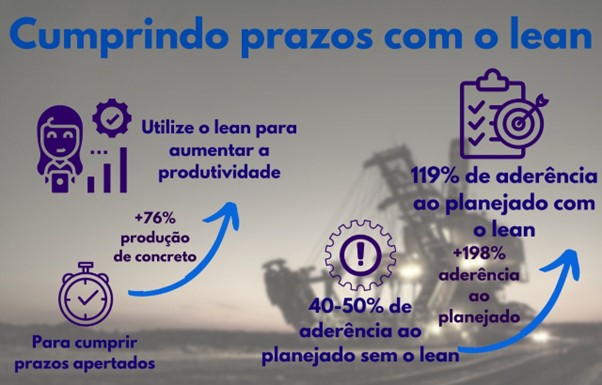
MRF (a consortium of construction companies made up of Milplan, Reta Engenharia and Flapa) was in a difficult situation regarding the deadline for completing the scope of the project. With the help of lean, they were able to increase production of reinforced concrete by 76% and revenue by 38% in just 1 month of the project. With this, they secured the pace needed to deliver the scope agreed with the client. Let's understand how they achieved this.
So, what was the problem that needed to be solved?
In the month before the “lean project”, a new, challenging schedule had been renegotiated, since the rainy season would soon begin, which would make carrying out the work much more difficult.
Due to these difficulties, adherence to the weekly plan was between 40% and 50%, which would have made completion within the required time impossible. With this, the opportunity was identified to apply lean concepts and tools.
Securing the deadline and increasing revenue with lean construction
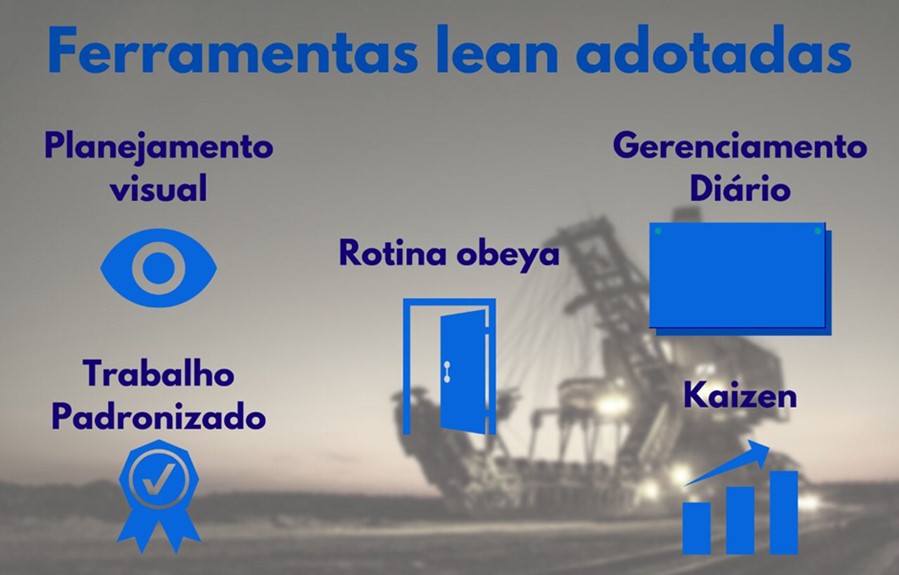
With a big challenge and a short period to implement lean, the “kaizen” approach was used over a period of four weeks. It began with brief training of the project team and then dove into understanding the problems in the field (gemba) and the project planning. After gaining a good understanding of the context and the current state of the project, a framework was developed and some lean tools were applied situationally:
- Macro visual planning of the inlet. The use of visual planning with the participation of the planning and production team (engineers and foremen) made it possible for them to achieve the best fit of the crews, with detailed planning and a strategy for running activities in parallel in order to meet the deadline agreed with the client. With this, they were able to complete the floor of the inlet (the beginning of the spillway channel) within the agreed deadline.
- Implementation of the obeya routine. By building an obeya, the team sought to solve internal communication problems between departments. In this way, they sought a stronger connection between departments to speed up the solution of macro problems and greater integration between areas.
- Implementation of Daily Management. With the implementation of Daily Management in the internal planning team and on the inlet and spillway channel staircase work fronts, involvement with the field crew increased dramatically, creating greater team alignment and greater agility in problem solving.
- Introduction of Standardized Work. The introduction of Standardized Work for the cycle of the spillway channel staircases allowed the execution cycle of the dam steps activity to be detailed, with the participation of the foremen and validation by engineering . Thus, it became possible to reduce idle time in the cycle and potentially reduce the execution cycle. In addition, a Process Study Sheet was prepared for the staircase work front; as a conclusion of this analysis, the following actions were reached: faster cleaning of the channel, as well as preventing mud from entering the channel, since this delayed the start of activities; after the analysis, the net available time gained came to one hour, with the potential to increase production by 10%.
- Kaizen. Finally, the introduction of kaizens in the inlet area and on the staircase allowed an on-site analysis of the waste and problems observed. This generated a discussion with the project team and an action plan to correct the deviations, as well as enabling a broader discussion about pending tools, equipment and materials and the separation of some tasks so that they would take place before production (for example, pre-cutting and bending of the steel). This helped complete the inlet floor within the deadline agreed with the client and created the potential to reduce the execution cycle of the spillway channel staircase steps
The results generated by implementing lean were emblematic:
- the renegotiated deadline was met;
- the volume produced increased by 76% compared to previous months;
- adherence to plan more than doubled, going from 40%-50% to 119%;
- revenue also increased by 38% compared to the average of the last four months.
What are the next steps for lean at the MRF consortium?
The consortium is now preparing for the rainy season, which is highly unproductive. . We recently published on the Lean Institute Brasil (LIB) LinkedIn page an Infographic with tips for raising productivity even in this context.
The consortium is also seeking to establish basic lean routines such as weekly collaborative planning, obeya and daily management in this first step.
In parallel, it continues to train the team and is already seeking to spread the pilot project to other projects of the consortium member companies.
However, there is an understanding that all this is only the beginning of a journey that still has a lot of potential, and that even more impactful results can be achieved in the medium and long term, not only on construction sites but also in other stages and areas.







