

Seven lean tips to improve OEE
Anyone who works in manufacturing is probably well acquainted with OEE, a productivity indicator that measures how efficiently the company's equipment is being used. The struggle to improve this indicator is the reality of most manufacturing companies, and lean can offer some important foundations to ensure that this improvement is achieved.
What is OEE?
OEE stands for Overall Equipment Efficiency (Overall Equipment Efficiency). It is an indicator used mainly in manufacturing to measure the difference between the productive capacity of the company's equipment and its actual output. From this, it is possible to see how much productive time is being wasted and to understand how that gap can be reduced. Let's look at an example to understand it better:
- Calendar Time - Initially, we have all the available time, known as Calendar Time, which considers 24 hours a day, 7 days a week, 365 days a year. It is the potential productive time in a company.
- Scheduled Time - Most companies, however, don't work 24 hours a day, 7 days a week. So, if we disregard the time when the company is closed, such as weekends, overnight hours etc., we have Scheduled Time, that is, the time actually scheduled for production.
- Gross Operating Time - Within scheduled time, there are moments when the equipment is stopped in a planned way, such as during setups, stops for scheduled maintenance (preventive, predictive), meals, start and end of production, meetings, among others. Disregarding these stops, we have Gross Operating Time.
- Net Operating Time - In addition to planned stops, equipment will often stop unexpectedly, as happens with breakdowns or some unavailability of external resources, such as lack of power, water, compressed air, inputs, labor etc. When we disregard these stops, we arrive at Net Operating Time.
- Effective Operating Time - Finally, we need to disregard the defective products that are produced. Although the machine ran during that time, it was wasted time, since the product will not be sold. Thus, we arrive at Effective Operating Time.
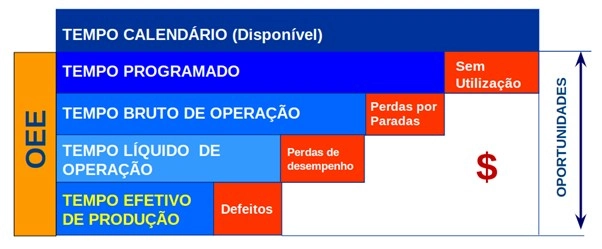
The difference between Effective Production Time and Calendar Time offers opportunities to increase productivity and improve the company's production efficiency. To do so, it is necessary to work on reducing defects and losses and, sometimes, idle time.
OEE can be looked at from two points of view. Idle time can be optimized, as long as there is market demand to absorb the output, because it is also no use increasing OEE by using all the calendar time, running push production and burdening inventories under the false perception that we are optimizing the installed assets, since product sitting in inventory is also a loss: besides consuming the company's working capital, it increases logistics and storage costs. The other point of view is to seek OEE improvement by focusing on bringing Effective Production Time closer to Scheduled Time, reducing losses, unavailability and standard execution times, both of manufacturing and of scheduled maintenance, setup, and start and end of production activities.
Whether we are seeking improvement in operational OEE or in overall OEE, here are seven lean tips that can boost results:
- Think about the end-to-end process - Often, a lean project may be started to seek specific improvements in some parts of the production process, and that's fine. However, no sustainable improvement is possible without thinking about the whole process, from beginning to end. That's why, when the focus is on improving the company's OEE, it is essential to consider all the impacts these changes can have on the entire process, including involving suppliers in the improvement initiative.
- Understand the three indicators that make up OEE - OEE is divided into three indicators: availability, which considers possible problems with lack of raw materials, power outages, production start and end times, setup times and product changeovers; performance, which considers stops, whether mechanical, electrical, operational, large or small (which, although they may last only a few seconds, greatly affect the production process when added up); and quality, considering lost sales due to defects or rework in the manufactured products.
- Use the right lean tools - Each of the OEE indicators can be improved using appropriate lean tools. To improve the availability and quality of inputs, for example, lean supply chain, with proper supplier qualification, can bring great benefits. Preventive maintenance and TPM can reduce stops and improve performance; SMED, standardized work and production planning can reduce setup time. In addition, process control can work to improve production quality.
- Seek accuracy in data recording - It is not possible to start a lean journey or sustainably improve a company's OEE without high precision in the data collection process. This requires being rigorous and having mechanisms to ensure a clear view of the process. Automation is an interesting opportunity here, but keep in mind that on its own it solves nothing and that good data collection is possible even without automation. Many companies that collect data manually, with pen and paper, and act on the data, even if it is not 100% accurate, achieve better results than others that have automated the process and have more accurate data but do not act on what they collect and, as a result, end up not benefiting from the results that technology and automation have made possible.
- Promote a critical cost-benefit analysis - Good data collection is essential to direct efforts to eliminate waste and improve OEE. However, it is not enough. If collection is not accompanied by good critical analysis to understand the data and propose effective countermeasures, the effort will be of no use. For this, using scientific thinking through PDCA and A3 thinking is essential.
- Create work groups - When addressing deviations to seize the opportunities uncovered by the critical analysis, it is important to form work groups to build Pareto Charts and understand, together, how the actions will improve the process. In addition, the use of Visual Management is also important so that the whole team is easily aware of everything that is happening and being done.
- Work cross-functionally - Finally, it is necessary to understand that OEE is not a local indicator, of one area only, but a global indicator, as the name itself says, of the whole company. Therefore, even if there are functional groups working on actions to improve OEE, which is perfectly acceptable, it is important to have a cross-functional group following the entire process to ensure a holistic view of it. This group should include people from different areas of the organization, in a proportion that ensures all areas are well represented.
Improving OEE is an important target for manufacturing companies. An indicator of 85% is usually considered extremely advanced, but it is important to keep in mind the need to put this figure in context. Some companies achieve an OEE of 95%, but when we look more closely, we realize that they leave several factors out of their calculations. That's why the goal should always be to improve your own results, setting realistic yet bold targets based on your specific context.
OEE is an excellent guide for focusing on where improvements should be made in an organization. By using lean philosophy and tools in this pursuit of OEE improvement, we can often optimize resources that are already available and depreciated, postponing new investments, ensuring that our focus is on eliminating waste and improving the company's production efficiency, always thinking about adding more value for our customers.







