Multipolar Chains: Realigning supply with the Lean Supply Chain strategy

The current context in supply chains is one of major problems and impacts on business, also affecting people’s lives: the excessive historical concentration of large-scale production in specific geographic regions, such as China and other Asian countries, means that supply chains adopt economic models still centered solely on production scale. To realign these chains according to the concept of multipolar design, the Lean Supply model offers new principles that make it possible to overcome these obstacles.
How the world became polarized
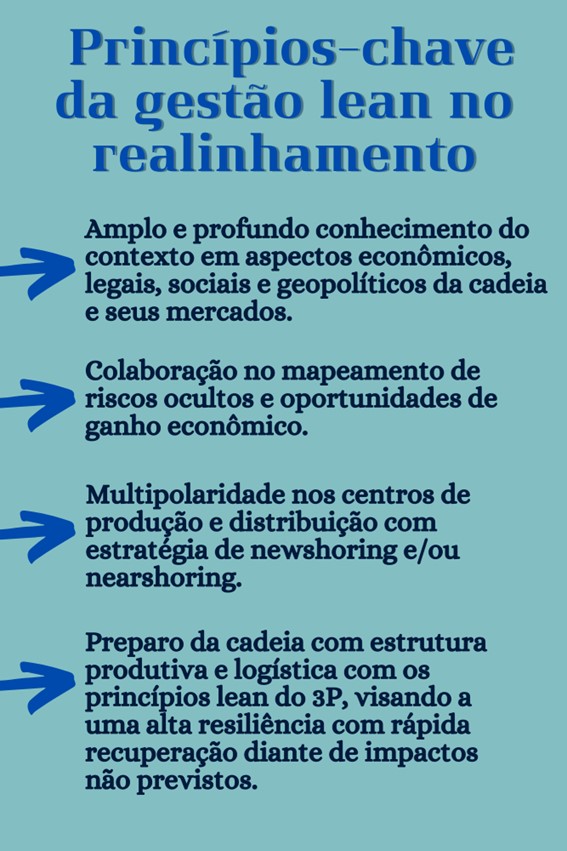
One of the principles of the lean management model is to fully understand the problem, with its context and current situation, which are analyzed in the first steps of a strategic A3, whose process for addressing the strategic problem is carried out in a structured and thoughtful way with the organization’s top leadership. It also requires research, gathering data from other experts and several rounds of critical analysis.
Carrying out this contextual analysis in the case of disruptions at major market players reveals their reach over local businesses and markets as well, and they are one of the causes cited at the origin of the strong supply shock behind global inflation. Another aspect is their direct relationship with geopolitical issues that erupted more strongly in recent years, after the emergence of the Covid-19 pandemic. Therefore, before moving on to decisions to realign the chain’s design, it is essential to understand what has been happening in the background of the scenario in which the chains operate.
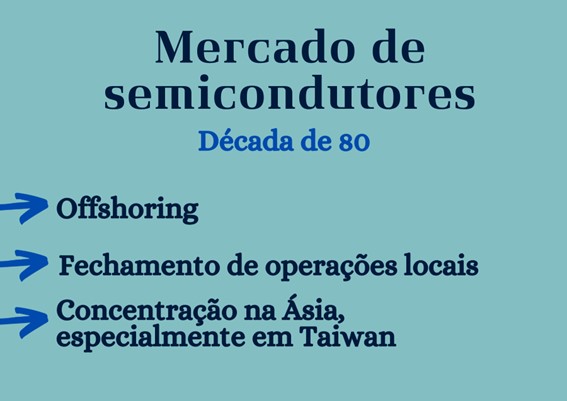
A great example for understanding polarization is the semiconductor market. In the 1980s, the renowned CEO Jack Welch was known for the decisions he made on offshoring part of General Electric’s operations to other countries. From the perspective of the time, the concept of offshoring reigned in the world of mainstream management, and companies chose to close their high-cost operations in domestic markets, migrating toward higher profits in other countries.
The search for new markets is an operationally valued measure for gaining better control of the situation, but closing local operations before making an effort to identify waste and inefficiencies that could be tackled with operational excellence strategies certainly created a latent risk, the trigger for a good part of today’s misalignment problems. Thus, semiconductor production became concentrated especially in Asian countries.
The fact is that this almost bipolar movement led to the design of supply chains that are at risk from several circumstantial factors (among them we highlight geopolitical risk). Current chains show low resilience to the risks surrounding decisions in the geopolitical context. More data must be sought to understand where the world is heading in its political decisions that will affect business.
Chain Multipolarity – More resilient Nearshoring and Newshoring with lean principles
To mitigate the risks brought by the polarity of chains, multipolarity efforts have become the norm in the global geopolitical scenario. Continuing with the example of the semiconductor market, as offshoring guided the design of this sector’s historical chains, this movement resulted in a concentration of production that heightened geopolitical tensions. As a result, several countries, such as the United States, South Korea, Japan, India and Germany, began to offer government subsidies so that this polarity would be undone in favor of greater multipolarity in the semiconductor chain. These subsidies are justified by the peculiarities of the sector: lead times for chip manufacturing are, on average, at least four months if capacity is available and no expansion is needed; otherwise, it will probably take at least 18 months to increase capacity with some brownfield expansion action. In general, it takes more than three years to build a new factory and increase production substantially.
Other sectors, on the other hand, which have relatively smaller technology investments than semiconductors, are already moving to seek other sites around the world to reduce concentration under Asian dominance, while not migrating back only to the United States, which would maintain the polarity. A more multipolar strategy is needed.
A significant example of this chain realignment movement is the case of Ingersoll Rand, in the compressor, pump and vacuum products market, a recognized practitioner of the lean management model. The company has been carrying out realignment actions by relocating its supply chain to be concentric with its factories.
The company employs about 16,000 people on six continents and reported in the US profits of about USD 104 million in the first quarter of 2022 and revenues of USD 1.34 billion. This reversed a loss of USD 90 million in 2021. Operating income increased almost 30%, to USD 157 million in the first quarter, due to double-digit growth in several divisions serving industrial end markets. All this is due to its multipolar strategy.
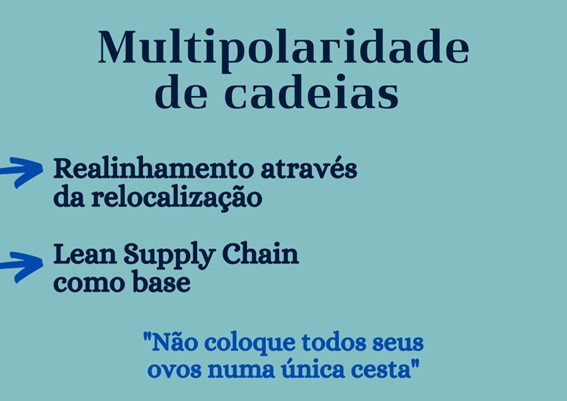
Thus, the relocation movement has been gaining strength in new supply chain design strategies based on Lean Supply Chain, in the face of this more complex and risk-filled world. The famous phrase “don’t put all your eggs in one basket”, in today’s reality of production and distribution, takes on the meaning of new concepts for applying nearshoring and newshoring.
The role of Lean Supply Chain
Lean Supply Chain is reshaping this entire process in the pursuit of broader nearshoring. Previously, it was more centered on local presence only for representation, communication and distribution to consumers; now, it is gaining strength in bringing production closer as well, with faster reconfiguration to the needs of local customers.
On the other hand, with newshoring, instead of just bringing back production units the way they are currently concentrated, the so-called American reshoring, the lean strategy now considers building units closer to markets, designing them from scratch with more technology and lean production concepts that amplify the benefit of relocating: reducing logistics and also production costs, making it possible to produce smaller volume scales with an economic advantage.
Multipolarity must follow the lean principles of collaboration through a collaborative systemic view, in which the macro-mapping of the chain based on the VSM model must be enhanced by data exchange, if possible with the help of more sophisticated data science (AI in simulation for stress tests, for example, aimed at discovering hidden risks: supplier bottlenecks, floods or earthquakes in supplier regions, cyberattacks, extreme dependence on information systems with no alternative plan, exclusive routes, among other aspects for which collaboration between the company and its agents in the chain, suppliers and distributors is indispensable).
It is important to take into account that relocating alone does not eliminate risks. Supply problems can occur with small second- or even third-tier suppliers in the chain, whether far away or located very close by. All it takes is dependence or a lack of capacity in the market. Therefore, mapping is always fundamental, with lean management’s well-established pessimistic perspective of always seeking evidence and not listening to phrases said in meetings, such as “it is very unlikely that there will be problems there”. Instead of this phrase, it is necessary to seek data and facts. The risk may even lie in that item we pay a few cents for. Be careful with ABC curves when selecting agents. With collaboration, we can check them all. With new technologies, too.
If new technologies are available, a virtual representation of what was collected in the macro-mapping can be created, building a “digital twin” or something close to it, so that chain partners can test situations at each stage of the flow to check for hidden risks and localized countermeasures, to see what would increase the resilience of the supply chain.
Some questions can be simulated and tested: whether the company should invest in lean production units closer to local markets, whether it should have a more capillary native logistics network, whether it should secure partnerships for the supply and distribution of key components… in short, based on the view of the macro flow map, some stress factors should be probed and the response checked. Experiments based on the principle of testing hypotheses can also be aligned with simulation resources, or may be the only more reliable means of checking the situation if the data are not sound enough for a simulation.
David Simchi-Levi, an MIT researcher and expert in supply chain resilience models, points out in his work that the search for disruption points in the chain cannot be based only on what has happened in recent years as lessons learned, but must take into account new emerging problems. Hence the importance that the lean strategy places on deeply understanding the context. It is there that new emergencies are being gestated.
To paraphrase Simchi-Levi, who illustrated this situation of new factors emerging in the chain in an interview, a good striker does not run to where the ball is, but to where it will be. Therefore, the analysis of the current situation needs to take into account a world in continuous crisis, in which historical precedents have their limitations in predicting all events. Establishing the conditions under which chains should operate based solely on what happened in the recent past becomes limiting.
Therefore, collaboration with the agents in the chain must go beyond seeking hidden risks, which is of course necessary, but not sufficient for the new context.
At the center of planning a chain with the lean strategy is the concept of structuring production and logistics with requirements for high adaptability to the stress of variation in the supplier and distributor market. Through 14 to 16 requirements checked in the 3P method – Production, Preparation, Process, created by Toyota and widely applied by more advanced practitioners of lean management in various businesses around the world, the aim is to design the chain with value-adding units that have fast recovery times in the face of any impact on their production and logistics capacity.
On the other hand, collaboration should also seek, in further rounds of analysis of the macro-mapping, to identify economic opportunities: places where we need to develop suppliers, new sources of raw materials, inputs and parts, new products, repositioning of inventories and more suitable logistics strategies with local partners, among others. In short, the combined use of the lean concept of macro-mapping and design with 3P, always in a collaborative way, raises risk-reduction actions while also seeking to increase economic performance.
It is not a defensive strategy, but a predictive and proactive one.