

Daily management in distribution centers
At a large retail chain in Brazil, a distribution center (DC) faced a recurring dilemma. Despite the daily effort of the teams, the operation's performance was marked by instability. The company, with a regionalized supply network and a growing presence in e-commerce, dealt with two critical and challenging flows: replenishing the stores and processing e-commerce orders. Both flows required a high capacity for adaptation and resource management, something the DC operation was not yet able to achieve efficiently.
Although it was an operation with good infrastructure and a committed team, the DC faced constant challenges, such as shipping delays, low inventory accuracy, productivity fluctuations between shifts and the feeling of “running at the limit”, even in periods without major variations in order volume. Low predictability and the lack of a consolidated management system prevented daily deviations from turning into learning and generating concrete improvement actions.
The decision to implement Daily Management
Faced with growing pressure for operational efficiency and flow stabilization, the operations leadership decided that it was no longer enough simply to “demand more” from the team. It was necessary to implement a system that would enable both leaders and teams to make quick decisions, identify and react to deviations effectively, and ensure that operations flowed without interruptions.
That was when Daily Management (DM) was chosen as the countermeasure. The idea was simple, but demanding: create a daily process that would make it possible to control what was happening, but that would also generate learning and continuous improvement from everyday problems. DM was supposed to ensure a work routine focused on stabilizing the operation, allowing the team to deal with problems more effectively, without overloading resources and without compromising quality.
The design of the Daily Management system
The design of the DM system involved creating a structure that connected all areas of the DC, using boards at the managerial and operational levels. DM was divided into two levels: the “Managerial DM”, which aimed at an overall view of the operation, and four “Operational DMs” — one for each macroprocess of the DC (receiving, storage, picking and shipping). Figure 1 illustrates the structure of the DM system.
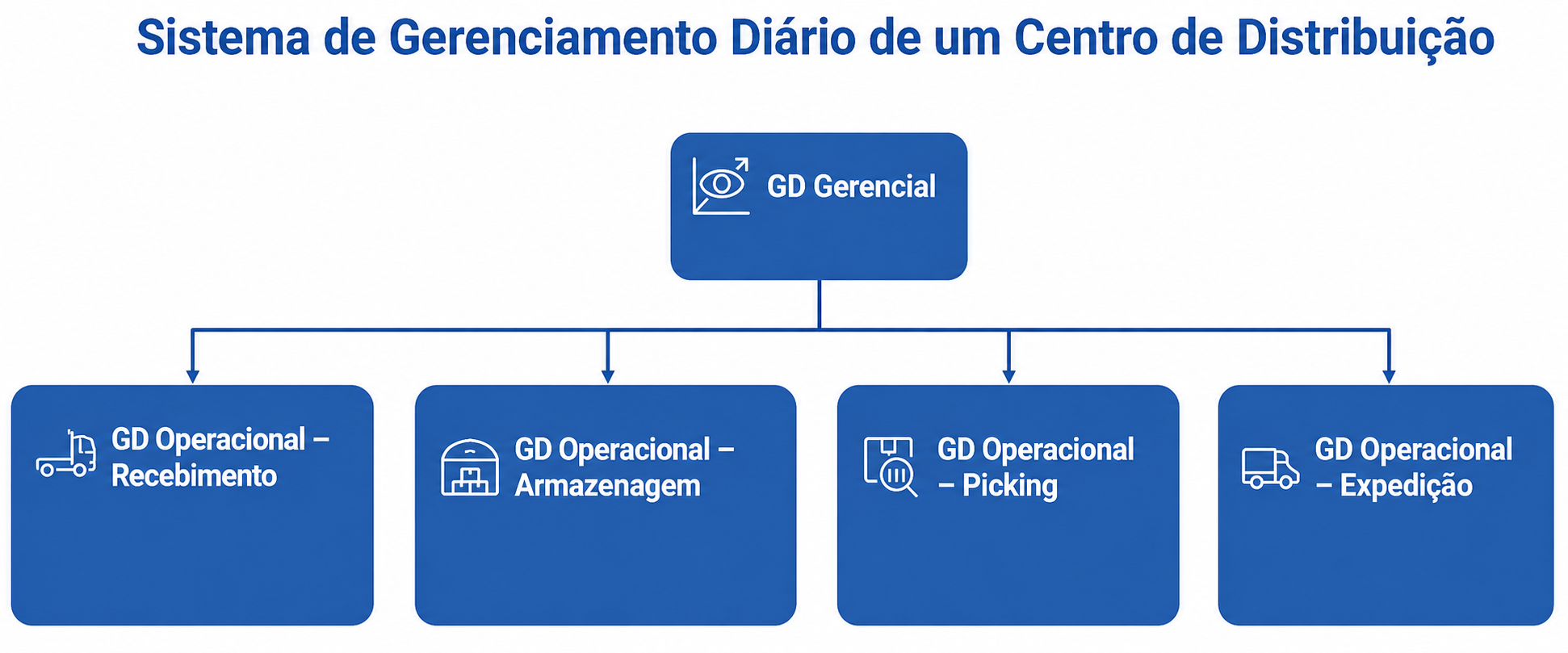
The four operational DMs were implemented directly in their respective areas, with short daily meetings led by the supervisors. Each area developed its own specific DM board to give visibility to performance in real time, but with a common starting point: an explicit connection with the DC's strategic indicators, especially productivity and efficiency. This connection ensured alignment and coordination between what was decided at the area level and what needed to be pursued in the overall performance of the operation, avoiding local optimizations disconnected from the result of the DC's value stream as a whole.
To make the operational DMs effectively manageable day to day, each board was structured with a selection of two to four control variables — for example: percentage of orders ready on time; volume of discrepancies at receiving; picking error rate —, chosen for their ability to anticipate deviations and cascade the strategic indicators. Thus, the boards began to highlight the few controls that determine the stability of the flow, guiding the prioritization of actions, the escalation of anomalies and coordination between areas to prevent isolated problems from turning into a systemic impact on the DC.
The Managerial DM, in turn, has the role of bringing together the leaders of the operational DMs with the DC Manager. The goal is to provide an integrated and consolidated view of the main variables of the operation, such as safety, productivity, quality and process output. In this sense, the Managerial DM serves as an integrating mechanism, used to make more strategic decisions and to address problems that have been escalated from the operational levels.
When designing the system, the initial option was to use “analog” boards, with paper and pen. This choice was based on the strong human interaction that these physical boards provide, creating a closer and more collaborative environment, especially in the operational context of the DC. The presence of the board, direct interaction and face-to-face communication play an important role in engaging the teams and in the immediate identification of problems.
Although the trend is to migrate to digital solutions, with management boards integrated into online platforms and real-time data systems, the transition to digital was seen as a second step, one that comes after the teams' experimentation, learning and adaptation. The DC's leaders considered that the most important thing is not the format of the board, but how it is used day to day, as an active tool for management and learning.
Tackling the operation's challenges with DM
In the very first weeks of DM implementation, the DC team began to clearly identify problems that had previously been invisible or ignored. Although the initial visibility caused a feeling of disappointment, this transparency was fundamental to identifying the main bottlenecks and recurring wastes, such as delays in putting materials away, discrepancies in shipping and patterns of tax-document inconsistencies at receiving.
One of the main challenges faced was the delay in storage, which directly harmed the picking process. The operation discovered that the problem was not a lack of effort by the teams, but rather inconsistent operational parameters in the WMS (Warehouse Management System) and the lack of a priority standard among items. The solution found was to fix the system and create explicit priority criteria. This change had an important effect, significantly reducing stoppages in picking due to lack of materials and minimizing improvisation and “firefighting”.
Another problem identified was in shipping. Numerous picking discrepancies were noticed, but they were not organized and classified so that their root cause could be addressed. With DM, these discrepancies began to be handled systematically. By mapping the errors, it was possible to see, for example, that they were concentrated in a specific zone of the DC, with greater signal instability for the digital scanners. To solve this problem, the antennas were redistributed, which resulted in a reduction in checking failures.
At receiving, DM exposed a problem of inefficiency in the prior tax-document handling and failures in packaging standards, which contributed to the formation of queues at the docks. Based on this visibility, the leadership created escalation channels to address these problems with suppliers, in addition to establishing a minimum standard for receiving and checking with objective checklists.
The impact of DM implementation
After a few weeks of DM implementation, results began to stabilize. The operation started to show greater adherence to the daily shipping plan, with a significant reduction in rework due to discrepancies and an improvement in inventory accuracy. Stoppages in picking decreased thanks to improved storage efficiency, and critical problems began to be identified and addressed at the beginning of the shift, avoiding late escalations.
In addition to the tangible operational gains, the organizational culture also underwent a significant transformation. Leadership stopped acting in reactive, “firefighting” mode and began to adopt a more strategic approach of removing impediments. The areas began to discuss not only their own indicators, but the overall flow of the operation, working in a more integrated and collaborative way.
Although the results achieved so far have been significant, the DM implementation journey is not yet complete. One of the main challenges that remains is strengthening discipline within the work routine, especially with regard to open communication about problems. Despite the visible improvements, there is a natural resistance to exposing failures or discrepancies, which may limit DM's potential to reveal root causes and implement effective countermeasures.
Continuity in carrying out the DM routines will be fundamental to building a psychologically safe environment, where everyone feels comfortable pointing out problems without fear of retaliation. Only then will it be possible to extract the full potential of this approach, allowing DM to become not only a means of management, but also a catalyst for the continuous and sustainable transformation of the operation.
The lesson: Daily Management as a stabilizer of the operation
This success story reinforces the importance of an efficient daily management system to stabilize operations, especially in high-variability environments such as retail DCs. DM is not a mere set of meetings and indicators, but a system of learning and continuous improvement capable of transforming everyday problems into concrete improvement actions.
DM helped the DC become more predictable, safer and better able to meet the demands of e-commerce and the physical stores. It served as a stabilizer of the value stream, ensuring that deviations were addressed quickly and effectively, without harming the operation as a whole. The experience also demonstrated DM's ability to strengthen the culture of discipline and collaboration, essential elements for operational excellence in a dynamic and challenging scenario.
References
- FERRO, J. R.; GOUVEIA, R. Gerenciamento diário para executar a estratégia. 1. ed. São Paulo: Lean Institute Brasil, 2021.







