

Creating value through reverse logistics

Rethinking reverse logistics as two distinct types of problems – caused reverse logistics (waste or incidental work) and causing reverse logistics (value) – allows us to think in terms of operational strategies and new businesses in ways that increase the sector's efficiency.
Since the first lessons of lean thinking, its practitioners have learned from Toyota's experience and examples about the concept of waste in workflows, systematized by Taiichi Ohno. Reverse logistics – according to the most traditional classification – deals with returns of products or parts that add costs with very little or no value; in other words, it relates much more to waste than to value creation.
Wastes are activities that consume resources but do not add value for the customer (they are usually disguised as useful work, consuming the resources of the company, of people and of society without delivering or meeting real needs). We must also recognize that such wastes are symptoms: they are an effect of the actions or decisions that cause them to arise. Therefore, behind every waste there is a treasure of new possibilities.
In reverse logistics, the return of defective products in after-sales or the destination of materials after use for controlled disposal and low-value recycling are the most common examples of waste, being activities much more tied to contractual obligations or environmental legislation than to an actual effort to continuously create more value.
One of the principles of lean thinking is understanding the problems that involve the customer and the stakeholders. In reverse logistics operations, this means understanding the related facts. We therefore propose a classification different from the traditional one of after-sales and post-consumption, making it possible to understand more clearly the role of reverse logistics in value creation.
1) Problem type 1 – Caused reverse logistics
Most after-sales and post-consumption cases fall into this first category. In it, reverse logistics is the effect of operating models or decisions that require materials to be returned in order to be reprocessed without creating a new product or value. This is the case of after-sales, in which deliveries of damaged or wrong products require them to be exchanged and replaced: not having the event that generates this need for exchange would be the ideal scenario, both for the company, which incurs costs without increasing its revenue, and for the customer, who is frustrated and will have to receive more visits.
In the case of post-consumption, this happens by collecting used products to direct them to environmentally safe disposal or to the recycling of their parts for new uses. Most of the time, this fair and necessary activity takes place from a perspective that is more about effect, about fulfilling an obligation, than about actually creating and maximizing value for the customer.
In both cases, reverse logistics is caused either by operational errors or by an ancillary obligation in meeting an environmental target. Thus, reverse logistics is a consequence of other activities, an effect of them, and it would be better to eliminate or transform those activities. As a result, reverse logistics ends up acting neither as an engine of the company nor as the protagonist of the business.
An example of this is the e-commerce sale of products that may eventually require an exchange (because of a garment or shoe that doesn't fit or doesn't suit the consumer's subjective preference, as is the case with clothing and footwear): when reverse logistics is classified as after-sales, it fails to highlight the causes and the real needs it must address.
If we focus on assessing its cause, we understand that this specific reverse logistics situation stems from the nature of the sale, being part of it because its process, even though it seeks to ensure the safest, clearest and most precise elements of choice for the customer on the website or app, has not yet reached perfection and therefore requires guaranteeing that the customer can try the product in order to complete the sale.
Until the degree of perfection needed in remote sales to eliminate the need for physical trial is achieved, the reverse logistics caused by this context constitutes incidental work. Lean thinking distinguishes this type of waste from the pure waste of damage because, although it adds some cost, the incidental work caused makes it possible to sustain value creation on acceptable and transitional terms.
Thus, it should be targeted for improvement in order to reduce it, speed it up and make exchanges free of bureaucracy, becoming part of the sales process while its improvement is pursued. Note that, by considering the reverse logistics caused by exchanges in this specific sales process to be incidental work caused within it, the sales lead time will increase in the cases where it occurs. This directs the analysis toward its cause in sales, through appropriate KPIs, and not toward its effect, which would be the case if reverse logistics were considered separately.
Accordingly, using lean thinking from this perspective of caused reverse logistics means identifying its causes, regardless of whether they come from after-sales or post-consumption. In this way, it eliminates those that constitute pure waste, such as returns due to damage or operational errors. At the same time, other return cases, as incidental work, must be ensured quickly and at low cost while efforts are made to mitigate or even eliminate their causes.
However, the true and full value creation of reverse logistics only takes shape when we seek to understand and explore the second type of problem: value-causing reverse logistics.
2) Problem type 2 – value-causing reverse logistics
Treating reverse logistics as a cause of value is a practical approach that makes it possible to innovate in business, whether in established businesses seeking to increase their added value, in the creation of new businesses through startups, or through new ecosystem arrangements in which reverse logistics becomes a central element.
When we think of reverse logistics as a cause of value, every residue of a process should be seen as a potential material or input, with a new destination to be found in which that material becomes another product with value. Reverse logistics ceases to be mere transportation and takes on the role of an operation that connects the transfer of residue into value, as illustrated by the simplest elements of everyday consumption.
One case that illustrates this is coffee grounds, which are collected by companies for various purposes: fertilizers for vegetable gardens, hair strands and recycled plant or synthetic fibers (becoming substitutes for plastic fibers that serve as structural reinforcement in partition panels), and residues removed from inside plastic packaging of chemical products, which are transformed into new products (while at the same time enabling the reuse of the clean plastic).
These are examples that illustrate the value-creating role of reverse logistics in identifying and selecting suitable destinations for new use, bridging new players and building a new value chain. It moves away from simple transportation to landfills and creates new connections.
Taking this approach to various materials, some companies specialized in reverse logistics are setting up reverse distribution centers that function as hubs, where the collected materials or residues are separated, classified and sent to customers to be incorporated into new applications. The work is not just transportation, but the entire management of collection and destination of reversibility for value creation.
Bringing both ends together, the Reverse Logistics Center collects not only from supplier organizations but also from voluntary collection points, creating a portfolio of origins and new destinations that, in addition to offsetting the environmental issue, enables income generation and new markets. Thus, a new dynamic emerges that contributes to the formation of the so-called Circular Economy, in which the regeneration of materials allows them to be used to a greater degree for longer, reducing the burden on the planet while creating income.
Broad value creation takes place for consumers and companies as well as for society, with the protection of the environment. What was a cost in the disposal of residue, with environmental impact as well, is transformed to achieve monetization and a reduction of the burden on the environment.
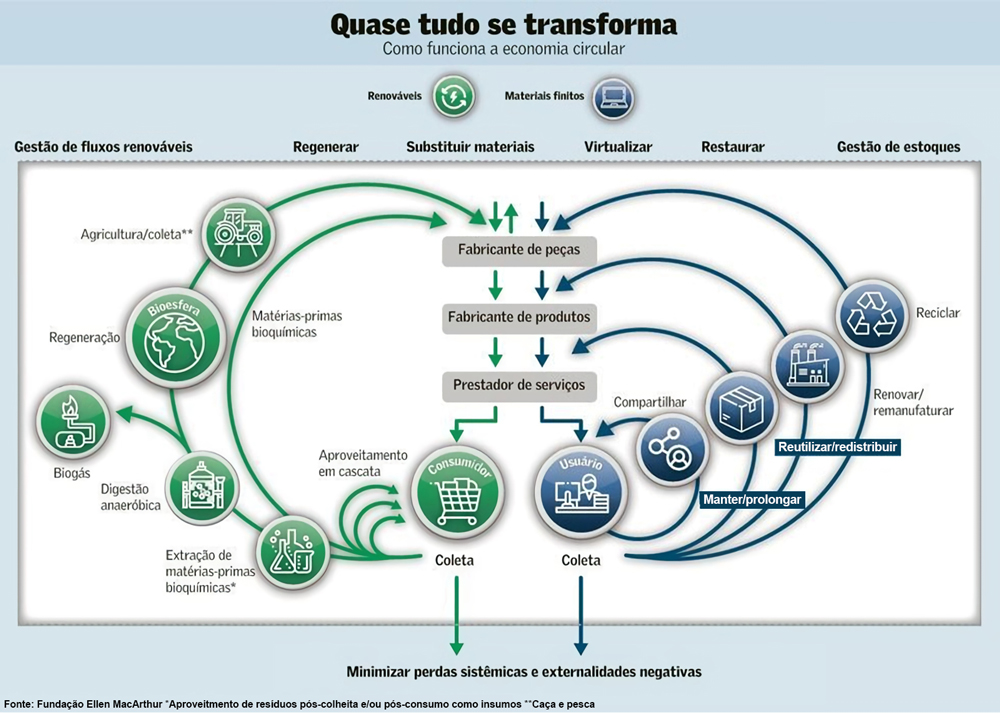
Figure 1 – Reverse logistics makes the circular economy system possible
The technologies of the so-called fourth industrial revolution, Industry 4.0, make it possible (when adopted in this context of reverse value chains) to monitor and control the greater complexity of this diversity of origins and destinations, ensuring that what is collected is reinserted into the production process with control of the location and stage of the chain.
The formation of cooperatives supported by monitoring technologies also enables the inclusion of small producers and businesses, diluting collection costs by densifying reverse routes. Thus, micro, small and medium-sized companies gain an economically viable solution to join the circular economy as they also contribute to increasing the scale of the entire system. Reverse logistics makes this inclusion possible by creating collection routes with continuous flows.
In this way, opportunities also open up for innovation with the participation of startups. Some of them, in the innovation ecosystem, are already operating platforms that connect companies, cooperatives, consumers and reverse logistics operators. Tracking solutions for returnable packaging are also added to the reverse system, making management easier.
With the broad inclusion of startups, not only in the realm of digital transformation, it becomes possible to add improvements with new technologies for reusing the various materials: physical, chemical and organic. Innovation is fostered as collection is made viable and new destinations are found through value-creating reverse logistics.
On the other hand, innovation through the creation of connections between reverse logistics and new origins and destinations enables new business models in sharing services, whether through the recurring economy or the sharing economy.
This is the case of renting or subscribing to the use of various durable goods (from furniture to toys and clothing, including goods with higher added value, such as automobiles). In these cases, reverse logistics delivers the rented item and picks up the previous one; from there, it continues on its route to processing centers for cleaning and maintenance and then, redirects the item to a new subscriber of the service.
There is also the possibility of creating value through reversibility, combined with a business innovation that makes it possible to create greater value than the original, or primary, products.
One case of this possibility is the practice of upcycling in the production of customized clothing. In this practice, companies receive textile residues through reverse logistics, such as cloths, rags and leftover knit yarns, and transform these materials into new clothes with distinctive designs recognized for their exclusivity, with greater added value than the products that generated the residues and leftovers that were reused.
These references to practical cases of value creation through reverse logistics allow us to foresee (as the possibilities for returns increase) that a database of countless materials will open the way for management via Industry 4.0 technologies, with organization of connections and even prediction of possible destinations as early as the design phase of new products.
In this way, the circular economy is incorporated as early as design and development, with the concurrent creation of circular value chains and simultaneous development of their agents. There is, therefore, an entire path of transformation that, if approached with the principles of lean thinking, directs companies toward concrete actions to move from caused reverse logistics to value-causing reverse logistics.
3) Transforming caused reverse logistics into causing reverse logistics
Thinking about this shift from caused to value-causing reverse logistics through lean thinking makes it possible to move its management from a mere consequence of transportation decisions to a protagonist, as an engine for transforming the linear economy (with one-way movement) into a circular economy in which causing logistics seeks value creation, identifies players and enables connections, bringing value to the planet and to citizens.
Thus, reverse logistics equipped with lean thinking makes it possible to think differently and open doors for the logistics professional to be the professional of connections, a nexialist (this concept has been used to describe the professional who promotes connections to solve problems, establishing links and thus connecting knowledge and values).
These connections, mediated by logistics as a management technique, will contribute to building circular networks and chains, allowing each movement to carry not only products or materials, but solutions in the continuity of a continuous value cycle. The result is the transformation of the product from a grave (in the sense of a useless disposal) into a relocation in a new cycle, with a new application and a new cradle.
Value-causing reverse logistics means thinking about innovation, reutilization, reuse, remanufacturing and reinvention. Or, as lean thinking sums it up, thinking and acting to create continuous value, without waste.







