

Practicing visual management in logistics
The Japanese term mieruka, often translated as “making visible” or “visualizing to understand”, is one of the most powerful artifacts of Lean practice. It expresses a premise that we can only manage well what we can see clearly. Making performance visible and accessible is a way to stimulate innovation, guide quick decisions and keep everyone aligned around a common purpose. That is what visual management is about.
By synthesizing the essential information of a process into simple visual elements (such as boards, charts, standards and signals), visual management turns scattered data into shared knowledge, fostering continuous learning. In distribution centers, for example, visual management boards help quickly align leaders and operators on targets, problems and priorities. This everyday transparency reinforces the teams' sense of unity and encourages everyone's engagement with the collective success of the operation, regardless of hierarchical level and degree of training.
But visual management should not be limited to making boards. Its value lies in how it is integrated into the organization's routine through consistent practices of leadership, strategy deployment and problem solving. To that end, knowing the main visual management tools — and the purpose of each one — helps managers and continuous improvement agents in logistics apply them coherently to their real needs.
Different boards, different purposes
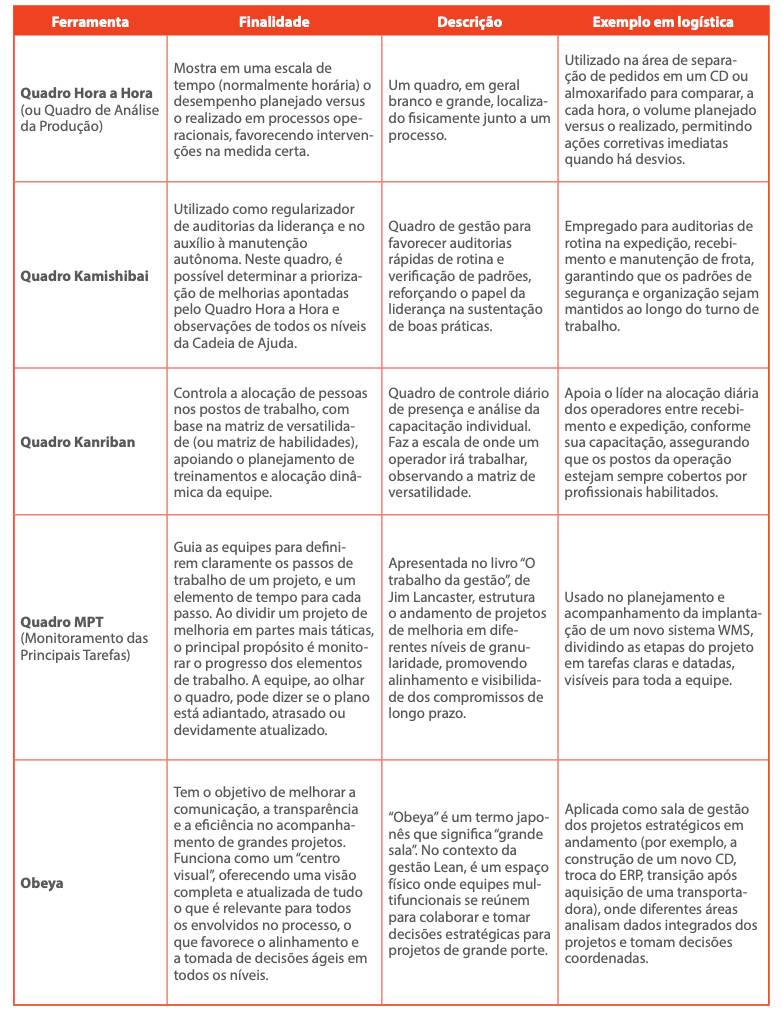
The universe of Lean practices offers a variety of boards and tools to support visual management. Understanding their differences, purposes and complementarities is important to strengthen the management model in logistics. Table 1 presents some of the most widely used traditional tools for visual management, their respective purposes and examples of application in logistics.
Each of the tools presented in Table 1 has a specific use. They should therefore be used according to their purpose, in a way that fits the management problem that needs to be solved (purpose). When used in an integrated and coordinated way, they contribute to building a more cohesive management system, capable of responding quickly to changes in the environment.
Daily management boards
Daily Management (DM) boards are other fundamental artifacts of visual management in Lean systems. Because they offer a unique dynamic within the management system, they deserve a chapter of their own for discussion. The purpose of DM boards is to align the operation with the company's strategy, following the daily execution of activities, sustaining results and optimizing performance through structured problem solving.
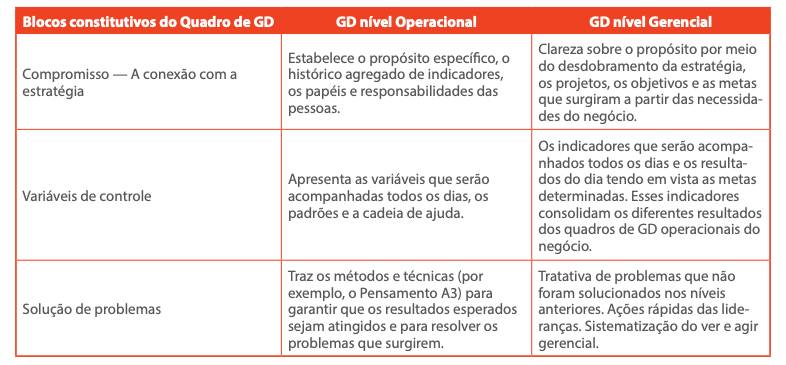
DM boards are associated with the leadership routine and are used for strategy deployment at all levels. They are organized in a clear and accessible way, and present three core blocks (commitment to the strategy; control variables; and problem solving) that allow the team to quickly understand whether the process is under control, which targets are at risk and what actions should be taken. It is the combination of these three blocks on a single board that qualifies DM as a management approach for executing the strategy, monitoring results and solving problems.
Companies in various sectors have widely adopted DM. In logistics, it has proven particularly valuable in warehouses and DCs, promoting daily alignment between leaders and operators and facilitating the control of critical variables such as picking productivity, losses and service level. In retail, its use has helped boost sales and improve the customer experience by allowing store teams to expose and quickly solve problems.
In addition, the approach has been successfully applied in areas such as purchasing and planning, in the most varied industry segments, reinforcing its broad applicability as a management artifact oriented toward action and continuous improvement. Also in dynamic environments, such as that of logtechs, it is versatile enough to adapt and support agile project management and organizational growth.
DM boards are used at both the operational and managerial levels, serving as meeting points for quick, objective discussions about the daily performance of processes and control variables. At each of these levels, the DM board always consists of the same three blocks, but with some differences, as shown in Table 2.
However, it is essential to understand that DM is a management approach that goes far beyond its visual board. DM combines elements of leadership, discipline in the routine and strategic connection to give cadence, purpose and engagement to the operation. The board is only the starting point for a broader process of listening, learning and action, in which leaders and teams share responsibilities, expose problems and act in a coordinated way to ensure that business objectives are achieved.
Once structured, DM connects the gemba (the actual place where work happens) to the organization's strategy, promoting an environment where progress becomes visible, continuous improvement happens and alignment among all levels is permanent.
Analog or digital: what matters is use and learning
With the advance of digital technologies, it is increasingly common for management boards to be present on online platforms, integrated with real-time data systems and remotely accessible by teams. This digitalization makes it possible, for example, to follow control variables dynamically, even in virtual meetings, with a high level of precision. However, more important than the format (analog or digital) is the way the board is used day to day.
Human interaction around a physical board remains a powerful catalyst for engagement and problem solving, especially in operational environments. That is why many organizations start visual management with analog boards (with paper and pen), test their effectiveness, learn from the routine and then turn them into more robust digital solutions. Analog boards have a strong interactive appeal in the operation, while digital boards gain strength in distributed or hybrid environments. Even in digital format, it is essential that digital boards be visible in the gemba, such as on a TV screen close to the process, maintaining their central function of aligning, informing and mobilizing people for action.
Visual management is not just making information visible
It is important to point out that “visual management” is not simply “making information visual”. Visual management is not just about displaying data on a wall or screen. It is about creating an environment where the right information is accessible to the right people, at the right time, with enough clarity to guide decisions and actions to the right degree.
A management board is not a decorative panel. Rather, it reveals its reason for existing, shows whether the operation is within the expected standards and supports intervention in the process at the right point and time. What is essential is that visual management be an active means of management, which reveals problems and fosters dialogue, and not a mere passive repository of information.
Leadership that provides visibility and purpose
No visual management tool can be sustained without the active presence of leadership connected to the day-to-day of operations. Management boards do not replace leaders' presence in the gemba. On the contrary: they are instruments that facilitate that closeness. When well applied, they help the leader (a transportation supervisor, for example) to see clearly the challenges faced by the teams at that moment (such as delays, blockages and pending tax issues), to make fact-based decisions and to support employees' development with respect. Grounded in Lean practices, this leadership turns boards and meetings into learning moments, reinforcing the connection between the purpose of the business and the work done every day.
A practical example of visual management in logistics
An illustrative practical example is a retail company that developed its management system by integrating the different visual management tools connecting its logistics operation. This company, in its DCs, uses the Hour-by-Hour Board to track the planned and actual picking volume, the Kanriban Board for allocating operators between receiving and shipping, and the Kamishibai Board for auditing working and safety conditions. In parallel, the logistics supervisors use the operational DM board (consolidating indicators and unresolved problems flagged on the hour-by-hour board) and the store managers each have their own managerial DM. The Obeya, in turn, is used to manage strategic projects, which involve expanding the business through the construction of new stores and the adoption of new technologies (software and equipment). This Obeya contains a managerial DM board with the main indicators to be measured and followed by executives and an MPT board where the actions of the strategic projects are deployed.
This example shows that visual management tools do not compete with one another, but complement each other, each playing a specific role in the management system. The key lies in understanding the purpose of each tool and applying it intentionally: if the challenge is meeting short deadlines (for example, on an hourly scale), the Hour-by-Hour Board can provide rhythm and focus; if the problem is the allocation of people, the Kanriban helps to visualize and act; if the issue is following a large project, the Obeya brings clarity and fosters interaction.
Thus, the choice of tool always starts from an essential question: “what needs to be improved in logistics today?”. The answer guides the construction of a visual management system tailored to that purpose.
Visual management to align, act and evolve
Visual management is much more than the aesthetics of making information visible: it is strategic in logistics for making it possible to follow performance and intervene to the right degree. Lean practices for visual management help turn abstract goals into concrete, measurable actions in a transparent way. When well designed, the management system becomes a living organism, which pulses to the rhythm of the real work, connects all areas of the organization and makes it possible to evolve based on collective learning.
It is at this intersection of strategy, routine and people that Lean management shows its strength through its approaches and tools. And it is by making visible what really matters (mieruka) that logistics builds resilient, collaborative cultures oriented toward continuous improvement.
References
- ABAD, S. Understanding Lean visual management tools. Planet Lean - The Lean Global Network Journal, 2019.
- BATTAGLIA, F.; ITIKAWA, R. Obeya for project management. LeanM@il. Lean Institute Brasil, 2024.
- FERRO, J. R.; GOUVEIA, R. Daily management to execute strategy. 1st ed. São Paulo: Lean Institute Brasil, 2021.
- KAMADA, S. The help chain to maintain production stability. Lean Institute Brasil article database, 2008.
- LANCASTER, J. The Work of Management. 1st ed. São Paulo: Lean Institute Brasil, 2017.
- LEAN ENTERPRISE INSTITUTE. Lean Lexicon: a graphical glossary for Lean thinkers. 5th ed. São Paulo: Lean Institute Brasil, 2016.







