

The promise of lean in healthcare
An imperative in US health care is to improve quality and efficiency while controlling costs. One promising management approach implemented by some leading health care institutions is lean, a quality improvement philosophy and set of principles originating at Toyota. Some cases show that lean is as applicable to complex knowledge work as it is to assembly lines.
When well executed, lean transforms how an organization works and leads to an insatiable quest for improvement. In this article, we define lean and present six principles that constitute the essential dynamic of this way of managing: a continuous improvement mindset, value creation, unity of purpose, respect for front-line workers, visual tracking and flexible regimentation. Health care case studies illustrate each principle. The goal of this article is to provide a model for health care leaders to use when considering implementing a lean management system or when assessing the current state of implementation in their organizations.
Pediatric surgeons at Seattle Children’s compete to operate at the new Bellevue clinic because of the efficient flow of patients, families and medical staff. Clinic time, defined as the time from dressings being placed on one patient to the time of incision on another, is fifty percent less than for similar operations performed at the main surgery center on campus. Operations start on time ninety-nine percent of the time. More than ninety percent of patients and families give the Bellevue surgery center a nine or a ten for overall care. ThedaCare, an integrated health system in Wisconsin, reduced the total cost of inpatient stays by twenty-five percent and improved patient satisfaction to the point that almost all give it the highest rating. After five years of operation, no medication reconciliation errors have occurred for patients in hospital units served by a care team that included a pharmacist.1 Staff in the otolaryngology department of the Christie Clinic in Champaign, Illinois, begin each day with a meeting to identify problems and discuss potential solutions. The daily rhythm of the meetings, which include physicians, has improved internal communication and teamwork. In less than a year after starting the meetings, the wait time for appointments decreased by twenty-eight percent, departmental capacity improved by ten percent with no increase in staffing, and customer satisfaction improved from 4.3 to 4.7 on a scale of 1 to 5. Leadership of the meetings rotates weekly among the department's staff.
What connects these three institutions is their journey of implementing a quality improvement philosophy and set of principles originating at Toyota Motor Company, commonly referred to as lean. The three health systems presented here, and many others, have clearly demonstrated that the lean approach is as applicable and useful in complex knowledge work as it is on assembly lines. Earlier health care experiences with lean also reveal the treacherous nature of the journey 2.
Lean is not a program, a set of quality improvement tools, a quick fix or a responsibility that can be delegated. Rather, lean is a cultural transformation that changes how an organization works; no one is left on the sidelines in the quest to discover how to improve daily work. It requires new habits, new skills and often a new attitude throughout the organization, from senior management to front-line service providers. Lean is a journey, not a destination. Unlike specific programs, lean has no end. Creating a lean culture is creating an insatiable appetite for improvement; there is no going back. As lean consultant Joan Wellman puts it: “With lean, you keep changing your definition of what ‘good’ means” 3.
The emergence of lean success stories in health care, a rapidly changing environment in need of improved quality and efficiency, and the trend toward publicly reporting health care performance data4,5 are converging to encourage health care leaders to consider lean in their institutions. No health care organization or clinician is immune to the simultaneous pressures to improve quality and reduce costs. As former administrator of the Centers for Medicare & Medicaid Services and founder of the Institute for Healthcare Improvement Dr. Donald Berwick states: “The only way to rescue American health care is by improving it... We know what to do – better care, better health, lower cost” 6.
Health care's growing interest in lean results in rushing something that cannot be rushed, misunderstanding what is not easily understood and underinvesting in something that requires constant, multifaceted investment. Attempts even to define lean have been elusive. Health care staff have encountered many versions of lean. They have been told it is a five-day training on the one hand and the cultural change of an entire system on the other. In this article, we apply our collective experience in leading a lean transformation at ThedaCare, in visiting more than one hundred health systems that apply lean (J.S.T.) and in our long career of service quality research inside and outside health care (L.L.B.) to define lean and present its essential principles. The principles are illustrated by health care case studies based on information provided by the institutions presented, personal visits and follow-up communications. Our goal is to provide a model for health care leaders to use when considering the opportunity lean offers their institutions or when assessing the current state of implementation in their organizations.
Definition and Principles of Lean
Influenced by the work of Womack and Jones 8, we define lean in health care as “an organization’s cultural commitment to applying the scientific method to designing, performing and continuously improving the work performed by teams of people, leading to measurably better value for patients and other stakeholders”. Lean is an operating system made up of six principles that constitute the essential dynamic of lean management. Failing to follow any of these principles means failing to tap the full potential of lean to benefit the organization's stakeholders.
Principle 1: lean is a continuous improvement mindset
Continuous improvement is based on a principle introduced by Shewhart 9 and refined by quality improvement pioneer Edward Deming. The Deming cycle is the basis of Plan-Do-Study-Act (PDSA), a central tenet of lean 10. The PDSA approach is the scientific method applied to daily work: defining an explicit, measurable hypothesis about how a process can be improved, objectively testing the hypothesis and, if improvement occurs, making the improved process the “standard work” until such time as further improvements can be demonstrated 11. Health care staff are familiar with the scientific method in the form of controlled doubleblind studies to test new treatments. Lean uses the same basic measurement approach every time a new process is shown to be superior to the one being used. For lean to enter an organization and transform its culture into one of continuous improvement, senior management must relinquish the role of master problem solver in favor of those closest to the problems to be solved – to take advantage of their knowledge of the local process, to give them experience in using lean methods, to see firsthand the performance improvement and teamwork this can create, and to promote an attitude that what exists can probably be improved. Team members, clinical or not, who receive encouragement, training and time to make meaningful improvements in how work is done are unlikely to want to return to a time when formalized effort to improve existing processes was outside their domain of responsibility. As team members gain confidence in their problem-solving skills and witness positive change, the impetus to improve work further is likely to grow. This is lean at its best; staff keep raising the bar, the organization becomes much more innovative, more staff want to be directly involved, and a continuous improvement mindset becomes the driving force behind all work.
At St. Jude Medical Center in Fullerton, California, a team recognized a significant problem in radiology scheduling. The average telephone wait time was twenty minutes, with a dropped-call rate ranging from seventeen to twenty percent. A PDSA-based process known as rapid improvement led to changes that included a staff meeting every morning to monitor and discuss metrics for wait time, call volume and dropped-call rate, among other topics. The team solves the previous day's problems and anticipates problems for the next day. At any time of day, any team member can call a meeting if performance problems arise. Such a meeting allows the team to identify and solve problems. Total call volume grew while wait time was reduced to less than one minute, and the dropped-call rate to less than three percent, with no new hires.
Principle 2: lean is about creating value
Health care is for patients; its resources, directly or indirectly, should be used to benefit them. The fundamental goal of lean in health care is to create value for patients. In doing so, other health care stakeholders also benefit. Fewer medication errors, fewer hospital infections, less nursing time away from the bedside, less operating room preparation time, better communication about patients within the care team and shorter emergency response times benefit not only patients but also physicians, nurses, health care organizations, payers and the community.
Value in health care has been conceptualized as outcomes achieved per dollar spent 12 and outcomes achieved per dollar over time 13. Patients, however, typically see value more broadly, as the benefits received relative to the burdens endured (14). Burdens include both monetary and nonmonetary costs. Benefits versus burdens include medical outcomes and financial costs, but extend beyond these constructs to also include patients' perceptions of the entire health care experience. A clinician's sensitivity in answering patients' questions, a surgery that starts on time and a quiet, calm medical center may be ancillary to medical outcomes, but they can still be important to patients' perception of value. Conversely, a clinician's insensitivity, a delayed operation and a medical center that increases stress can be significant nonmonetary burdens in patients' assessment of value 15,16. Measurable process improvements resulting from lean interventions should ideally involve a benefits versus burdens effect on all affected stakeholders. Who is affected by the changed processes, and how? Do the benefits increase? Do the burdens increase? These are the questions that robust lean management must answer.
Value stream mapping is the main lean tool used to distinguish between steps in a process that do or do not create value (Figure 1). A work team creates a visual map of each phase of an existing process to better understand it (that is, the current state). Clearly understanding the current state is essential to improving it, and creating a detailed representation of the process facilitates understanding. A value stream map differs from other maps by combining information flow with the flow of materials and people; this allows the team to see more clearly the current state of a complex system and offers guidelines for improvement. When studying a value stream map, the team can ask questions such as: “Why do we do this step?”, “Would the patient be willing to pay for this part of the process if given a choice?”, “Is there a more efficient or effective alternative?”, “Which phases of the process are most vulnerable to errors?”.
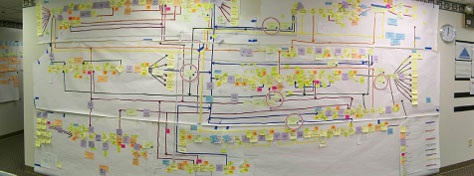
Figure 1: example of a value stream map
Value stream mapping requires attention to detail; every distinct step in a process must be captured on the map. Lean is primarily about “expertise in the details”, that is, performing many small tasks better and creating value through the cumulative effect of small improvements. ThedaCare has a meeting room containing a large, highly detailed map of patients' experiences during their hospital stay. The admission process involves one hundred and twenty-four steps, the discharge process one hundred and forty. This map has gone through seven stages of refinement to date. Many cross-functional teams work on different parts of the map in pursuit of measurable improvements. One team, for example, has been working on reducing hospital readmission rates by improving the discharge process. The hospital's value stream map room is where dozens of ThedaCare staff work on the various improvements the teams pursue in order to deeply understand the current state of the hospital's care system, with the goal of creating more value – increasing benefits and reducing burdens for all stakeholders 17.
In perioperative services at eight member hospitals of New York City Health and Hospitals Corporation, management recognized the need for a different structure to support improvement. To engage front-line interdisciplinary teams in applying lean tools, an external sensei (teacher) trained internal lean facilitators at each site to design and lead improvements. These teams sought to reduce patient handoffs and steps in preoperative testing so that the first case would start on time more often, to reduce turnaround time between cases and to reduce waste in searching for supplies and the potential for errors caused by poorly managed inventory. Before the improvements, the facilitator and area managers collected data to study process steps, cycle times, flow and patient handoffs in order to then draw up a precise definition of the problem. During four or five days of rapid improvement, the teams reviewed the problem, mapped the current state and the state they wanted to achieve, described the ideal state (perfection) and analyzed the (gap) between the current state and the one they wanted to achieve, developed, tested and implemented successful solutions, and established the metrics needed to ensure the desired state was reached. Results as of spring 2012 include:
- Percentage of procedures starting on time increased from 50% to 70%;
- Number of surgeries increased from 329 to 351 per month;
- Operating room turnaround time fell from 60 to less than 40 minutes;
- Percentage of cases rescheduled because of delays fell from 21% to 4.4%;
- Same-day surgery cancellations fell from 7% to 3% of total cases.
Principle 3: lean is unity of purpose
Because health care organizations are complex systems, it is difficult for staff to know which tasks are most important. Properly executed, lean clarifies priorities and guides staff in improvement work. Lean work is focused; priorities govern the investment of resources in improvement.
A key role of senior management in lean is to prioritize and clearly communicate a small number of strategic goal categories that are relevant to the entire organization and most likely to strengthen it and create value for stakeholders. Ideally, all lean improvement projects should fit within the strategic framework. Specific improvement projects (the “how”) help the organization with its prioritized goal categories (the “what”). Management uses a process called “catchball”. From the CEO to the front-line supervisor, a series of conversations is constantly taking place. These conversations are documented on a simple sheet of paper and changed each time different ideas emerge from team members. On this sheet (called an A3, simply to denote the paper size), the experience and current conditions are documented for the strategy being studied. A strategic statement is developed and goals are set. The market opportunities the strategy is trying to seize are identified and countermeasures are suggested. Finally, a plan is established. In the catchball process, it is not unusual to have fifteen A3 drafts, indicating that many people were involved in defining the new strategy 18. This circular communication throughout the organization creates consensus, understanding and commitment to priorities 19.
Lean organizations often use the symbolic term true north and visual expression to communicate and reinforce strategic priorities. ThedaCare's true north representation board (Figure 2) places the patient in the middle of a triangle and the strategic goal categories at the points. Two metrics are used to measure progress for each goal category and one for the patient, which is a customer loyalty score. This specific figure appears on improvement work boards in almost every department and unit throughout ThedaCare's system of hospitals, clinics and administrative offices. The many teams that have conducted four-day rapid improvements every week at ThedaCare show how their work supports the true north representation board on the fifth day, when they present their findings at a staff meeting called a “Report Out”.
St. Jude Medical Center defined its true north as “Perfect Care, Healthy Communities and Sacred Encounters”. Perfect Care is translated into specific initiatives and metrics for inpatient, outpatient and support areas. The focus of Perfect Care in the intensive care area is the elimination of ventilator-associated pneumonia. Before the rapid improvement, intensive care staff believed they were doing everything possible to prevent this type of pneumonia. The improvement showed otherwise, and staff implemented a visual management board in each room where a patient was receiving ventilator support. On this board, red and green magnets were flipped every two hours as prevention measures were carried out. This technique allowed staff to quickly identify potential failures in prevention measures. The care team regularly reviews clinical evidence and discusses any failure in prevention measures. To date, the intensive care unit has had no preventable cases of ventilator-associated pneumonia for more than three years, the result of unity of purpose around a true north metric.
Principle 4: lean is respect for the people who do the work
A lean leadership and management system differs from a hierarchical one, in which higher-level managers and supervisors tell lower-level staff what to do and how to do it 20. This is perhaps the greatest challenge of implementing lean in many organizations: the people in charge need to change a great deal for a lean culture to develop.
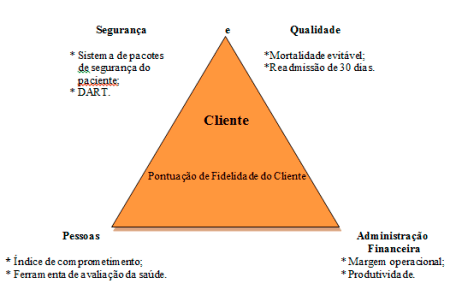
Figure 2: ThedaCare's true north representation board. DART stands for days away, restricted or transferred and is an Occupational Safety and Health Administration formula for tracking employee injuries and illnesses.
Lean, by consensus, turns leadership upside down, with front-line staff making many of the innovations and managers trusting and supporting them. Respect for the potential of front-line staff has the mental power and commitment to improve work that must permeate the organization. Respect flows downward, not only upward. In lean organizations, higher-level managers support the “improvers” by regularly visiting the workplace (or Gemba, in lean language) to learn firsthand about problems and barriers to improvement, by becoming teachers and working models of quality improvement, and by investing in the education, skills training and tools front-line staff need to be effective in improvement work. Management must strive to create a safe environment for innovation, attacking processes, not people, so that team members are not afraid to report problems (3). Lean health care organizations often commit to retaining and, if necessary, retraining staff whose positions are eliminated because of productivity gains or structural innovations. Such a policy eases staff concerns about losing their jobs.
Leading a lean transformation from the top of the organization requires perseverance (because setbacks are inevitable, as is resistance) and humility (because lean exposes many problems, some of which are caused by the leaders themselves). Lean has the potential to transform the organization into a community of innovators. However, this can only happen in a culture of respect.
Martin Health System, headquartered in Stuart, Florida, had an incident at its satellite hospital in which an emergency department (ED) nurse could not quickly locate an infusion (IV) pump for a patient. Critical time was spent before the pump was located. This incident led to a comprehensive assessment of nursing care processes. One finding was that each nurse spent an average of thirty-eight minutes per shift looking for the necessary equipment. If the equipment was not available, more time was spent waiting for it to be provided. The effect on patients was less nursing time and a number of delayed treatments.
The nursing staff thought there would never be enough pumps and that the solution was to order more. Lean concepts were applied to determine whether there was a shortage and, if so, how many pumps were needed. The hospital had an inventory of five hundred and eight infusion pumps for three hundred and forty-four beds. Considering the national rate of 1.2 pumps per bed, there was in fact an excess of ninety-six pumps. The problem was not a shortage but the lack of a procedure for nurses to access pumps quickly and easily. The lack of a procedure led to the hoarding of unused pumps, which worsened the problem.
To improve, Martin Health System installed “equipment supermarkets” in nursing units. The supermarkets had all the equipment needed for specific units, for example, IV pumps, patient-controlled analgesia pumps, feeding pumps, sequential compression devices and bed alarms. Standard work was developed to facilitate the availability of the necessary equipment. The equipment supermarket shelves were coded and numbered with the quantity of items by color: green indicates that supply is adequate, yellow that supply needs replenishing and red that an immediate call is needed to restock the item.
This process improvement reduced the average nursing time spent gathering equipment to less than one minute, contributing to cash savings and productivity gains. For example, when the use of a medication is discontinued, the IV pump is cleaned and returned to the equipment supermarket. By improving the use or “turns” of the IV pumps, the hospital was able to replace its current pump inventory with one hundred fewer units, which produced a direct saving of three hundred thousand dollars. Total nursing time spent gathering supplies was reduced by thirty-four hours per day.
Many departments collaborated in developing, testing and refining the nursing equipment flow process, including nursing, materials management, housekeeping and decontamination. These team members became a community of innovators to discover a better way to ensure that essential hospital equipment would be available where and when needed while minimizing equipment idleness. An additional result at Martin: nurses stopped hoarding IV pumps.
Principle 5: lean is visual
Visual tracking centers exist in many places in a lean hospital or clinic. These tracking centers are displays of information mounted on the walls of staff-only areas. Their purpose is manifold: to present daily performance data and trends on key metrics (for example, patient satisfaction, cost and quality metrics), to serve as a dedicated place where any team member can communicate a problem that needs attention or post an improvement idea, to organize all relevant improvement information in a single place (including projects not yet started, in progress and completed), to serve as a place for meetings, both scheduled and impromptu, and to symbolize a culture of transparency. A common sight in a lean health care facility is staff gathered in front of a monitoring center with the meeting leader continually referring to the information posted. This practice is known as “working the wall”.
The information on the visual tracking center is always changing, and therefore it is common to use dry-erase markers, pencils or sticky notes to present it. Whereas conventional workplace bulletin boards become obsolete because the information is either not relevant or rarely changes, which happens often, conversation is more productive using lean monitoring centers; the information is dynamic and relates directly to staff's thinking about how well they are providing what patients need and want.
When Seattle Children’s built its new Bellevue clinic and surgery center, it used Integrated Facility Design, a process based on Toyota's Production Preparation Process approach. Integrated Facility Design brings a diverse group of stakeholders into planning before a single shovel goes into the ground. Early stakeholder involvement typically results in fewer design change requests and more efficient construction. During planning, Seattle Children’s brought in nurses, physicians, support staff, patients, architects, designers and others to help determine the needs, objectives and metrics for the facility and to think about the most efficient flow and use of space. Value stream maps representing the workflow were developed and agreed upon by all parties involved, including patients and families. Families played an important role in providing insight into their needs and wishes. For example, parents made clear their wish to stay with their children in the preoperative area, and the space was designed to accommodate the presence of parents.
The value stream maps helped prioritize design requirements, which contributed to the facility being built for thirty million dollars less than initially estimated. Mapping allowed the team to see the waste in its current care process, much of which was removed in designing a new ideal-state care process. The new ideal state was used to design the space needed for the building, which cost less compared with the space proposed in the original architectural design. The maps are still displayed in the back hall of the building and are regularly reviewed and updated. Metrics for the clinic and surgery center are displayed in visual monitoring centers throughout the facility.
Principle 6: lean is flexible regimentation
Processes are perfectly designed to produce the results that occur. 21 But what if the results are not optimal? What if the results of specific processes indicate unnecessary waiting, lost productivity, unexplained error rates, staff dissatisfaction or patient harm? The key to improvement is to determine the root cause (or root causes) of the performance shortfall and rid the process of the cause(s) through countermeasures. This is the essence of lean: transforming non-standardized work processes into standard processes that improve performance, and then continuing to improve the standard work through PDSA.
Standard work is best described as “flexible regimentation”, a phrase coined by Dr. Robert Wilson, a ThedaCare cardiologist. Regimentation refers to developing a common or standard process for performing a specific service based on the best available evidence; flexible refers to ongoing efforts to improve the standard process. A paradox of standard work is that established standards unleash creativity.3 With standardized clinical approaches, patients who deviate from the standard are more easily cared for, so that clinicians can spend their mental energy on problems and patients. An example at Seattle Children’s is the asthma care unit, where standardizing albuterol therapy has allowed physicians to better identify patients who are not following the typical course. The fact that the standard approach to treatment does not work calls the asthma diagnosis into question and forces the physician to look for other causes. The specific design of a standard process offers the opportunity for focused study and testing. Work is easier to study when it has been well defined as a set of expected activities.
Process results are sometimes so variable that they must first be stabilized before they can be standardized. Stabilizing a process involves finding a short-term method to contain unacceptable results until a standardized solution can be developed. For example, a patient falling off an orthopedic table may be considered a “never event”. If this happens, the hospital may decide to place a nurse on each side of the table. Stabilizing this process with two nurses ensures the safety of the next patient in the same situation, but it may not be the final solution to the problem. The root cause of the fall must be identified before new standard work can be designed to permanently eliminate the defect.
Inova, an integrated health system in Virginia, has nine emergency departments that treat approximately four hundred thousand patients a year. At the beginning of 2008, Inova's emergency departments were achieving average performance on quality, patient satisfaction, cost and profitability measures. During 2008, Inova began an improvement process in its emergency departments together with the implementation of a new electronic health record system. Each emergency department completed value stream maps developed by staff, which indicated significant flow problems at intake and triage. Patients were routinely pushed to other departments between registration, triage and intake, even when physicians were available to see them. The prevailing culture in most emergency departments was that a nurse would always check on a patient in the exam room before the physician. The value stream mapping work changed this so that physicians could enter the room at any time and at any point, and their assessment of the patient would be brought forward.
Other new standards included quick registration (three minutes) followed by quick triage (three minutes) and sending the patient directly to the treatment location. Many of the emergency departments chose to do all triage at the patient's bedside. Using the new electronic health record system to measure and direct all stages of the process and to make performance visual was fundamental to the improvements achieved across all emergency departments in 2011: length of stay until patient discharge fell from two hundred and fifteen to one hundred and thirty-five minutes, time to see a physician fell from fifty-five to twenty-two minutes, diversion fell from one thousand three hundred to fifty hours a year, and patient satisfaction rose from sixty to eighty percent in a survey vendor's national database. The emergency departments have provided approximately ten million dollars in additional revenue each year since 2009, using 2008 as the baseline. Volume grew six to seven percent each year with few beds added in the emergency departments. By the end of 2012, the emergency departments will have provided more than six million dollars in labor productivity gains.
Turn your institution into a benchmark of operational excellence with Lean consulting for health care. Reduce waste, increase productivity and provide better experiences for everyone involved. Visit and see!
CONCLUSION
Lean is an innovative management approach that has proven its success in health care organizations. It promises improvements in quality and efficiency while controlling costs in delivering optimal patient care. To implement lean philosophy and principles, however, is to embark on a treacherous and never-ending improvement journey. Because lean transforms organizational culture from the inside out, it offers both challenges and opportunities. It requires a major role change: managers and leaders must become facilitators, mentors and teachers and allow front-line staff to make improvements. It engages all staff in identifying and solving problems based on a continuous improvement mindset, the driving force behind lean work.
The underlying goal of lean is to create value for the patient. Innovation through proven lean methods offers hope of better health care at lower cost, rather than worse health care at lower cost. For us, the choice is clear.
Abbreviations and Acronyms: IV = intravenous; PDSA = Plan-Do-Check-Act.
REFERENCES
1. Bielaszka-DuVernay C. Redesigning acute care health services in Wisconsin. Health Aff (Millwood). 2011;30(3):422-425.
2. Toussaint J, Gerard RA. On the Mend: Revolutionizing Healthcare to Save Lives and Transform the Industry. Cambridge, MA: Lean Enterprise Institute; 2010.
3. Wellman J. Paper presented at: Nemours Foundation Board of Directors Meeting; November 7, 2011; Orlando, FL.
4. Partnership for Healthcare Payment Reform. http://www.phprwi.com/index.php1. Accessed May 13, 2012.
5. Toussaint J. Potent Medicine: The Collaborative Cure for Healthcare. Appleton, WI: ThedaCare Center for Healthcare Value; 2012.
6. Berwick D. Paper presented at: Institute for Healthcare Improvement National Forum; December 7, 2011; Orlando, FL.
7. Petersen J. Defining lean production: some conceptual and practical issues. TQM J. 2009;21(2):127-142.
8. Womack J, Jones D. Lean Thinking: Banish Waste and Create Wealth in Your Corporation. 2nd ed. New York, NY: Free Press; 2003.
9. Shewhart WA. Statistical Method from the Viewpoint of Quality Control. Washington, DC: US Dept of Agriculture; 1939.
10. Moen R, Norman C. Evolution of the PDCA Cycle. http://pkpinc.com/files/NA01MoenNormanFullpaper.pdf. Accessed June 7, 2012.
11. Staats BR, Upton DM. Lean knowledge work. Harv Bus Rev. 2011;89(10):100-110.
12. Porter ME, Teisberg EO. Redefining Health Care: Creating Value- Based Competition on Results. Cambridge, MA: Harvard Business Review Press; 2006.
13. Smoldt RK, Cortese DA. Pay-for-performance or pay for value? Mayo Clin Proc. 2007;82(2):210-213.
14. Berry LL. Discovering the Soul of Service. New York, NY: Free Press; 1999:12-13.
15. Bendapudi NM, Berry LL, Frey KA, Parish JT, Rayburn WL. Patients’ perspectives on ideal physician behaviors. Mayo Clin Proc. 2006;81(3):338-344.
16. Fung CH, Elliott MN, Hays RD, et al. Patients’ preferences for technical versus interpersonal quality when selecting a primary care physician. Health Serv Res. 2005;40(4):957-977.
17. Toussaint J. Writing the new playbook for U.S. health care: lessons from Wisconsin. Health Aff (Millwood). 2009;28(5): 1343-1350.
18. Shook J. Managing to Learn (Gerenciando para o Aprendizado). São Paulo, SP: Lean Institute Brasil; 2008.
19. Dennis P. Getting the Right Things Done. Cambridge, MA: Lean Enterprise Institute; 2007.
20. Barmas K. ThedaCare’s business performance system: sustaining continuous daily improvement through hospital management in a Lean environment. Jt Comm J Qual Patient Saf. 2011;37(9): 387-399.
21. Deming WE. Out of the Crisis. Cambridge, MA: MIT Press; 1986.
*Originally published in Mayo Clinic Proceedings (Mayo Foundation for Medical Education and Research)/ Mayo Clin Proc. 2013; 88 (1):74-82**From the ThedaCare Center for Healthcare Value, Appleton, WI (J.S.T.) and the Department of Marketing, Mays Business School, Texas A&M University, College Station (L.L.B.).
Correspondence: Address to Leonard L. Berry, PhD, Department of Marketing, Mays Business School, Texas A&M University, 4112 TAMU, College Station, TX 77843-4112 ([email protected]).





