

What do you do when the problems are solved?
Omnipack is a packaging company with two main lines of business. Historically, one of them has been profitable, while the other – finishing – has been losing money. For years, we tried everything to turn the situation around (through several management changes, for example), but nothing seemed to work.
In 2018, in addition to the margin-related problems, we began to see a worrying increase in the number of quality defects. This led to a customer threatening to terminate the contract (there is no greater incentive than that). Faced with this prospect of having to change, and eager to start down a path of continuous improvement to serve our customers better every day, the company decided to dive into lean thinking and hire a change agent (me), as well as a sensei to support our efforts (Néstor Gavilan, of Instituto Lean Management). That is how our journey began.
At the same time that senior management's mindset began to focus on making prevention a priority for the company, it also focused on adopting lean principles to standardize our processes and leadership behaviors across the company. The change at the senior management level gave a great boost to our improvement efforts, and we quickly began to structure our implementation around culture change and kaizen.
The first thing we did, guided by Néstor, was to start creating our hoshin kanri, hoping to move away from firefighting and make prevention part of our DNA, while at the same time we began to focus on the process rather than on cost. From the start, we worked in full alignment with senior management.
In 2019, our plant's hoshin was ready. It had 25 KPIs – well defined and with clear responsibilities. From the outset, people were taught to gather useful and reliable data for each of these indicators, which in turn represent the results the company wants to achieve.
It was interesting that we introduced the hoshin at the beginning. We know that many organizations wait until they are further along in their lean journeys to do this, but we decided to entrust that part to Néstor. We didn't understand what hoshin was at first, but now we do. We believe it is where PDCA begins. The hoshin tells us where to focus our improvement and our resources (which is particularly useful when we have many open projects – as is the case now that we are working to improve our information flow). It also allows us to translate profit-and-loss goals into tangible operational KPIs that the whole organization can understand, whereas before implementing them we had the impression that our business priorities changed every week. The hoshin has now become a fundamental tool for senior management.
The initial work we did with the hoshin helped us identify three main strategic projects (the first two addressing urgent business needs and the third the advancement of our lean transformation – in line with the approach Néstor described in this article):
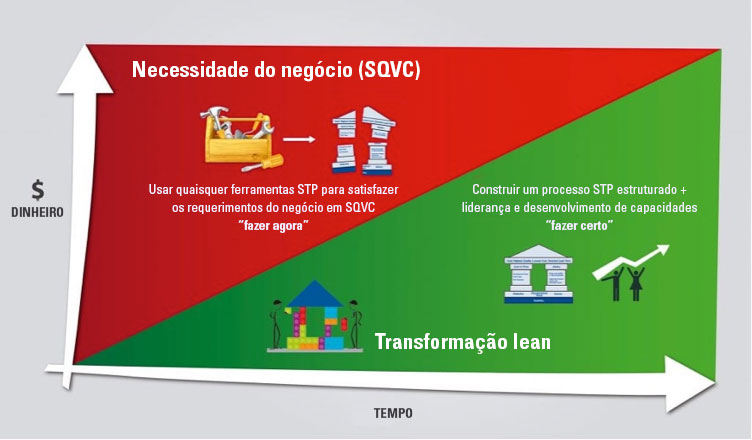
- Improve quality (PPM) and productivity by selecting the most precise tools based on the situation.
- OEE analysis to identify priorities and the root cause of our productivity problems.
- Development of a culture of prevention.
The most problematic business area has five very old assembly lines (all more than 60 years old) and a more modern process through which 56% of our volume passes. We carried out an in-depth analysis of our equipment, breaking each machine down into work points – a very interesting exercise that revealed that the business problem lay in one specific work point of one specific machine on one line. The infamous point 7 on line 1. When we found it and dealt with it, we were able to go from 30 stoppages per shift to just one. Productivity soared: in 2017 it was 450, and today it is 580.
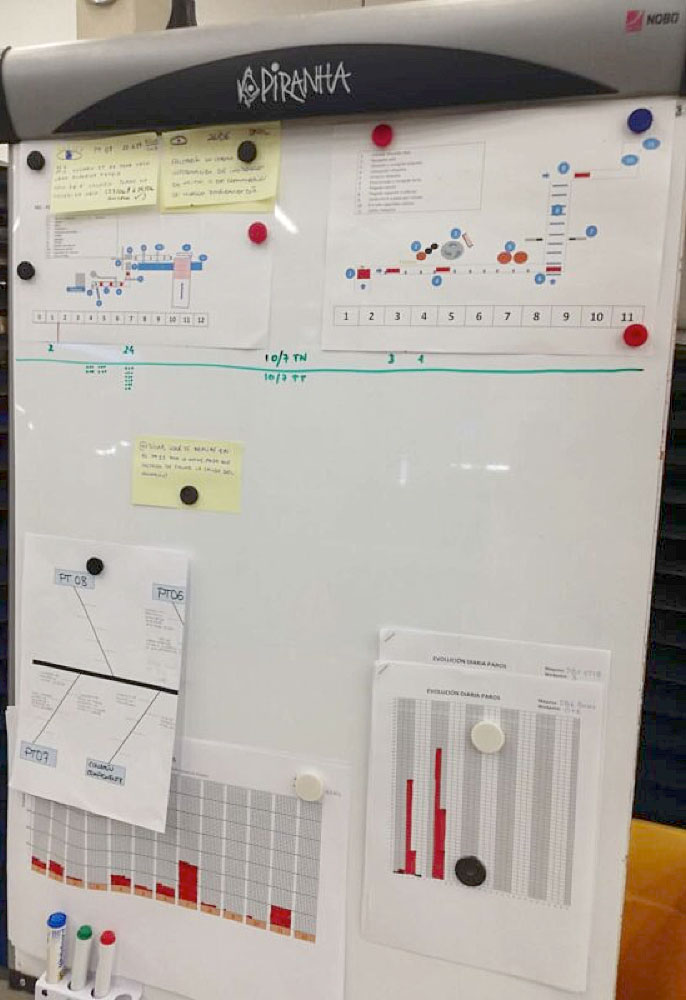
Over time, our strategy changed: at first we were trying to cut costs, but now we focus on creating basic stability and improving quality. In the first year, we went from 30-35% OEE on a line without changeovers to 50%. Now we are at 60% with changeovers (we achieved this mainly by developing people and using standards). We have much more stability now, even with changeovers. It used to take us two weeks to change over and restart the line; now we can do it in 8 hours and reach 70% OEE over just one shift. Quality has also improved significantly: we started at 70 ppm and are now at 31.
Cultural change
In 2020, we became one of the suppliers offering the highest quality to our once-dissatisfied customer. As we gradually stabilized our process and solved our quality problems, we began to focus more on advancing our lean transformation. This allowed us to concentrate our work on the cultural change needed to become a lean company.
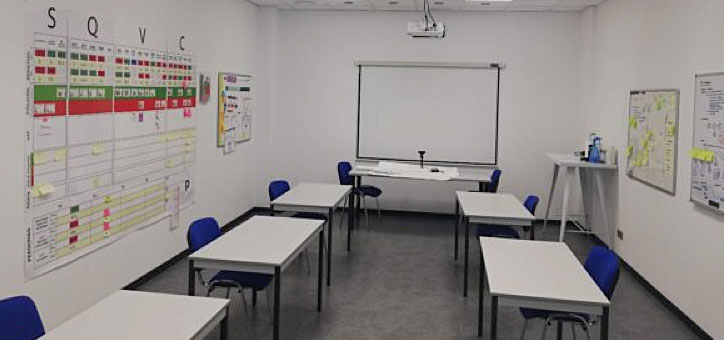
Last year, we began important work to ensure that the site hoshin was a good representation of our annual budget goals, and we gave a big boost to visual management with the evolution of our Obeya room. At the same time, we began working on soft skills – developing lean leadership capabilities – and designing the OPS (Omnipack Production System, an adaptation of the Toyota system).
When the pandemic came, we quickly went back to the “red zone”: there was now another major business need to address – ensuring supply to customers without compromising the health of our people. We relied on our developing lean culture to face the uncertainty caused by Covid-19, in particular through daily data analysis, communication, and teamwork. In fact, the year turned out to be quite healthy in many respects.
Our success was the result of the lean methodology, of course, but we also recognize the great role played by people in our transformation. Before we began our lean transformation, in the loss-making part of our business, 30% of employees were temporary. Because of the very specific nature of the work, this meant we often struggled hard to train newcomers as quickly as needed. When we started working with Néstor and lean came onto the scene, we realized we had to bet on our people, and we decided to hire the entire workforce full time. That was when we started to see changes.
When we look back and reflect, we realize that our lean transformation could have progressed further. To close this gap, we tried to devise a strategy that would take into account the needs of different areas and allow us to strike a balance between lean tools and culture. As John Shook said, “lean isn't lean if it doesn't involve everyone.”
This balance is fundamental (lean is a sociotechnical system), but difficult to achieve. As managers, we made mistakes in selecting leaders because we were not mature enough in our understanding of the lean system. As a result, we were slow to make bold decisions and to bet clearly on leaner leadership as a driver of change. Now we are telling our leaders to focus on culture rather than tools. For example, we are asking them to redesign the daily management settings so that they focus on the process and not just on results. What matters is not that the result is green on the board, but that we know how to get to green! We see this as the leader's standardized work.
To sum up our lean journey so far, we can say that in 2019 we were clearly more focused on the tools. From 2020 on, we shifted our focus to culture in order to sustain the changes we made in the plant while changing our people's mindset. Last year, we also moved to the weekly level of the hoshin: each month is closed together with the line staff, who learn what the indicators are, what the strategy is, what will change in the next month, and what allowed us to get to green. In this way, strategy deployment goes from senior management down to the plant floor.
The problems are solved... now what?
We now have young, enthusiastic leaders we are very happy with. We have basic tools that prove sufficient to give us a management routine we can follow. We are striving to find an effective way to align our leaders and ensure that those who join us can quickly adopt the Omnipack way of thinking and working. So we are working hard to create standards, and I am personally coaching young leaders to make sure they ground their leadership in these standards.
Our current challenge is that, now that the problems in the finishing section have been solved, we no longer have an incentive to drive our transformation, even though the plant's senior management wants to continue with it. What do you do when the problems are solved? How can we share the “generated” problems with the rest of the organization? We are experiencing an interesting dynamic: the formerly problematic section has now adopted the lean culture, while the areas where things have historically gone well are struggling to do the same. I am encouraging the management team to change the way they talk about the situation in the area: instead of saying there are no problems, they should start highlighting the improvements we can make there. I believe we need to step out of our comfort zone. The reluctance they feel is probably due to fear that we might destroy something that is working, but I am not the least bit worried about that. The fact that things are good doesn't mean they can't be better. It's not about what we are gaining, but about what we are failing to gain.
Reflecting on our journey so far, I can say that lean without a cultural transformation is not lean. Lean thinking may be the slower path, but it is the only one that ensures people learn every day and that results are sustained.
Without culture, we can achieve technical improvements, but we will never create a sense of responsibility in people. We can't have a continuous improvement team on top of everything. We use the tools – such as A3 thinking – as a Trojan horse, a way to change the culture while we transfer responsibility for improvement work to people and nurture and create the systems that will ensure any future deviation from the standard is seen.
Roles and responsibilities
Of course, there is an additional benefit to this: now that problems are flagged immediately and solved quickly, we leaders can focus on creating a path to a better future for the organization. You can't do that if you are busy fighting fires every day. One of the main goals of a lean organization is to be able to look toward a better future, toward the fulfillment of its vision, and we can't do that if we don't have time to focus on improving our strategy. To achieve this, we need to make sure there is balance in the working lives of the different actors in the organization, so that they can spend their time in the way Masaaki Imai explained in his book.
Roles and responsibilities
When we look around and see so many organizations all over the world adopting lean thinking, we are encouraged to continue our journey. We know we have a long way to go, but we are excited to see where this transformation will take us. The “lean journey” has only just begun!
Coach's comments
By Néstor Gavilan, Instituto Lean Management
Omnipack's story is a great example of how advancing a lean transformation needs to go hand in hand with solving urgent business problems. At the company, there were areas that urgently needed to improve. In parallel, we worked to create a lean culture throughout the organization. The company needed quick wins to drive the journey. When the customer threatened to terminate its contract with Omnipack over quality problems, the team – led by Oriol, with the full support of the management committee (David, Natalia, and Daniel) – did a fantastic job of solving those problems. Oriol created a giant board that would help operators distinguish good work from bad – that is where the improvement began. It was the first time we involved the operators, encouraging them to gather the data we needed to make their lives easier and keep the board up to date. The front line was quick to engage with the new changes, because they saw that updating the charts meant Oriol would show up to help them.
The Omnipack team also did remarkable leadership work. In 2019, management realized what the essence of lean is and decided to do something to change its managerial approach. We held a session with Eva Fernandez to understand the kind of leadership the company needed. The second session was key to identifying the leadership traits they wanted to develop. This drive to create more lean leaders throughout the organization serves the company's desire to transform its culture.
When I started working with Omnipack, I saw a plant very focused on profit and loss. We needed to move away from that and create a system where business problems could be easily identified and resources deployed quickly. In this way, good profit-and-loss results became a consequence of the work being done. The management team learned this “by doing,” and each of them is now a good lean practitioner! Oriol made a great effort to make lean tangible for everyone, knowing that without it there is a lot of effort and little impact. This connection between the work people do and the results they are asked to achieve is fundamental. When it fails to materialize, the lean transformation fails too. It's great to see that Omnipack is building a solid foundation for its lean journey. All the best for the future of this great team and company!







