
Lean in the Pharmaceutical Industry - Breaking paradigms
In this article, I present a brief personal account of how I experienced the lean transformation firsthand in a pharmaceutical environment and how some paradigms typical of this industry keep us from moving faster toward leaner processes that are, at the same time, more robust from the standpoint of quality and patient safety.
After many years of seeing and living the model of maximum utilization of the manufacturing plant, through mass production aimed at filling inventories (push system), and of watching processes evolve more slowly than the demands of a highly competitive market, I realized that we were using a “crutch” called GMP (Good Manufacturing Practices) as a justification for not changing our processes.
According to the current resolution of ANVISA – the Brazilian Health Regulatory Agency, GMP is defined as: “a set of standards that standardize and define procedures, Quality Control methods, manufacturing, conditions of facilities, equipment and their maintenance, packaging, storage and distribution of pharmaceutical products.” This set of standards always gave us the certainty that we were meeting the high standards of quality and safety required when it comes to saving and/or improving people’s lives.
On the other hand, the risk of changing processes and failing to comply with good practices reinforced a paradigm that the pharmaceutical industry is different and that, therefore, changes are not easy and are rarely allowed. It is worth stressing that we are not talking about changes to formulas, manufacturing practices, analytical methods or any other change that directly impacts the quality and safety of medicines. That type of change must always be submitted to the regulatory agency for evaluation and approval. Here we are referring to changes aimed at optimizing processes, making them simpler without, however, being simplistic; changes that bring improvements mainly to operators’ activities, making their work more stable, level, safer and easier.
My lean story begins at the point in the company when we realized we might be close to a “crisis” that took the form of a need to keep pace with ambitious sales growth without increasing investment or headcount in the plant. After studying what was happening outside the pharmaceutical industry that could help us with the challenge, senior Operations leadership decided to adopt lean as a work philosophy, albeit in only one division of the company. So we began our lean journey in Operations, by raising awareness and training the entire leadership (middle and senior). It is worth highlighting that a key point, which I only realized some time later, lay in this group’s initial agreement, in the determination, support and complicity among everyone. We were willing to break paradigms to achieve our vision.
The awareness period took place through guided readings of articles carefully selected to make us reflect, but we did not understand how that could help us in a practical way, since we needed quick results.
Like every lean journey, we had initial moments of distrust, because it was all different from what we had practiced and learned, each of us with our own background, knowledge and previous experience of what defined a good management system. However, what this transforming team had in common was an open mind for learning.
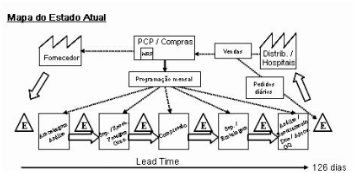
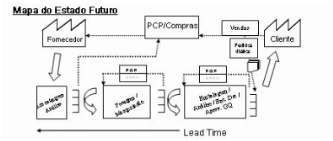
With this agreement and a favorable environment, we started the cycle of workshops in which the leadership group was trained in the concepts, always followed by actions in the field (gemba) to gather real data and gain a broader understanding of the processes, since we were actually in contact with the products, equipment and operators. Thus we took a very important step by drawing our Value Stream Map (VSM) of a product that ran through the entire production chain. This gave us the basis for developing our first Future State, and so the desire for change was born, along with the direction we intended to take, as shown schematically below:
Step by step we came to understand our processes better through genuine gemba visits in the areas, improving processes, solving dormant problems, listening and paying due attention to operators and earning people’s trust; we were surprised by the initial results, without, however, interfering with the integrity of Good Manufacturing Practices.
The training cycle advanced as our learning and understanding grew, and then topics such as Continuous Flow, Pull System, Production Leveling, Quick Setup, Standardized Work, Making Materials Flow, among others, were already seen as new challenges for practical application in the processes. Even so, I must admit that at times we doubted whether a particular lean concept and/or tool was suited to our operation, but we were willing to move forward toward our Future State.
This learning cycle, which began with Awareness and continued through the workshops, lasted approximately 6 months; during this period we were able to spread knowledge, prepare the ground and apply improvements and process transformations in practice, which allowed us to prepare the operation to move toward the Future State.
Learning to see is one of the hardest challenges of lean transformation. We usually think we have no waste, that we know our operation better than anyone or that we have already squeezed the most out of our processes. The mass production system – push – leads us to the worst of all wastes, which is overproduction. A defect or error is easily perceived as waste, but only after we went to the gemba did we learn to pay attention to less visible wastes such as unnecessary motion, excess transportation of materials, long waiting times, intermediate inventories, etc.
With a deeper understanding of the processes and greater knowledge of lean techniques and tools, a critical moment came when we decided to move to a “pull system.” We had the confidence needed to flip the switch, that is, to stop producing for inventory and start producing only what the customer would demand from us. I confess that even for me (one of the main advocates of the lean philosophy) it was a difficult moment and one of great apprehension for people, because we stopped our production and waited for the calculated inventory level to call for the manufacture of that item. For a period of one month, and especially in the first two weeks, we had many people on banked hours and in training activities, among others, waiting for the system to ask the plant to manufacture products. I understand that during this period we caused discomfort, anxiety and fear in the people involved, but we had the trust we needed from them to proceed, and that is why I believe that at this specific moment we achieved awareness of the lean journey at every level of the division.
Although the entire leadership was engaged and all areas involved, the most striking conceptual transformation took place in the Production Planning and Control (PPC) area, because the whole way this area was managed changed, from the management of inventory levels, to the planning logic shifting from monthly scheduling to daily planning based on kanban, the elimination of intermediate inventories and the creation of strategic supermarkets (replenishment points), and the change in the information flow, with only one point of contact between PPC and the operation, making the pull system work as autonomously as possible. On the other hand, we had several achievements already implemented in setup reduction, standardized work, visual management, production supply routes and continuous flow, which supported the migration from the Push System to the Pull System. We started with one product family and intended to test the system for a period of 3 to 6 months. The success and confidence achieved allowed us to switch our entire production to the Pull System in 2 months.
I later realized that this near-crisis was the engine that drove us to change and to break paradigms, which made a big difference in the company’s processes, people and results. We achieved significant reductions in inventory levels, improvements in customer service levels with fewer stock outs, less interference from production planning in the plant and in the Quality Control laboratory, improved process stability with less noise and, consequently, a better quality of life for employees.
Because of the nature of our segment, we had very robust methods for evaluating problems in search of the root cause, but I admit it was not natural to expose them. An effort to encourage raising problems in a structured way, to give operators a voice and to create a help chain for problem solving was decisive in fostering encouragement, and many hidden and even chronic problems were fixed. Good visual management accompanied this process of effective communication.
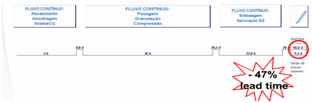
By the end of the first year of our lean journey, we had already achieved significant results, such as those shown below:
- Lead time reduction for the 1st product mapped:
-
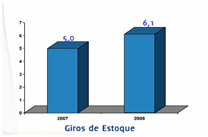
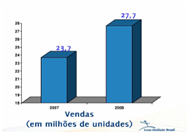
A 14% reduction in inventory volume, with a consequent increase in inventory turns from 5 to 6.1 times/year, even with a 16.9% increase in sales volume:
- Average lead time reduced by 23%
- Sampling booth (bottleneck) - Cleaning time reduced by 45%, with gains in physical space and a drastic reduction of the backlog, leveling and implementation of FIFO (prioritizing was no longer the rule),
-
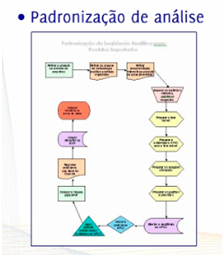
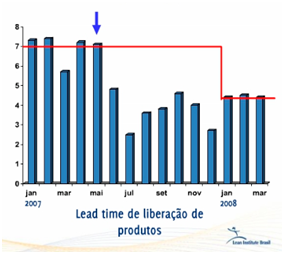
Quality Control Laboratory – FIFO in analyses (prioritizing became the exception), standardization of analytical methods, reduction in product release lead time:
- Other gains, such as: reduced operator movement, gains in physical space, improved safety conditions, significant reductions in setup and cleaning times, etc.
We were aware that this was only the beginning of a long journey; nevertheless, we knew that in a short time we had made a real transformation for the better in the way the plant operated. It was rewarding, at the end of the first year, to take stock of the “before” and “after” of the lean journey and assess the success factors and lessons learned, as shown below:
|
Before |
After |
|
Several intermediate inventories |
Creation of supermarkets (replenishment points |
|
PPC intervening at several points of the operation |
A single information point so that the operation could flow autonomously. |
|
Materials received on specific days (low frequency) Batch work |
Increased receiving frequency (smaller volumes / greater safety) Receiving in continuous flow (immediate labeling and put-away) |
|
PPC set the priority for laboratory analyses |
Laboratory working with FIFO in analyses |
|
Laboratory analyses performed according to the experience of each analyst |
Standardization of analyses implemented by the analysts, based on best practices |
|
Materials taken to the packaging line in batches (operator travel, lack of physical space, long transport of some materials) |
Supply route for materials and documentation implemented (time devoted to what adds value, gain in physical space, proximity to the point of use) |
|
Lack of standardized work in setup and cleaning |
External setup implemented, standardization of the best method and sequence, setup and cleaning time reduced by 18 to 37% |
|
Low flexibility and lack of rhythm in packaging |
Rhythm tracked through visual management (time ruler and andons), awareness of hourly targets |
|
Long times to finalize and reconcile documentation |
Clear definition of Production vs. Quality Assurance responsibilities, with a 50% reduction in time. |
Some success factors:
- Broad dissemination of the “lean journey” theme,
- Active participation of top management (senior leadership),
- The entire division leadership involved,
- Starting with a high-impact “pilot,”
- Quick results,
- Smart visual management,
- Change in mindset – “this is anti-lean,”
- Encouraging recognition of lean ideas.
Some lessons learned:
- Break paradigms, ask questions,
- Do not use regulations as an excuse for not challenging processes,
- Lean can and should be adapted to each reality,
- Perhaps we don’t know our processes that well – go to the gemba,
- Lean is meant to be simple,
- The work created complicity between the parties, fostering systemic growth,
- Lean requires maintenance, commitment and continuous effort,
- Convert into the final product close to consumption (“more flour and less cake”).
The organization as a whole began to notice that something was different in the Operations division and then started its own lean journey in administrative processes, called lean office, a recognition, even if informal, that we had “infected” the entire organization through the results achieved.
As we know, this journey has no end and is arduous, because once the desired future state has been reached and stabilized, it is time to move forward in search of a new improvement, a new future state. In addition, it is worth remembering that there are countless reasons that make us regress, stall or even abandon the lean journey, because we have the ability to complicate what is simple. It is not easy to do what is simple. Failing to follow up on standardized work, loss of human knowledge, lack of prepared succession, distance from the processes (lack of gemba) and the absence of a systematic way to surface and solve problems are among the main causes.
As we have seen, transforming companies is a slow but continuous process, and like every process of cultural change, you need to take one step at a time and be willing to break paradigms. The results are surprising and rewarding.
Mario Alberto Ferrari is an instructor at Lean Institute Brasil. He worked at AstraZeneca