

Lean Accounting - Accounting for the Lean Enterprise
For a company, lean production represents the best of all worlds, that is, significant reductions in: the rate of customer service calls, the cost of quality, the amount of overtime, order processing time within the company, the customer delivery rate, inventories, occupied space, etc.
However, when a company is in transition from the old way of producing (mass production) to the new way (lean production), the financial reports of traditional cost accounting show that profitability has fallen, and because of these results many companies cancel the transition and go back to the traditional form of production/operation.
The problem, however, is caused by traditional accounting, which was designed for the mass production that has existed for about a hundred years and is therefore not suited to the new times of lean production. In short, the following happens:
1. Lean companies keep little or almost no inventory; companies in transition to lean thinking will obviously start consuming those inventories and will reduce them. So reducing inventory, which is very favorable, will on the contrary reduce the value of the company, and profitability falls in the financial statements of traditional cost accounting.
2. This does not happen only in companies in transition to lean thinking; customers also reduce their inventories, because they come to trust that, with the shorter delivery times of their suppliers that use lean production, in addition to higher quality, they too can reduce their inventories. So customers adjust their orders and instead of, for example, placing them five weeks in advance, they place them one week in advance. Thus, sales are postponed in the short term.
3. Being lean makes the company more productive. However, in the short term it is difficult for the company to benefit from these improvements in its profitability. That is because the idle workforce cannot be laid off, since the cooperation of workers and managers is needed for the rest of the implementation.
4. Nor can the extra capacity made available as a result of the productivity improvement be used in the short term, because the company, still in transition, takes time to introduce new products into manufacturing and to optimize the system along the lean product lines.
Thus, a new way of reporting financial results in lean companies was created, a subject addressed by lean accounting. The current traditional profit and loss statement is difficult for non-accountants in companies to understand. It is replaced by a simple statement that can be calculated over short periods, such as weekly, and that everyone in the company can understand. In addition, this simple statement shows the gains obtained by lean production, avoiding the problems already described here. Among others, the Box Score is a chart that gives the value stream manager, as well as his work group, a summary view of the value stream's performance; it consists of three parts: the upper part is made up of performance indicators; the central part shows capacity resource indicators; and the lower section presents the financial indicators. The Box Score is reported weekly and presents the previous weeks as well as the planned target for the future, agreed with the work group, aiming at the improvements expected from lean production.
In addition to the simple financial reports created by lean accounting, it is also worth highlighting a new way of costing products, represented by value stream costing.
As is well known, one of the perennial problems of traditional accounting is its inability to determine product/service costs accurately because of the arbitrary allocation of indirect costs. Lean accounting puts an end to this problem, which has persisted for about a hundred years, with the introduction of value stream costing.
Determining product cost becomes less important than it is in traditional accounting. Not least because, owing to the allocations already mentioned, these figures are questionable. Even activity-based costing, because of its complexity, has been restricted to few companies, which led Thomas Johnson, in the article Lean Dilemma (2006), to say “...ABC costing seemed like a good idea at the time, but in retrospect it was a good answer to the wrong question. Today, we see better....The point is that ABC proponents should have sought to ask how to organize work to eliminate the causes of overhead cost activity, not how to find ways to distribute overhead costs to products...”. In this sense, the author meant that ABC costing was no more than an advance on traditional accounting, since it continued to distribute (allocate) indirect costs; instead, he proposes attacking the causes of the problems, which would be the lean organization as Toyota does it. In this form of organization, lean, this would be avoided, because value stream costing acts on the cause that generates the current problems in determining costs – it avoids allocating indirect costs. In value stream costing there is no need for this allocation, or rather, when there is, it is absolutely minimal. In this form of costing, direct and indirect costs within their value stream behave as if they were all direct. Value stream costing would be a good answer to the right question, to paraphrase Johnson.
Since the company's inventory is low and under control, the value stream's material costs correspond to the materials purchased for the value stream. All purchases are charged directly to the value stream cost center. The same is done for supplies, tools, and other costs. They are simply applied to the value stream cost center or are derived from the accounts payable process. Another aspect that shows the simplicity of the system is that there are few cost centers. Instead of having a large number of departments, the organization configured in value streams has few cost centers per value stream. The information placed in the simple value stream income statement is real, reflecting what is happening in that week or month. Revenue is represented by the actual amount of invoices processed for products manufactured in the specific value stream. Eliminating indirect cost allocations (the great villain of cost accuracy) makes cost and profit information current and understood by everyone who works in the value stream, even non-accountants.
There are some people in the organization or in the plant who do not work in the value streams. They are people whose tasks are not directly related to the value stream, such as financial accounting, for example, or whose work cuts across all value streams, such as quality support staff for ISO 9000 or ISO14000. The costs and expenses associated with these groups of tasks that are not directly in the value stream are not allocated to the value streams. They are treated as business-sustaining costs; that is, they are budgeted and controlled, but not allocated. The only allocation really admitted is for facilities support, and the driver used is square meters, which also encourages each value stream to try to use the smallest possible space. There is, therefore, no place for full absorption costing. So the costs that are not reported in the value streams are reported separately in the P&L statements as sustaining costs or under some other name.
Most of the decisions for which it is necessary to know product prices (the make-or-buy decision, for example) are made in the value stream without taking product cost into account.
Pricing decisions in lean organizations have never been made by requiring product cost. The lean organization focuses on the value created for the customer or for the market. It is the value to the customer that determines the price. Customer value has no cause-and-effect relationship with product cost. Considering that prices are determined by the market, one only has to ask another question in response to this issue: Are we making a profit on this product if it is sold at this price? It is pointless, therefore, to determine profitability by taking only the product as a reference. The correct approach is to look at the potential of the order and work out its effect on the profitability of the value stream as a whole. See the example shown in the following table:
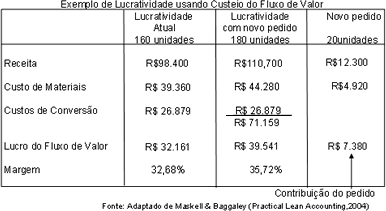
As can be seen, standard costs do not necessarily influence the performance of the value stream or the cell, or even of the plant as a whole. The example in the table shows the decision to accept a new order of 20 units where the conversion cost remains the same, since the value stream supposedly has the capacity for it. The analysis did not depend on product cost, and the table shows that profitability is higher with the new order.
The make-or-buy decision also comes down to the profitability of the value stream as a whole. Using traditional costing to make the decision to buy or make an item can be dangerous, because that cost will probably lead to a wrong decision. If the value stream has additional capacity to make the item, then there is no financial reason to have it made outside by an external supplier. The cost of making it internally is virtually nothing because the costs of the machines, the people, and the facilities have already been paid. Alternatively, if there is no capacity within the value stream, then the cost of making the product internally will be the cost of obtaining the additional resources to make the product. These resources may simply be the cost of additional overtime, or they may even represent a capital investment to increase production capacity.
The same reasoning applies when one wants to analyze the profitability of products or customers. It is not necessary to look at the individual cost of a product. What is needed is to look at the effect of the change on the profitability of the value stream. If a given product family is removed from the value stream, what does that change do to the total profitability of that stream? Similarly, the effect of removing a given customer is assessed at the value stream level, not at the level of the individual product or customer.
The introduction of new products requires a similar analysis. If there is available capacity within the value stream, then introducing a new product will increase the profitability of the value stream by that product's contribution. The contribution is the revenue minus the direct costs external to the value stream. The direct materials external to the value stream are precisely the required materials and components, but they may sometimes include other external processing costs, or other services required outside the company. Labor and machine costs are not included in the contribution. If the value stream does not have enough available capacity to make the additional products, then the profitability of the value stream is calculated taking into account the people and machines needed to meet the additional capacity required.
Standard costs are not necessary to value inventories. When lean is introduced, inventory levels fall substantially. If inventory levels are low, then valuation is much less important than when they are high. For example, if inventory amounts to three months of customer demand, then it is important to value that inventory in detail, using the standard costs of traditional accounting. If inventory is less than five days of sales, that level of detail is no longer necessary. And in this case of low inventory under control, several methods exist to calculate it. Thus, forms of valuation can be used such as, for example, counting it, calculating the number of days of sales that this inventory represents, and multiplying that number by the daily cost of the value stream. In this case counting inventory is quick and easy, because inventory is low and, equally important, visually managed.
James Huntzinger (Lean Cost Management: Accounting for Lean by Establishing Flow, 2007) also comments on the truth regarding generally accepted accounting principles, since many financial executives and leaders are reluctant to change the traditional practices of cost management accounting. According to him, there is a lack of understanding of what is necessary and of what the system is capable of doing. Generally accepted accounting principles are a very important part of accounting, and critical for maintaining basic standards so as to give people and institutions valuable information with the necessary credibility for decision-making in the market. He also says that the truth regarding generally accepted accounting principles is that they have nothing to do with the company's cost management accounting system. That system is for internal decision-making, while accounting principles cover the methods and external or financial decision-making. Huntzinger also quotes Orest Fiume and Jean Cunningham (Real Numbers: Management Accounting in a lean Organization, 2003), who make explicit the reality between lean accounting and generally accepted accounting principles when they say: “Nothing in lean management accounting violates generally accepted accounting principles”.
In the few cases in which it becomes necessary to know product prices (transfer prices, product exports), and if the products are homogeneous, one simply uses the average cost of the products within their value stream. And if the products within the stream happen to be heterogeneous, a criterion is used that takes into account the features and characteristics of those products. James Huntzinger's observation is worth noting here; he makes an interesting analysis of precision versus accuracy. According to him, traditional cost accounting produces cost information that is grossly distorted. He says the system is capable of reporting to five decimal places, which is totally misleading. He quotes Orest Fiume, who says emphatically: “Most companies still believe they know the costs of their products – even to four decimal places – which is a classic confusion between precision and accuracy”. Thus, Orest Fiume and Jean Cunningham define these terms: “Precision is knowing the answer to the third decimal place. Accuracy is the correct answer for the decision you are trying to make”.
Lean accounting provides the correct (accurate) cost of the value stream's product family.
* Doctor in Production Engineering; retired Associate Professor at UFRJ;







