

HOSHIN: the link between point improvements and the lean transformation
The lean journey of Wabtec, formerly GE Transportation, goes back a long way. Many improvement efforts have always been part of the organization's culture. However, a new demand peak in 2011 presented the organization with a new opportunity that could not be handled merely by applying concepts on a one-off basis and in a few areas of the company.
Then a big “aha” moment arose, bringing to light that a global transformation would have to be carried out to sustain the improvements and to increase the capacity to serve customers with quality. The link between the one-off initiatives and a complete transformation of the organization, with sustained improvements and people development, was hoshin kanri. Here we will tell how it all happened, what the results and learnings were, and where we stand now after a few years.
Taking a step back: before building one idea, you have to deconstruct another
Since 2008-2009, GE Transportation had built a culture of working in silos. That culture led people to develop resistance to change and new initiatives.
Given this scenario, the company observed that the approach it had been taking at the time was not conducive to collaboration. That is why the organization's leadership understood that a transformation in the way people thought had to take place.
This transformation had to be very carefully thought out so as not to frustrate employees; on the contrary, it had to bring a sense of security, an understanding that problems are important as opportunities for improvement and that processes would need to be better structured to support and improve everyone's work, connecting departments and working more together, as a team.
The learning they wanted to build in everyone's mind was that lean is about improving, bringing more revenue to the company, more service, more diversity to the organization's portfolio, and also about developing people, and that is not possible if we are working in silos. What makes the difference when looking at these two ways of thinking is the destructive (anti-lean) or constructive (truly lean) approach that will be used in the process.
The first truly lean initiatives
Wabtec's unit in Brazil (at the time, GE Transportation) initially only refurbished locomotives. With the decision to also start manufacturing locomotives, the company's demand began to grow, until in 2011 there was a very large peak that forced the company to do something in order to meet it and survive in the market.
Starting the transformation on a one-off basis in the manufacturing area, they chose a workstation and decided to apply everything they knew about lean there. Mistakes happened, adjustments were made, and much was learned in this process until an operating model that made sense and delivered better results was defined. Everything that was happening was new; therefore, the focus, besides being operational, was also on developing people.
With this definition in place in the workstation pilot, a roadmap was created to guide and replicate the improvements to the other workstations. This initial approach on the factory floor was strategic in showing people that results were emerging and that this was having a positive effect on the company and on employees. In this way, much of the entrenched resistance was broken.
Hoshin Kanri: connecting areas and people and consolidating the changes
The leadership and the improvement team realized that these initial changes were only the tip of the iceberg and that there was an enormous range of opportunities in the operations areas and, later, in services. The need at that point, then, was to have a more robust strategy, connecting and engaging the other areas of the organization and spreading lean culture and fundamentals to everyone. And this is where Lean Institute Brasil came into this story, supporting the implementation of lean in the company, which began to take deeper root in its culture, ceasing to be just small one-off improvement projects with isolated use of tools.
The true north set was to be a world-class operation, being the first choice for customers and employees, with strong collaboration with suppliers and the community. As a kickoff, two days of training were held: one day on hoshin, half a day on A3 and half a day on leadership. At that point, all the staff of the supply chain directorate, the corporate area and all the owners of the area A3s began to align better regarding the organization's processes.
This training deepened employees' knowledge of lean tools, philosophy and culture. With the help of hoshin and the active support of leadership, a truly lean environment began to spread to every corner.
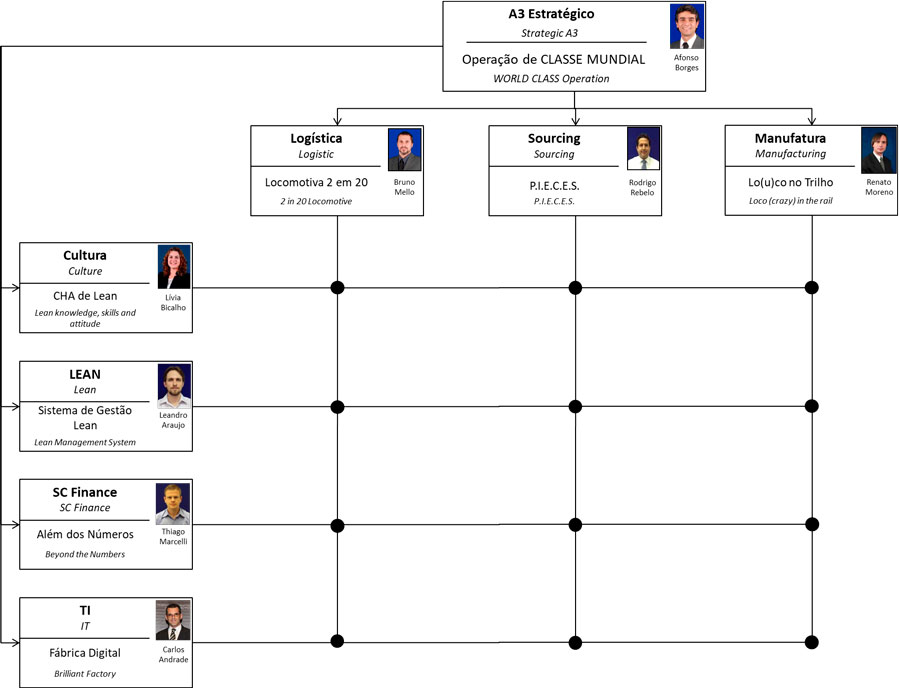
From then on, the company needed to translate its true north into a strategic parent A3, developed by the supply chain directorate. Building this parent A3 was a vital step in the process and had the collaboration of all the managers who reported to that directorate. In a short time, the A3 became the guide for aligning and deploying the strategy in the area.
Since the company's true north, of being a world-class operation, required eliminating waste and adding more value from the customer's perspective, lean tools and attitudes then began to be connected to the strategies developed.
This is how the building of the child A3s began, seeking to align and deploy the strategy to the manufacturing, logistics, purchasing, finance and HR areas (after holding a catchball event – vertical and horizontal deployment of the process –, the IT area was also incorporated into the project).
In addition to this alignment of strategies across areas, all of them incorporated into the countermeasures and action plans of their respective child A3s the application of lean tools (VSM, A3, SW, 5S, etc.) as a way of consolidating the concepts that until then had been applied only in manufacturing.
Avoiding a fatal course for lean
Soon, new projects began to be requested (for example, a logistics project aimed at optimizing the process of moving and storing materials). It was at that moment that the team leading the transformation realized that special attention had to be paid to middle management, so that the entire lean transformation would not be lost and everything would not go down the drain.
From observations of many experiences implementing lean in companies, lean often ends up dying in middle management. Historically, this happens both in small companies (at the supervisory level, for example) and in large companies (at the management level, for example). The goal was not to let this happen at Wabtec.
With this in mind, the lean transformation team created a program called “Lean Locomotive Engineer” (approximately 40 hours long), which aimed to bring knowledge of lean culture and tools to the operational levels of all the areas involved. To complete the program, each participant had to complete some assignments throughout the course and develop and present an A3 with the support and mentoring of their immediate leader, applying the concepts and tools learned as much as possible.
As a result of operations employees turning to their respective managers, those leaders who had not yet sought out the knowledge or who thought they already knew everything about lean began to feel “uncomfortable” and realized that organizational change was indeed happening and that they too needed to mobilize in order to keep up with and support their teams and the whole transformation.
This action prevented the course taken by many organizations of “dying in middle management” from happening. In addition to training operations in lean tools and concepts, the “Lean Locomotive Engineer” program was also aimed at building capability and creating a “mobilization” in middle management in favor of improvements and the change of mindset.
First version of the post-catchball deployment matrix
Sustainable results call for everyone's involvement
Hoshin achieved something at Wabtec that many companies struggle to accomplish: connecting the different areas of the organization around common objectives and working together as a single team. This connection yielded visibly better results in some key indicators for business success:
- 43% reduction in WIP;
- Reduction of 1256m² in the area needed for locomotive assembly – creating the opportunity to insource cab manufacturing;
- Reduction in manufacturing Cycle Time and Lead Time;
- Increase in inventory turnover;
- Reduction in workplace accidents.
This example can be yours too!
Even with promising initial results on a lean journey, the hardest battle is often making sure the efforts are not limited to isolated projects, but take root across the entire organization as part of the culture. What Wabtec shows us is how a lean tool can be crucial in this difficult undertaking: hoshin kanri.
Hoshin Kanri is about involving people, connecting teams, deploying strategy and structuring long-term growth, with a clear path to be followed by all areas of the company.
The achievements made possible by hoshin go far beyond what applying any tool in isolation could offer, because it changes the culture in a lasting way and makes everyone involved begin to see the aspects of the transformation through different eyes: through leaner eyes. This can be your journey too. Open your eyes to hoshin. Open your eyes to lean.
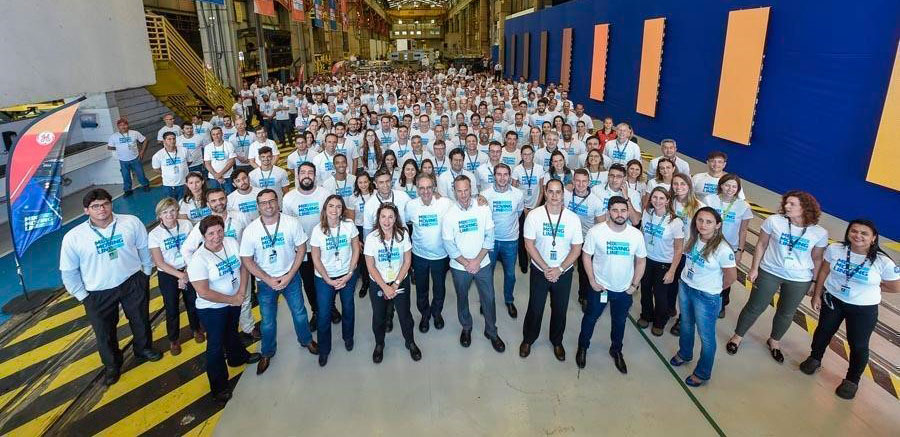
“Hoshin Kanri was the ‘Game Changer’ for our operation. With a focus on the right objectives and a genuine desire for continuous improvement, with hoshin we were able to define the long-term strategic direction and create a management standard that ensured our performance today is better than yesterday's, forever!”
Afonso Borges - Operations Director







