

Let’s celebrate work
We need to think about redefining work. Until we can – any of us who wants to bring about organizational change – redefine the actual value-creating work of our business, we won't make any meaningful change. You can create wealth through a variety of business models or ways of thinking, but if you want to create real value and jobs that value people, you must think hard about how your people are working every day. That's because the essence of lean thinking is about work. Lean thinking and practice mean “working on the work”: the value-creating work that takes place on the front line of your company.
If you want me, your employee, to put my whole heart and soul into the work, think about whether that work is menial or meaningful. Why would I do that if the relationship we have is a mere monetary transaction? There's nothing morally wrong with a purely transactional relationship if that is our mutual agreement, but if you want me and every person in your organization to fully commit, we need to be purposefully aligned on why we are here, on what we are trying to accomplish. Then I can focus – applying all of my humanity – on the work in front of me, on the work I have at hand.
I'm outraged by the comments I hear so often these days: “We know how to do the work. We just need to change our culture.” Or “We know the lean tools. We want the lean culture.” Or any assumption that people can engage in continuous improvement as a training exercise. This way of thinking is often associated with vague claims that “We engage our people. People are the most important part of the process. We just give them space, but they take responsibility for their own work.”
Really? Was it your people who decided the coffee shop would sit above the subway station and would need to open every day at 5 a.m.? Did they decide to be the only trauma center within 200 miles? Did they choose to build the new building on a swamp? Did they determine that their wage is $20 an hour?
Every person comes to work every day and does their job. In an office, on an assembly line. In administration, at the front desk. On a construction site, on a farm. Performing heart surgery, making coffee. Lean thinking asks: What is the work? And what is the care and feeding of that work? Who cares for it and feeds off it? How much? So let's not kid ourselves and talk about “meaningful work.” About how “our people are our most valuable resource.” About “respect for people.” We cannot have that conversation without a deep respect for people and for the work itself.
Is your work menial or meaningful? How about both? It's normal for meaningful work to feel menial. Most workdays consist of exactly that, no matter how glamorous it may look from the outside. Talk to a surgeon at the end of a long day in the operating room. Is it good work?
Unfortunately, many supposed champions of meaningful work are the quickest to demean work, such as assembly-line work. Notice the underlying assumption of the common remark: “That job is like working on an assembly line.”
That job is like working on an assembly line
If the assembly line is degrading, let's get rid of it. Then you, Mr. Consumer, can pay the price and the penalty of the poor quality that will come from people trying to build by hand – which is mostly, you know, a process full of rework for the sake of craftsmanship: “Let me shave a little more off here… oh, that was too much; now I'll have to shave a little more off here.”
I'm not saying craftsmanship isn't real. I'm saying that if it is real and good, then let's raise all work to that level and give it the respect it deserves.
Making things is, in its essential nature, something meaningful. It's one of the most meaningful ways we humans can choose to fill our time. Work in a factory – whether a workshop or an assembly line, carving frames or making steering brackets – is a way we organize ourselves to make things. It is extremely rewarding and meaningful work. Or at least it can be, if we want it to be.
So let's do it. Let's elevate work. Celebrate it. And, in doing so, let's treat it (the work) with the deep respect it deserves. That applies to the “humble” receptionist or the most respected surgeon. Or to a street sweeper.
Lean thinking is, more than anything else, rethinking, reimagining what work can be. To do that, we have to start with its purpose. We ask: “Why are we doing this? What problem are we trying to solve?” You, as owner or CEO, have a problem you are trying to solve, which brought you to this position of gathering dozens or thousands of people every day to do this work, to create this value together.
Lean thinking is rethinking, reimagining what work can be
Recently I had the disheartening experience of walking the gemba with a young entrepreneur, a lean startup enthusiast, who explained to me how perfect the design of his system was. His only problem was that he couldn't get good workers to operate it properly. I couldn't believe what I was hearing. When I pressed him, he insisted: “We just can't get good workers around here.”
It was a picking operation. Many items were out of place because the pickers sometimes mistakenly grabbed the wrong part and put it back in the wrong location.
We walked and talked, and I left his gemba with a deep sense of personal failure for not being able to find the words to show him an alternative way of thinking about his situation. He really thought he had the perfect business system, one he was sure would soon (probably) bring great wealth (despite, by the way, the terrible customer service); his problem was bad workers.
Contrast that with this. Build your business from the work. Define the work based on the value you will provide to the customer, on the work to be done to solve the customer's problem. Build the work (the business) from there so that whoever is doing the work (I'm intentionally avoiding here the word that bothers so many: “the worker”) can do it perfectly every time. When a customer orders their favorite drink, the barista knows how to do the work to provide it. And when the inevitable problem arises – “we have more customers than we've ever had at this time of day!” –, he knows what to do and how to do it:
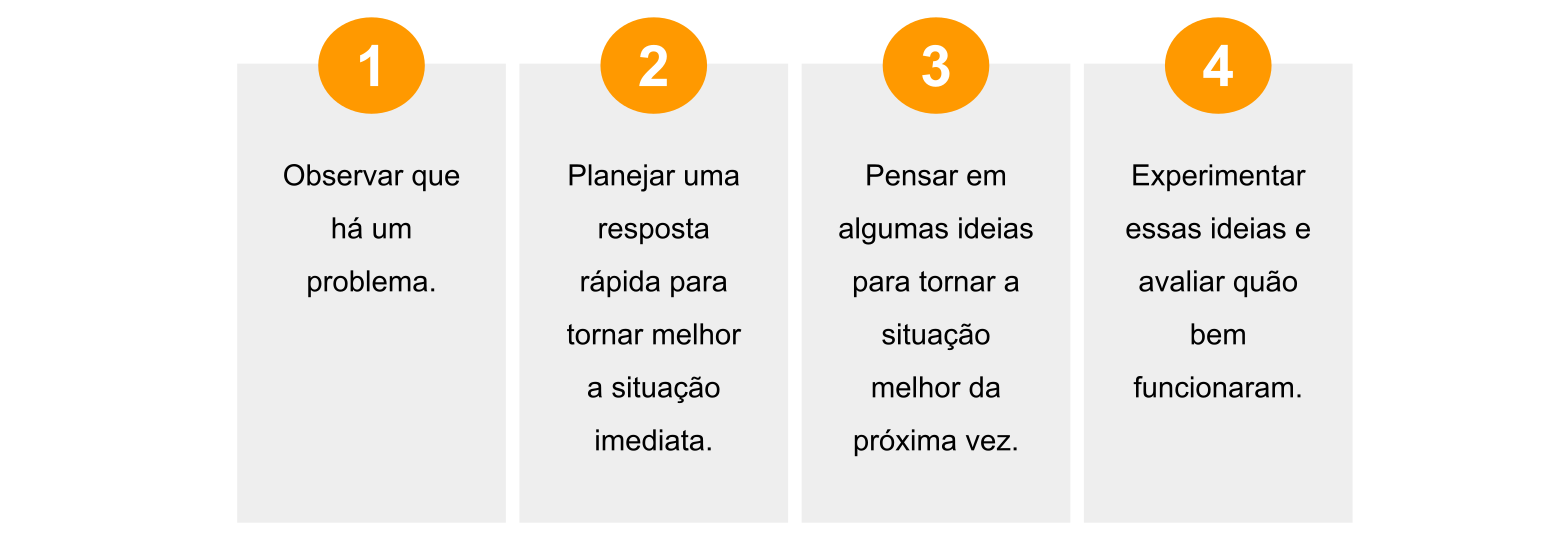
And here is the real payoff: he knows that although this specific problem may not occur again, another problem, a different problem, will surely occur – probably very soon – and he can say: “It's all right, I'll deal with each situation as it arises, as a new challenge to keep making things better and better.”
And here is an even bigger kicker: instead of waiting for the next problem, he will create it! By learning to see “problems” merely as “gaps” between the way things are now and how they should or could be, we can begin to see every situation as a problem waiting to be solved. For example, when the barista adjusts the size of the batches of ground coffee, or eliminates batches by opting for a brew-by-the-cup method, or challenges the team to respond more quickly when lines start to form during the peak hours of the day. Problems no longer reside in the realm of things that happen to us; they are improvements in waiting, gaps we can close as an integral part of our regular work.
Coming back to the street sweeper, consider this passage from Martin Luther King:
If a man is called to be a street sweeper, he should sweep streets even as Michelangelo painted, or Beethoven composed music, or Shakespeare wrote poetry. He should sweep streets so well that all the hosts of heaven and earth will pause to say, “Here lived a great street sweeper who did his job well.”
So this ideal – “Let's make work meaningful” – is not new. What is new are the means of making work meaningful through lean thinking.







