

Achieve more effective results with the digital lean journey
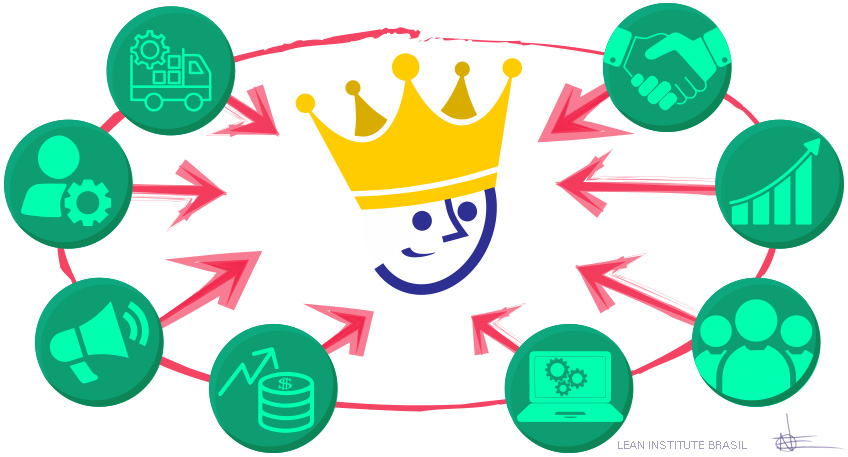
Companies in every sector are pursuing what has been called digital transformation. This is largely due to the increased availability and lower cost of a range of technologies with great potential to create stronger connections with customers and to offer new products, processes and businesses.
We have already pointed out, in a previous Lean Mail, that this digital transformation, to be effective, must be integrated into the lean journey, which constantly seeks ways to add ever more value for customers.
After a few years of companies' attempts in this direction, we can say that a considerable number are still in the learning phase. The results, whether for customers or for companies, are still, for the most part, below expectations and below the investments made, which in many cases are significant.
Some problems, which are becoming frequent and recurrent, can already be identified, enabling us to adopt strategies to avoid them and make this lean digital journey more agile and effective, both for those who have already started and for those who intend to start.
RECURRING PROBLEMS
Action restricted to technology
Although the corporate discourse claims that digital transformation covers the entire organization, what we see in practice is that the “IT department view” still persists. Countless companies already operate with teams formed to apply agile methods and frameworks, such as Kanban and Scrum, but the investments and the professionals involved remain concentrated in “silos” and in a few areas of the organizations. Digital is still seen as something “of the technology department”, disconnected from the business areas, which often continue to make demands on and interact with these “agile teams” in the traditional way.
A distorted view of the end customer
In this context, and even as a consequence of this silo view, teams working on digital regularly forget that they must always work with a focus on the end customer, the one who buys the company's products or services. A distortion occurs, leading to a greater concern with the “internal customer”, the one closest to their process in the value stream, and losing the complete, horizontal view of the journey and of the value that the entire stream must deliver to the external customer at the end.
Team turnover
Companies have already realized that digital teams need to work no longer on specific projects, which end after a certain time, but rather organized around lasting missions and purposes, with a long-term mindset and way of working, and deep knowledge of the needs of the customers they serve. This first part is well oriented; the problem is that these teams are made up of the company's existing professionals, who come from the old processes established previously. Fixed-term hiring and the use of contractors and freelancers make up a considerable share of projects with fixed deadlines and scopes. Turnover was not a concern, and it was common for all the professionals to be completely replaced in less than two years; however, the loss of knowledge and continuity in permanent teams has serious consequences for learning and for delivery capability.
Careers and incentives that reinforce silos
An effective digital transformation requires a view long emphasized in lean philosophy, which is that of the value stream. Teams (with some variations and different names, such as squads, communities, tribes, teams, cells, etc.) are generally created by bringing together professionals from different specialties who come from different parts of the value stream. The problem is that these professionals systematically continue to report to their specialty managers, and the typical evaluation, promotion and reward mechanisms continue to reinforce the old silos more than the common goals of the newly formed teams.
Absent leadership
In any lean environment, it is essential that people have more autonomy, proactivity and the ability to solve problems quickly, and leaders must be the supporters and developers of team members for this to happen. Leaders formed in vertical, departmentalized structures, used to being the center of every decision, are unsure how to interact in these new, much more horizontal environments. One reaction we have seen is avoiding exposure and friction with the team, leading to an absence of leadership. In the digital journey this distancing is harmful and can quickly lead to a breakdown in the leader's relationship with the team. The team will be going through a great intensity of change and evolution at this early stage, and if it is not properly guided and challenged it may develop in the wrong direction, generating meager results for the company and its customers.
Fear of exposing problems
Teams involved in digital transformation structures usually incorporate various routines, such as visual management, daily meetings, etc. These practices are essential for exposing problems so that they can be solved quickly. Unfortunately, many of these rituals become bureaucratic, with people generating indicators that do not show the real problems, because of the climate of fear that still exists. Leadership, generally absent, occasionally appears to interact with the team, and old, typical command-and-control and blame-seeking attitudes still persist. Unlike practices, behaviors take longer and more effort to change.
HOW TO AVOID THESE TRAPS
As you can see, there are still many setbacks hindering the real development of lean digital. How can we try to avoid these traps? Below we suggest some practices that can help make this evolution more real and effective.
A clear, customer-focused purpose
Some companies launch digital initiatives without clear objectives. Rather than generating supposed “learning from new technologies”, this can generate discredit and a lot of wasted resources, with no results. A good way to begin a true lean digital transformation is to understand it as part of the company's strategy, identifying very clearly what additional value for customers will be sought, whether in new products, forms of delivery, experience, businesses, etc.
Teams that understand the end-to-end stream
For an entire value stream to be redesigned or created, generating a new customer journey, teams must master all the specialties involved, not just technology. Business, marketing, sales, finance, etc., need to be part of the team, and everyone must be pulled by a deep knowledge of end customers' problems. Everyone's indicators must look at maximizing that customer's experience, and not at partial deliveries or sub-step indicators, which do not always reflect what happens at the end of the stream.
Matrix structure
While on the one hand it is essential to reinforce the horizontal, end-to-end view of the value stream, on the other hand the specific knowledge of the many specialties must continue to be developed and aligned across the different value streams. There are several ways to preserve this knowledge (e.g. communities of practice, in which people from different teams interact on specific subjects), and one of the most effective is matrix structures. Maintaining the functional area structure, concentrating the specialty's specific knowledge, facilitates the sharing, retention and development of new professionals focused on a given skill; the care lies in creating these structures to “serve” the value streams.
Lean agility practices
Digital transformation has a strong technology component. In this area, and particularly in software development environments, agile concepts and tools are often better known than the principles of lean philosophy. Agile methods and frameworks, such as Kanban and Scrum, openly draw on lean concepts, but of course they cover only part of the philosophy, and in formats originally conceived for the software development environment. The move to cover the business as a whole with digital transformation, and not merely technology, has shown everyone involved that it is essential to combine agile practices with lean concepts and tools. This is a movement, which we call lean agility, that has already begun and has brought important contributions.
Develop people for team stability
We have followed companies that, already in their first digital transformation experiments, realize the need for changes in their people management systems. Mechanisms that lead to internal competition, for example, make teams that must pursue common multidisciplinary goals unviable. Team stability must be a priority, with mechanisms that reduce turnover. Development needs expand, whether in technical skills, aiming at multifunctionality, in the new lean and agile practices, or in interpersonal skills, since collaboration, communication and teamwork skills are required to a much higher degree. Lean digital initiatives must be strongly accompanied by processes of transforming people.
Consolidate learning before scaling
Many companies, right after the first pilot teams, usually partial and limited to IT, want to scale quickly, that is, to spread it across the whole company. The risk is propagating a partial model that perpetuates many of the problems pointed out earlier. Of course speed is a goal, but the ability to sustain the transformation cannot be compromised. It is more important to deepen and stabilize the first initiatives in their various dimensions, such as horizontal integration of business and technology, people, leadership, etc., consolidating learning for a dissemination on more lasting and effective foundations.
Inspiring lean leadership
If all the people involved in the lean digital transformation need to be developed, leaders are the first who need to undergo a transformation, because they are the ones who inspire everyone's changes in the organization. Their roles become much more those of coaches and mentors, developing people, and of value stream managers, with a more horizontal than departmental view. It is a very big change, in roles and behaviors, that must be practiced explicitly from the first lean digital initiatives. Otherwise, instead of pulling the transformation, leadership may even get in the way, as it is quickly overtaken by the teams in terms of experience and understanding of the new ways of working.
A lean digital culture across the whole company
The whole company needs to “breathe” lean digital, not just this or that area or a separate group. It is necessary to instill in everyone pride in revealing and solving customers' problems, in an agile and effective way, with a structured method, and making the most intelligent use of all available technological resources. This is the true lean digital transformation, which must be pulled by the company's President or CEO, and not by a specific department.
If you are involved in digital initiatives at your company, we are sure you have already noticed some of the recurring problems we have mentioned. If you intend to start, you will most likely come across them quickly. We hope the ideas we have brought can help you avoid these traps, accelerating your lean digital journey and making it more effective and sustainable. Experiment, learn, correct, share.







