

Lean steps to improve the “customer experience” in services
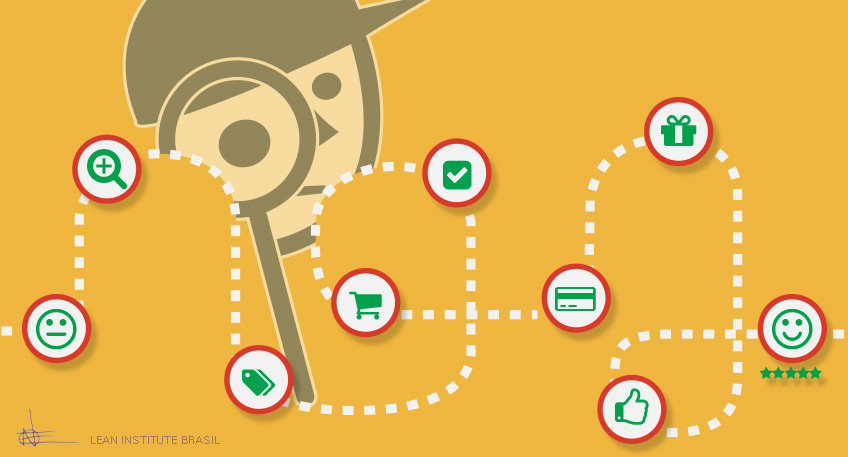
The services sector is one of the greatest economic forces in Brazil. According to Federal Government data, it is an area that today accounts for 70% of the country's GDP (Gross Domestic Product). It is therefore more than strategic to think increasingly about lean management specific to this sector, which is one of the largest generators of jobs and income.
Essentially, analyzing a services company from a lean perspective means thinking about the so-called “customer experience”, which, at the end of the day, is what determines whether customers are satisfied or frustrated with what they received.
So we can define a basic lean step-by-step that can make this experience meet and exceed all customer expectations.
Understanding the customer “journey”
The first step in implementing the lean system in a services company is to understand how the “customer journey” takes place. This means understanding, deeply and in detail, what happens from the moment the customer first contacts the company until the moment the service they want and purchase is actually delivered.
However, this journey needs to be understood in a specific way: with a “horizontal” view. That is because organizations, regardless of whether they are focused on products or services, still maintain so-called departmental “silos”. This happens with every type of organization, but it is especially noticeable in those more focused on services: retailers, hypermarkets, banks, insurers, telephone companies, etc.
This usually becomes a problem, because when customers request a service, they are not requesting something from a specific department of the company. They are requesting something from the organization as a whole. Therefore, they want their problem to be fully resolved in a coherent way, preferably through a single point of contact, rather than being subjected to a real ping-pong between areas of the company that do not talk to each other.
Mapping the journey
To improve this, it is necessary to see how the production of the value delivered to the customer takes place. For example, by using the concept and technique of Value Stream Mapping. It will make it possible to understand, in detail, how the customer journey is actually taking place.
With this, it will be possible to identify where the bottlenecks, barriers, rework and unnecessary activities are that represent costs and expenditure of time and space but do not add value for the customer. The services sector is permeated with this waste, which remains “hidden” amid the often painful and confusing journeys people are subjected to.
For this to start changing, it is necessary to bring together the employees who work along the entire customer journey so that they work together on this management change, and to make them understand that they must develop a view that goes from the beginning to the end of this journey.
In this context, it is necessary to break down the barriers that exist in companies so that people have this perspective. Companies need to become horizontal organizations, no longer vertical ones. Their people must “wear the journey's jersey”, and no longer “the department's jersey”, developing an “organizational community” mindset. That of a group of people who need to work together, although often physically separated, but who know they are parts of a whole whose mission is to deliver value to the customer.
It is a change of lens, of point of view. It matters little whether I am in sales, finance, operations... What matters is the customer journey and what everyone's roles are in making that journey as perfect as possible. In other words, I am there to solve the customer's problems, not my department's.
This obviously requires the engagement of leaders, who need to create the conditions to tear down the departmental culture, which is often quite resistant in some organizations. This often requires revising the forms of evaluation, seeking indicators much more focused on customer satisfaction at the end of the value chain and on collective work. Leadership behavior also needs to change, breaking down rigid hierarchy and promoting dialogue and everyone's participation in problem solving.
Lean first, digitize later
Digital resources, increasingly available, are profoundly changing the way companies interact with customers, which has an impact on all companies, and particularly on service companies, where this interaction is quite intense. However, it must be said that, unfortunately, many companies, in their eagerness to become “modern”, are massively, and sometimes even excessively, digitizing, robotizing and automating processes that should not even exist.
When we analyze the processes that have been mapped, we need to ask: does each activity make sense? Should it exist? If so, how can I improve it? If not, how will I promptly eliminate it?
What happens, however, is that many companies, seduced by the increasingly engaging digital world, are carrying out digital transformation without first questioning the customer journey. In other words, they run the risk of digitizing waste, keeping processes that do not add value and do not make any kind of relevant “delivery”.
So it is necessary to be critical of processes and “separate the wheat from the chaff”. With a clear purpose of adding greater quality, safety and reliability to the customer journey, and the appropriate analysis and optimization mechanisms, then digital transformation integrated with lean transformation will lead to a superior customer experience.
Kaizens, visual management and daily management
Once the processes have been mapped and redesigned, how can improvements be made constant? For example, through everyday kaizen actions, which can be done in groups, considering that several employees take part in the customer journey. Or even individually, with each person identifying, in their respective work, which processes add value and which are waste.
It is important to understand that services customers increasingly demand speed; they have no patience for failures. In this sense, two lean concepts can help improve the quality of the services provided on a daily basis: visual management and daily management.
Visual management, if well organized, will provide teams with a real-time view of how delivery processes are taking place, whether they are happening as planned... And if this is not happening, daily management routines need to act, mobilizing teams and leaders to identify which root causes are preventing continuous and agile flow. Organizations need to quickly find out where they are going wrong, learn even more quickly and carry out improvements daily. This is real agility in the lean universe.
One of the pillars of lean management is daily management, which is the pursuit of identifying and solving problems every day. It is the practice that will make continuous improvement a routine activity within the organization, in which all work will be analyzed every day to check whether it is within the expectations of the organization and, above all, of the customers.
Daily management closes an existing gap between strategy, deployment and execution. This practice speeds up deliveries while developing people.
When this happens, we will have a management system that flows through the organization, and no longer a departmentalized and rigid structure.
Empowering people
For all this to really happen, it is necessary to empower people at the base of the system so that they have the autonomy to solve problems every day at every level. Companies, when they become horizontal (and this is necessary especially in services), need to create an environment in which people can “experiment”.
Because lean is not just about implementing a set of preconceived concepts and practices. Lean is, essentially, getting people to identify problems and plan experiments to solve them, thus generating learning.
Empowering people also means challenging them with ambitious targets, which is a form of “respect” within lean leadership practices. The lean leader, when challenging, empowers. The leader also needs to support and develop the team. To ask more questions than provide answers. These practices, together, unleash creative thinking and innovation and boost the transformation needed for the services sector, which is extremely dynamic.
Spreading the lean culture
The next step is to spread these concepts throughout the organization every day, not letting them fall into oblivion and people return to the old processes. In other words, it means investing in spreading a lean culture within the company, so that it creates a management identity across the company as a whole.
The services sector is one of the most competitive in the market. That is because it is increasingly easy for customers to “switch” suppliers. In retail, whether at a coffee shop or a supermarket, if I am poorly served, I never go back. Financial services, insurance, health plans, telephony, etc. are increasingly moving toward portability, making it easier for dissatisfied customers to switch. So it is a sector in which customers make (and change) the purchasing decision very quickly.
So if you are not prepared to serve your customers perfectly from the first contact and deliver to them with excellence everything they want and look for, you will lose them. As simple as that. And you will certainly fall behind in this sector, where the focus on the customer, the starting point of any lean initiative, is much more intense than in others.
Do you want to raise the customer experience in your service delivery in a consistent and measurable way? Our Lean Office consulting works directly on the customer journey, optimizing processes, eliminating failures and creating flows that truly generate value. Talk to our specialists and transform the experience your brand delivers.







