Process improvement combined with people development brings millions in gains to CBA
Our lean journey has been under way for some time on several fronts, but in the first half of 2022 we brought together people from various administrative, engineering and production areas to take part in the Programa Prático de Formação Lean (PPFL). There were 80 hours of theoretical content and 40 hours of practical work for the more than 20 participants over the program's modules. It was one of the most important mobilizations we have seen in CBA's lean journey: in a quest to develop our people, we promoted an initiative with a number of different projects as a way of driving the transformation in our company.
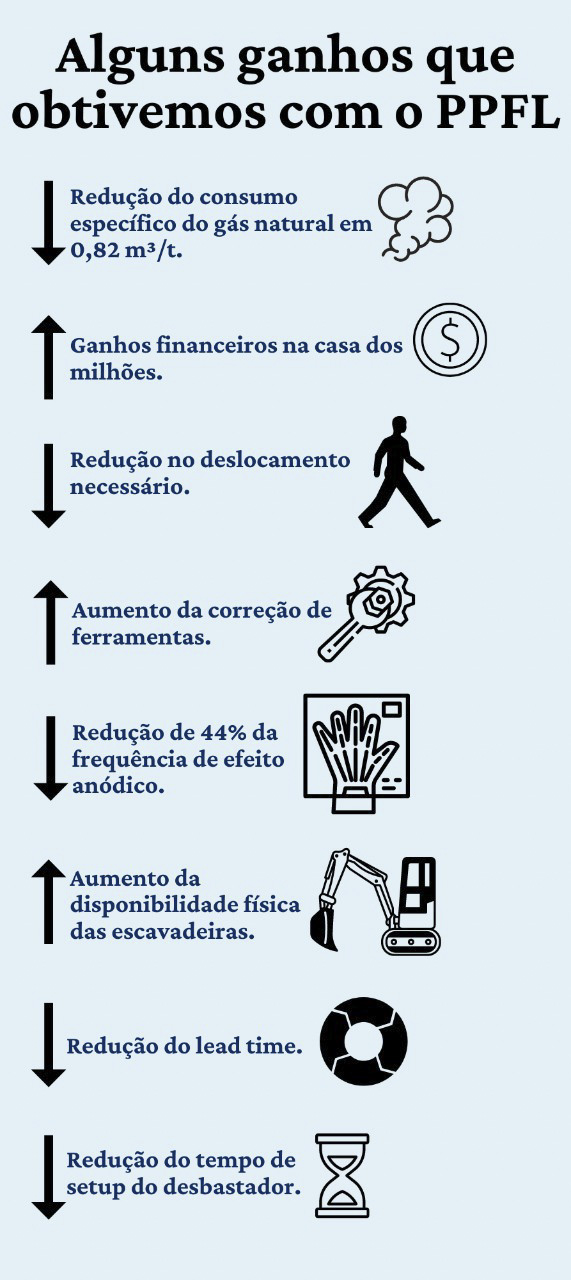
A few months after presenting the first results of these projects, we are now able to show significant gains, such as those reported in the infographic below.
After collecting these encouraging data, we went through an important period of hoshin to better understand, and share with the lean community, how we managed to achieve the significant gains we see in our operation. The first conclusion we quickly reached was that combining theory and practice in the pursuit of excellence allowed us to improve processes and develop people at the same time. We believe this alignment was fundamental to what we have achieved so far.
We consider our experience a success and, for that reason, we have gathered some lessons that we can share with the whole community and that we hope can serve as an excellent driver of the organizational transformation of each of you.
- To develop people and improve processes, go and learn
One of the main things we learned this year was to value immensely the moments of training and of sharing lessons learned. This is the first and perhaps most important message we want to leave.
At the start of the projects, we held online modules, partly because of the pandemic. As we became more confident about the health risks, we began to shift to some in-person meetings; we believe the online modules add a great deal and that this hybrid format is very interesting, but we do not underestimate the importance of being there, in person, sharing our ideas and lessons.
During these projects we had the opportunity to have many interactions that allowed us to perceive value more clearly at CBA. In addition, we also had the great opportunity to visit factories and go to gembas to learn to see waste, assess current situations and improve day-to-day points to ensure a smoother execution of activities.
We have always had a very strong focus on process improvement and eliminating waste, but what really made this initiative the best we have ever seen was aligning these guidelines with a very clear focus on training and developing people so that they can have the autonomy to continue the efforts even after the projects have ended. Learning from those with experience in the lean journey is very enriching, as we are able to anticipate and overcome obstacles that would have made us suffer a great deal without any help.
- The first results should serve as encouragement
When we presented the initial results of the projects, we could see that they had immediately provided us with increased physical availability of the excavators, optimized energy efficiency, increased manufacturing revenue, fewer operational and machine stoppages, and reduced setup time on the sheet lines, among other gains, such as those reported at the beginning of this article.
We should not approach the lean journey as just a one-off improvement project for the company, because it goes much further, ensuring a sustainable transformation of the business through cultural change and the development of people's capabilities. However, these initial gains give the people involved hope for a better future, that the results will keep coming.
If the alignment with the personal development of those involved has been done properly, people will already have the skills needed to carry the projects forward, and the initial results will give them the desire to continue. It is the perfect combination to feed a cycle of continuous improvement.
- Some tools are essential
It is easy to get lost among the dozens of tools we are introduced to on our lean transformation journey. Of course, all of them have their value and there are suitable moments to use each one. However, our experience showed us that three of them made a big difference in the projects:
- Daily Routine Management (GRD) had a great impact during the training module, since CBA had already been practicing this tool in our factory processes, but we found great opportunities to make it even better and more effective with this depth of theoretical concepts.
- Value Stream Mapping (VSM) allowed us to learn to see waste and opportunities by drawing the processes. In some processes, VSM was readily adopted, for example in the foundry and in GAF (Physical Asset Management), and it is gradually becoming common practice at CBA, in line with the need.
- A3 Thinking offered us a real way to solve problems. Today, in all projects, we apply A3 thinking to pursue continuous improvement through problem solving. It is a tool widely practiced in the 6 Sigma projects at our CBA.
The combination of these and other tools was fundamental to the results we achieved. That is why we suggest you do not forget them during your journeys; they were and continue to be the pillars of our CBA.
- Seek a cultural transformation across the whole organization
When we talk about the tools we learned during our journey, many are left with the impression of one-off applications in specific areas of improvement projects. Nothing could be further from the reality of lean. Take the GRD tool, for example: with it, we were able to see and better connect the execution of the strategy and also rapid action on the problems that occur on the line; so we focused heavily on applying problem-solving methods, on the help chain and on designing the GRD regions.
GRD quickly spread to various areas across the projects and brought some interesting results we had not even expected: by using this tool, we were able to reduce operational stoppages in the company's legal process. In this process, we are on track to reach and perhaps even exceed the expected objectives: the goal is an average reduction from 148 to 99 stoppages by December of this year, a 33% reduction.
Want another example? All the projects, without exception, used the A3 methodology to pursue continuous improvement through problem solving. These are not one-off improvements in specific areas. Lean promotes a cultural transformation that will necessarily involve the whole company.
***
The fact that we began with the theoretical part, but had the opportunity to put what we were learning into practice with a real problem the company has, was something that truly made us learn and change our mindset, our way of thinking about the organization.
Our journey involves, at the same time, theoretical learning, the development of people and also the improvement of processes. We always pursue perfection, so in each of the projects CBA developed during this period, we continuously sought to challenge our limits and always to ask what problem we need to solve right now. This helps a lot.
We hope this short article has managed to give you an idea of why process improvement needs to be aligned with people development. For us, the results and indicators speak for themselves and make a far stronger argument than any reasoning I could put forward here. Discovering the importance of this alignment was a very important step in our never-ending lean journey.