What's new in Lead with Respect?
Well, the “respect” dimension of lean can hardly be called new. The first article published in English on the Toyota Production System, dating from 1977, describes this dimension as having two important characteristics:
- Just-in-time production: only the necessary products, at the necessary time, in the necessary quantity are produced, with inventory kept to a minimum.
- Respect-for-human system: employees can show their full capabilities through active participation in running and improving their own work.
Even so, the meaning of the term “lean” evolves continuously (and, we hope, improves continuously); in the past, just-in-time really was placed ahead of everything, but we have collectively and progressively come to realize the importance of respect for people in lean thinking. Although lean was initially essentially about kaizen workshops to improve flow, ten years ago we saw that, to move from one-step improvement to continuous improvement, ongoing training in problem solving was also a central element of lean thinking. Even so, until now, we had not looked at lean starting from “respect” and figuring out what the rest of lean thinking looked like from that point of view.
When Freddy and I started having this discussion, about five years ago, shortly after the publication of “The Lean Manager,” we kept coming back to the basic fact that, although Freddy had worked hard to develop all of his direct reports in lean thinking, few “got it” and many did not. Later, after Freddy retired, we designed lean programs to help other companies based on his experience and tried to improve the rate of “getting it” without, I must confess, much success. The conclusion always seemed to be that two or three out of every ten executives “got it” and, as a result, would learn to redefine what performance meant for the group, and they would be followed by another five or six, who would then apply tools to keep up, inevitably leaving two or three who resisted new ideas to the bitter end. In general, this produced very visible results, but it had the well-known weakness of being very fragile, because the entire program depended on the energy and intelligence of a small number of people.
I'm at the gemba, so what?
Looking at this case by case, we then asked ourselves what distinguished the leaders who “made it work” from the others, and we realized we were asking a question about a leadership standard – was there a lean leadership behavior that people could aspire to in order to generate lean results? We have said for years that the first step of lean thinking was “go to the gemba and see” – but what, exactly, should a leader do once at the gemba (we realized that many leaders avoided the gemba because they felt uncomfortable with their role on the shop floor in the face of employees' occasional comments and demands).
As a starting point, based on Freddy's firsthand experience as a Toyota supplier, we began by interpreting “leadership” as a commitment to achieving objectives by developing each person. Then we realized that developing people was the first imperative: results should be achieved by developing people first, not by command and control while incidentally developing people. This led us to define the main leadership objectives at the gemba:
1. Get people to agree on what the problem is before discussing solutions, by focusing on the facts and their interpretation – and make an effort to listen to the opinions and concerns of frontline staff.
2. Make development part of day-to-day work through the discipline of pull (just-in-time and jidoka) – everyone learns by solving problems within their own work by (1) learning the standards and (2) solving problems.
3. Intensify collaboration within teams and across functional boundaries by learning to solve problems with colleagues – and then improve processes overall through better coordination.
4. Encourage the initiative and creativity of employees by supporting them in improving their own workplaces through suggestions or kaizens. In the countless versions of earlier drafts (thanks here to our editor, Tom Ehrenfeld, who kept challenging us on the subject), we realized that –
5. Leaders who “got it” learned to learn: by supporting kaizen and listening to people, they also changed their own understanding of what was important and what was less so, occasionally opening the way to real innovations.
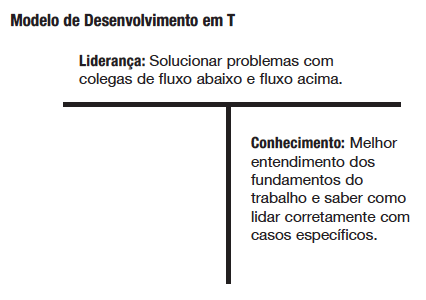
What we then needed to do was describe more precisely what, exactly, we meant by “developing people” – and the people development present in Toyota's approach – thanks to the generous help of Jeff Liker of The Toyota Way, which we illustrate with the “T-shaped development” presented in the book:
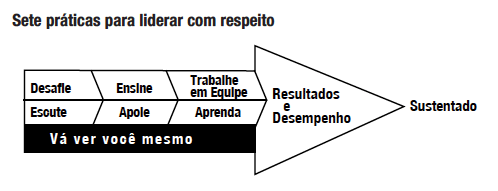
Finally, looking back at the actual behavior of lean leaders at the gemba, we defined a behavioral management model based on both results and relationships, which is now presented at the beginning of the book as the seven practices of Lead with Respect:
Boring text is waste!
Indeed, we all know there is not much new under the sun and that these ideas and practices have been at the center of lean practice from the beginning – many of them can already be found in Taiichi Ohno's own writings – what we hope to have done is focus on lean's “people first” approach and describe as precisely as possible the principles and tools of the people aspects of the lean tradition.
Is it new? No, since all of this has been part of the TPS tradition for decades, but we believe that this material has not, until now, been published in a consistent way. It is new in that it presents what we hope is a complete and consistent theory of HR that stands apart from the traditional Taylorist and Human Relations schools. The principles and practices presented here are specific to lean, and the underlying motivational model is a blend of modern psychological research and lean experience in the workplace – that part, of course, is new.
In the ten years we have been writing lean novels, Freddy and I have tried to present lean each time from a new perspective. “The Gold Mine” is an introduction to lean thinking and tools in a practical context, with a strong link to the business situation. “The Lean Manager” presents a complete lean system as a way of running the business. “Lead with Respect” shows the on-the-job behaviors of lean leaders, which can be learned through practice to achieve lean's commitment of aligning the company's success with personal fulfillment. A loftier goal, which we have tried to make as lively as possible through the characters' lives (boring text is waste!) so that it also makes a good summer read!
Source: Lean Enterprise Institute.