


Related term
Brownfield
Production facilities usually managed according to the philosophy of mass production. Compare with : Greenfield.
View termThree terms often used together in the Toyota Production System (known as "the three Ms") that collectively describe wasteful practices to be eliminated. See: Heijunka.


Three terms often used together in the Toyota Production System (known as "the three Ms") that collectively describe wasteful practices to be eliminated.
Muda
Any activity that consumes resources without creating value for the customer. Within this general category, it is useful to distinguish between type one muda, consisting of activities that cannot be quickly eliminated through kaizen. An example of type one muda would be a rework operation after a paint station, needed to obtain a finish acceptable to the customer from a painting process. Because fully reliable painting processes for finer finishes have frustrated manufacturers for decades, this type of muda is unlikely to be eliminated quickly. An example of type two muda would be the multiple handling of products and inventories between the steps of a fabrication and assembly process. Such steps can be quickly eliminated in a kaizen workshop by moving the production equipment and operators into a cell with smoother flow.
Mura
Unevenness in an operation, such as ups and downs in the schedule caused not by end-customer demand but by the production system, or an uneven work pace in an operation, causing operators to have peaks of intense work followed by moments of waiting. Unevenness can often be eliminated by managers through level scheduling and careful attention to the work pace.
Muri
Overburdening equipment or operators by requiring them to run at a more intense or faster pace, with more force or effort, for a longer period of time than they can withstand
Muda, Mura and Muri in combination
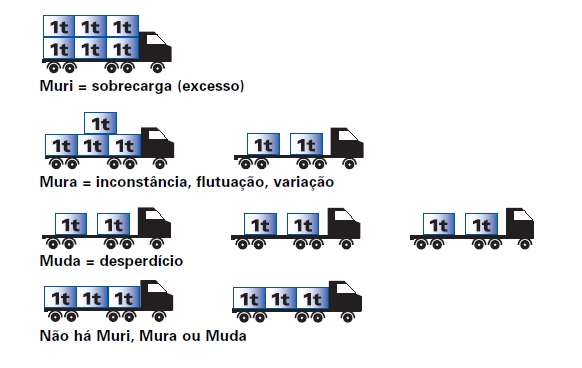
A simple example shows how muda, mura and muri are often related, so that eliminating one helps eliminate the others. Suppose a company needs to haul six tons of material to its customer and is considering a few options. One would be to pile all six tons onto one truck and make a single trip. However, this would be muri, because it would overburden the truck (whose load capacity is three tons). That would cause breakdowns, which, in turn, would lead to muda and mura.
A second option would be to make two trips, one with four tons and the other with two. But this would be mura, because the variation in the amount of material arriving at the customer would create congestion at the receiving dock, followed by little work. This option also creates muri, because on one of the trips the truck would still be overloaded, and muda, because the uneven work pace would cause the waste of waiting on the part of the employees in the customer's receiving area.
The third option would be to load two tons on the truck and make three trips, which would be muda, even though there would be no mura or muri, because the truck would be only partially loaded on each trip. The only way to eliminate muda, mura and muri would be to load the truck with three tons (its rated capacity) and make two trips.
Explore related terms and go deeper with real-world analyses by our industry leads.
Production facilities usually managed according to the philosophy of mass production. Compare with : Greenfield.
View term
See how this concept and management mindset were applied in practice to deliver real business results.
Read the full article
Build leadership and problem-solving skills at the gemba with support from our specialists.
See the training
