

Related term
Change Agent
Leader of a lean transformation with the authority and initiative to undertake the fundamental changes.
View termContinuous improvement of an entire value stream or an individual process in order to create more value with less waste.


Continuous improvement of an entire value stream or an individual process, in order to create more value with less waste.
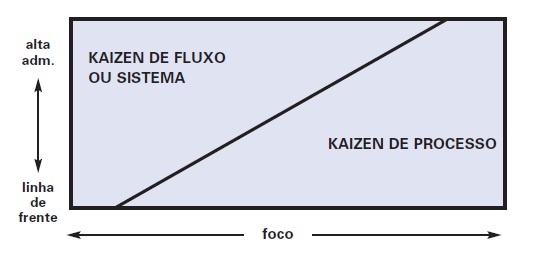
There are two levels of kaizen (Rother and Shook, 1999):
1. System or flow kaizen, which considers the entire value stream. Led by management.
2. Process kaizen, which focuses on individual processes. Led by work teams and team leaders.
Value Stream Mapping is an excellent tool for identifying a value stream and determining where flow kaizen or process kaizen is appropriate.
Related article - "The Roots of Lean" - Author: Jim Huntzinger - Lean Institute Brasil. Read the full article here.
"The Kaizen Technique
The most interesting aspect of what TWI accomplished, beyond, of course, the great success that American factories achieved during the war effort, is KAIZEN. Kaizen has become one of the most recognized and widely used techniques of Japanese management methods, or of the Toyota Production System, TPS. Even though kaizen is just one of many tools and/or philosophies of lean production, its origin can be traced back to the early 20th century. In short, Charles Allen's Four-Step Method can be considered the grandfather of kaizen. Work Methods - The Original Kaizen
To briefly review the previous topics, the goal of Work Methods was to give supervisors a means of improving production using a practical method rather than a technical one. TWI wanted to give supervisors, and succeeded in doing so, a simple but effective method for making improvements in their work areas as an ongoing process. The purpose of the pocket cards was to keep their ideas close to the procedures, available to the supervisor at all times. The term kaizen is usually translated as continuous improvement for the better, or simply continuous improvement. The point TWI emphasized about Work Methods could literally be the definition of kaizen today.
Management had to be shown that Work Methods was not an attempt to turn supervisors into professional engineers. Work Methods would help supervisors make many small improvements in the jobs closest to them. TWI needed to emphasize these points to management, and the instructors needed to guide supervisors toward the improvements that might be close at hand, those that could be made without restructuring machines, tools or the department layout.
The aim of this program was to teach supervisors the importance of continuous improvement and its techniques.
Further details on how the TWI programs spread through Japanese industry will be explained in the section itself. As will be seen, it is clear that Work Methods is the foundation of today's kaizen methods."
Explore related terms and go deeper with real-world analyses by our industry leads.
Leader of a lean transformation with the authority and initiative to undertake the fundamental changes.
View term
See how this concept and management mindset were applied in practice to deliver real business results.
Read the full article
Build leadership and problem-solving skills at the gemba with support from our specialists.
See the training
