


Related term
Andon
A visual management tool that shows the status of operations in an area at a single location and signals when something…
View termEstablishing precise procedures for the work of each operator in a production process, based on the following three elements: Takt time, which is the rate at which products must…


Establishing precise procedures for the work of each operator in a production process, based on the following three elements:
1. Takt time, which is the rate at which products must be produced to meet customer demand.
2. The exact work sequence in which an operator performs his or her tasks within takt time.
3. The standard inventory, including items on the machines, required to keep the process operating smoothly.
Standardized work, once established and displayed at the workstations, is the object of continuous improvement through kaizen. Its benefits include documentation of the current process for all shifts, reductions in variability, easier training for new operators, fewer accidents and risks, and a common baseline for improvement activities.
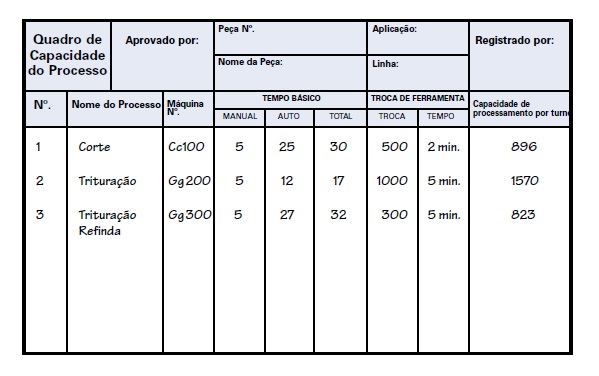
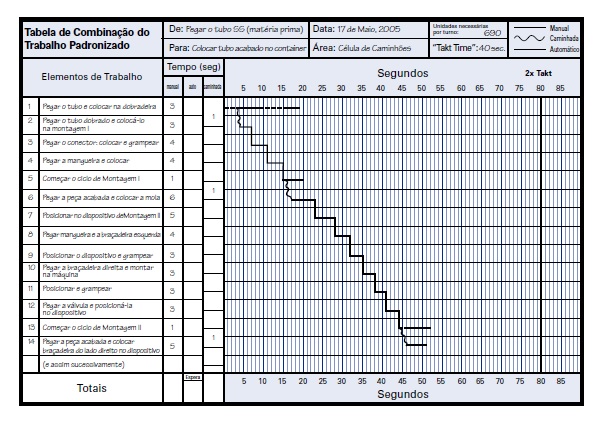
Three basic documents are commonly used in creating standardized work. They are used by engineers and supervisors to design the process and by operators to make improvements in their own jobs.
1. Process Capacity Sheet
This form is used to calculate the capacity of each machine in linked processes
(often a cell) in order to confirm true capacity and to identify
and eliminate bottlenecks. The sheet determines factors such as machine cycle time,
setup and tool change intervals, and manual
work times.
2. Standardized Work Combination Table
This form shows the combination of manual work time, walking time
and machine processing time for each operator in a production sequence.
This table provides more detail and is a more precise tool than the operator balance chart. The completed table shows the interactions between operators and machines in a process and makes it possible to recalculate an operator's work content as takt time expands or contracts.
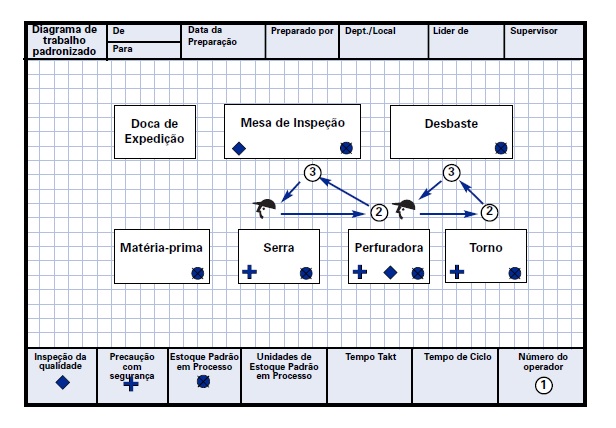
3. Standardized Work Chart
This chart shows the operator's movement and the location of material in
relation to the machine and the overall process layout. The chart should show the three
elements that make up standardized work: the current takt time (and cycle
time) for the job, the work sequence, and the amount of standard inventory
required to ensure smooth operations. Standardized work charts
are usually displayed at the workstations as a tool for visual
management and kaizen. They are continuously reviewed and updated whenever conditions
at the workstation change.
These standardized work documents are usually used together with two other tools: the work standards sheet and the job instruction sheet. The work standards sheet summarizes a variety of documents that define how to make the product according to engineering specifications. It usually provides the precise operating requirements that must be followed to ensure product quality.
The job instruction sheet, also called a job breakdown sheet or job element sheet, is used to train new operators. It lists the steps of the job, detailing any special skills required to perform the work safely, with quality and efficiently.
Related Article - "How do we start implementing standardized work?" - Author: Michael Ballé - Lean Institute Brasil. Read the full article here.
How do we start implementing standardized work?
How do we start implementing standardized work? From the literature, it seems that there can be no meaningful "kaizen" without standards, but, on the other hand, we have procedures for everything, and they seem very far from "standards." I believe I see what needs to be done, but the work seems very challenging!
Funny you should ask me that. I have struggled with the same question for years. I remember that, at one company, we asked an unfortunate lean practitioner to "write the standards." He was (is) a good guy and read the books about what standards really look like - I strongly recommend the book "Toyota Talent," by Jeff Liker and David Meier - and then he wrote a document called "work standards" for each workstation, complete with photos and everything. The poor guy stayed at it for almost two years and, like a complete idiot, I kept arguing that he should write everything down, since "all of this would come in handy in due time." In the end, he nearly had a stress breakdown and we never used all his hard work - I still feel sorry and ashamed about that episode (and this is one of the lucky cases in which the recovered young man went on to do excellent work afterwards).
After this embarrassing episode, awkward and ashamed, I tried to avoid the topic, but its inevitability kept coming up all the time. My sensei kept insisting, as you mentioned, that there can be no kaizen without standards. The good side of lean (or rather, the irritating side of lean) is that you don't choose your learning topics, so I took a deep breath and tried to step back to look at the topic differently. I've found that, when in doubt, with lean ideas that don't seem to work, you should start by putting yourself in the operators' shoes and looking through their eyes.
Eight Hours of Standardized Work
What can really ruin an operator's day? Whether on a shop floor or in any area of the company, picture the person you think is doing their very best every day and who gets sworn at by customers or blamed by their supervisor for doing a bad job. This is particularly painful because it is unfair (they give their all every day under difficult circumstances) and destabilizing because of the nagging doubt that, in fact, they might be doing the wrong job. No amount of self-justification (I'm doing what I can) or rationalization (It can't be that bad) can make up for the anxiety created by the fear that your boss has a bad (or wrong) impression of you. This is very, very bad.
The other point that stumped me was one of my sensei's insistence that the role of the supervisor was to give each operator eight hours of standardized work - not just work standards, but standardized work! I could never connect with this because in most work environments I know, from manufacturing to services, what supervisors actually do is move people from one station to another and tell them what to do and when, not how to do it, specifically how to do it within takt time and in the right sequence of movements. My sensei's points were that:
1. An operator should only perform standardized work during his or her working day;
2. The manager should give him or her eight hours of standardized work to perform;
3. When the standardized work ran out, the person should stop working;
4. Any non-standardized work should be examined and questioned:
1. Is this work
necessary?
2. If so, should the operator
be doing it?
His point was that management's responsibility was to progressively eliminate non-standardized work from the shop floor - a real challenge!
Another aspect of the conundrum was that in any Toyota plant in the world, the routine emphasis on on-the-job training is obvious, but here we are back to the puzzle. Since there are work standards for everything in the Toyota environment, TWI techniques can be applied - but what do you do when there are no standards? Back to the chicken-and-egg problem.
Well, having failed the first time by attacking the standards side of the puzzle, I wondered why not start from the other side. In the same plant where we had left a young man exhausted from writing the work standards, we asked the supervisor to train operators every day - the rule was one day, one operator, 20 minutes of training. The supervisor did this with roughly thirty operators, which meant he would see each person for 20 minutes every two months, and so on. We set up a visual plan on a whiteboard so that each operator could see when they would be trained.
At first, the supervisor tried to use the detailed work standards that had been compiled, but it simply didn't work. Either the operator was a veteran with experience who scoffed at the procedure, so it told him nothing he needed to know, or the operator was a newcomer, and so the documents prepared were far too detailed to be used in twenty minutes. Aaargh! After a few months, we decided to drop the documents and focus on the training relationship. The supervisor would have to work with paper and pencil to write on an A4 sheet (no more than one A4 - this became important) with a checklist for doing the job correctly. In the end, this checklist came to include:
1. The main steps for performing the job;
2. OK versus not-OK descriptions at the key points;
3. Safety reminders.
Which is what a classic operations work standard sheet should look like! It turned out that during the twenty-minute discussions, the supervisor checked the main sequence with inexperienced operators and whether they understood the difficult parts, and refined the OK/not-OK descriptions with the veterans. To my utter surprise (and relief), folders of work standard sheets started appearing at the workstations (a high-mix environment), and many new technical kaizen opportunities started to come up in standardized work discussions: the operator's actual movements in the cell: feet, hands and eyes.
Suddenly I find myself working in a company's service operation with staff who told the maintenance technician where to drive to repair what. After visualizing the first key indicators (trips with incorrect information, customer lead time, etc.), we started a training program in the same format. What we discovered is that contracts vary from customer to customer and it is incredibly hard for staff to know exactly what is specific to each customer. So they are starting to set standards by contract type and now they are finding that they need to dig more thoroughly with the same customer on the phone before sending out a technician. In this case, they start with existing procedures and, with a twenty-minutes-a-day system, turn these general procedures into specific work standards."
Explore related terms and go deeper with real-world analyses by our industry leads.
A visual management tool that shows the status of operations in an area at a single location and signals when something…
View term
See how this concept and management mindset were applied in practice to deliver real business results.
Read the full article
Build leadership and problem-solving skills at the gemba with support from our specialists.
See the training
