


Related term
Lean Mindset / Lean Thinking
A five-step thought process proposed by Womack and Jones in 1996 to guide managers through a lean transformation.
View termA production system developed by Toyota Motor Corporation to provide the best quality, the lowest cost and the shortest lead time through the elimination of waste.


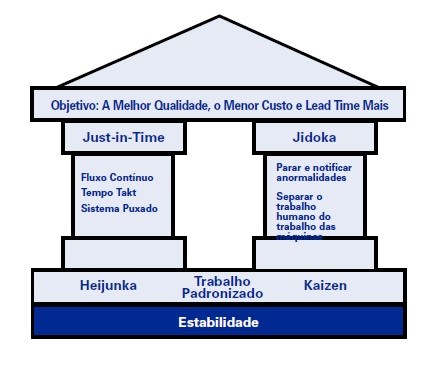
A production system developed by Toyota Motor Corporation to provide the best quality, the lowest cost and the shortest lead time through the elimination of waste. TPS is built on two pillars, Just-in-Time and Jidoka, and is usually illustrated by the "house" shown below. TPS is maintained and improved through iterations of standardized work and kaizen, following PDCA, or the scientific method.
The development of TPS is credited to Taiichi Ohno, Toyota's chief of production in the period after World War II. Beginning in machining operations, Ohno led the development of TPS throughout the 1950s and 1960s, and its spread to the supply chain in the 1960s and 1970s.
Outside Japan, its dissemination began with the creation of the Toyota - General Motors joint venture (NUMMI) in California in 1984. The concepts of Just-in-Time (JIT) and Jidoka have their roots in the prewar period. Sakichi Toyoda, founder of the Toyota group, invented the concept of Jidoka in the early 20th century by incorporating an automatic stop device into his looms that halted the machine whenever a thread broke. This made way for major improvements in quality and freed workers to do work that added more value than simply monitoring the equipment. Eventually, this simple concept found its way into every machine, every production line and every Toyota operation.
Kiichiro Toyoda, Sakichi's son and the founder of Toyota's automobile business, developed the concept of Just-in-Time in the 1930s. He decreed that the company's operations would carry no excess inventory and that Toyota would strive to work in partnership with its suppliers to level production. Under the leadership of Ohno, JIT became a unique system of material and information flows to prevent overproduction.
Recognition of TPS as a model production system spread rapidly with the publication of the book "The Machine That Changed the World" in 1990, the result of five years of research led by the Massachusetts Institute of Technology (MIT). The MIT researchers found that TPS was far more effective and efficient than the traditional mass production system, so much so that it represented a completely new paradigm, and the term lean production was then coined to describe this radically different approach to production.
Explore related terms and go deeper with real-world analyses by our industry leads.
A five-step thought process proposed by Womack and Jones in 1996 to guide managers through a lean transformation.
View term
See how this concept and management mindset were applied in practice to deliver real business results.
Read the full article
Build leadership and problem-solving skills at the gemba with support from our specialists.
See the training
