

Bringing lean to the people
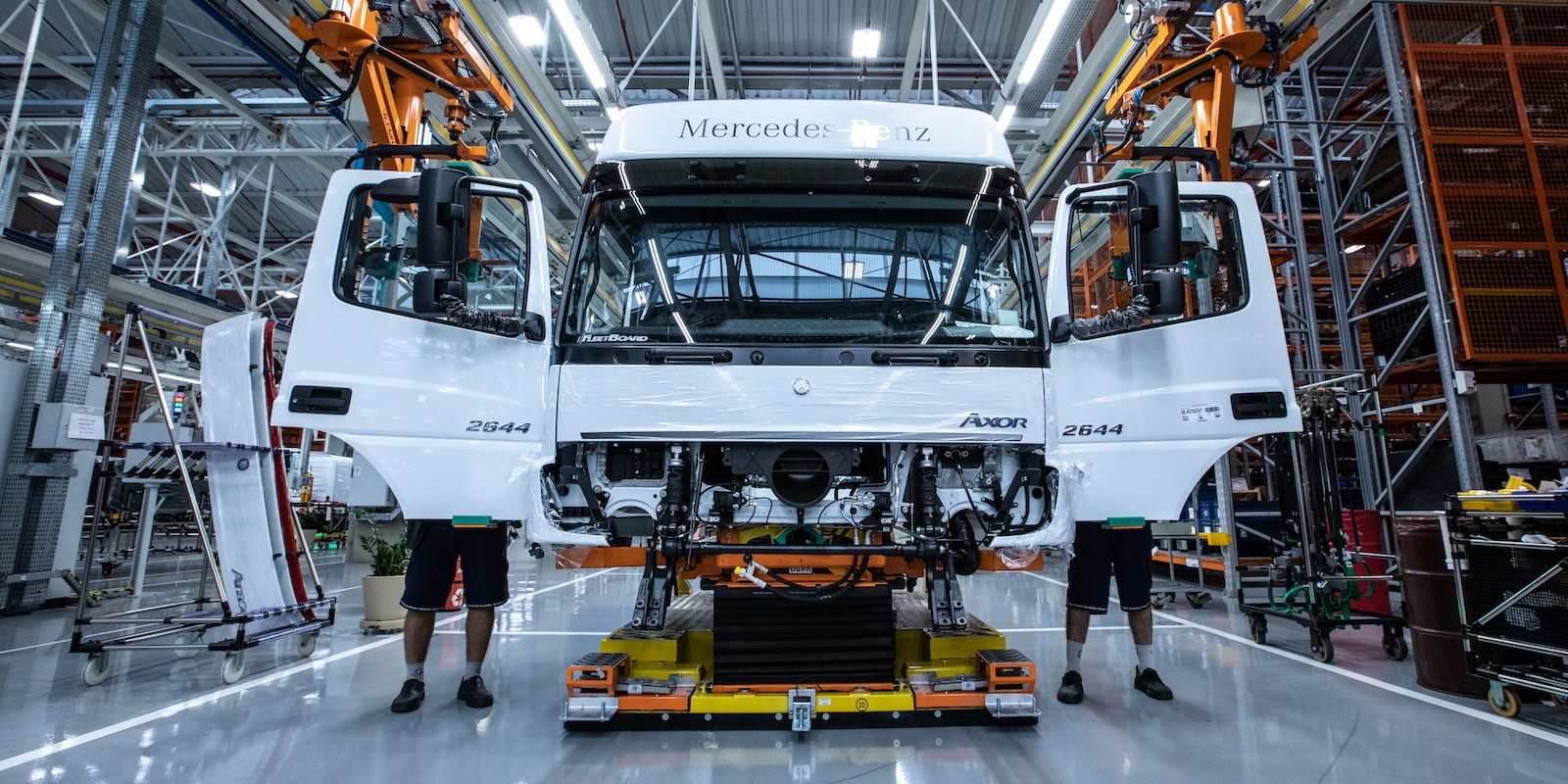
Manufacturing trucks and buses has been the focus of our work at Mercedes-Benz do Brasil since the company opened its first plant in the country — in São Bernardo do Campo, near São Paulo — in 1956. Over time, as our brand gained more recognition in Brazil and the rest of the world, we expanded our portfolio of products and services.
Today, Mercedes-Benz do Brasil has four plants spread across the country (São Bernardo do Campo, Juiz de Fora, Campinas and Iracemápolis), producing trucks, bus chassis, powerpacks and luxury cars and employing more than 10,000 people.
Trucks and buses account for most of our business, and these segments are highly dependent on the country’s economic situation. Because of the recession the country has faced in recent years, we sought cost savings in our operations. To do this, we decided to embrace lean thinking.
Lean thinking has been in our company since the early 1990s, when we hired outside consultants and introduced the practice of production kaizens. After that, a central Lean Department was created (today called the Continuous Improvement Office). In the early years, however, it focused heavily on lean compliance audits, which eventually caused lean to lose credibility.
A first turning point came in 2011, when headquarters introduced in Brazil an international program to develop lean consultants. For those of us, like me, who took part in this initiative, the qualification program was a fantastic learning opportunity. I was a warehouse supervisor when I started, but as I began working on improvement projects in machining, assembly, logistics, maintenance, etc., I learned a lot about the company. I eventually became a manager and, about three years ago, joined the Continuous Improvement Office team. Despite being a high-quality training program, its transformation potential and results were limited because lean knowledge was restricted to just a few highly qualified individuals.
Having learned from our experience, in 2017 we developed and introduced the Continuous Improvement Framework (CI Framework) to represent and coordinate the many activities we had already implemented. This was the second and most important turning point in our lean transformation. The framework had a clear strategy: business excellence (“why?”), achieved through process improvement (“what?”), carried out through people development (“how?”). It is our own version of the TPS house, and it has lean thinking as its foundation.
By better structuring our improvement work, we discovered where the blind spots were. For example, we learned that the qualification program was too lengthy to “go viral” in the organization and that it was not engaging everyone in continuous improvement. We realized we had to find a way to make our improvement work more inclusive so that it would be everyone’s responsibility. To do this, we created the roles of Lean Specialist and Kaizen Facilitator and introduced the Idea Factory (I will explain more later).
The goal of the CI framework is to develop a large number of people in the techniques and mindset of continuous improvement to solve various kinds of problems (from simple to complex) at all levels of the organization. This is done through training programs aimed at all audiences, from the operational level to leadership, in both production and administrative areas.
The main strategic element of this new approach is the decentralization of lean knowledge: the small Continuous Improvement Office team (five coaches and consultants) only coordinates the program strategy and people development, but it is the responsibility of every person at Mercedes-Benz do Brasil to spread the lean culture throughout the business and make improvements. The CI framework is what really brought lean thinking to our people!
What we did and how
As mentioned, the CI framework is represented as a house, whose pillars (the “what” and the “how”) are people development and process improvement:
- Capability development at Mercedes-Benz do Brasil comes to life through the Lean Career, a five-level development program. Each level has its own target audience and focuses on solving a specific type of problem. To take part in this program, trainees leave their jobs for a while. In true lean tradition, the training program consists of 10-15% theoretical content and 85-90% practical content. When the training is completed, the person returns to their original job as a lean transformation agent in their department. They will eventually be invited to take on projects in other departments, which is how we ensure cross-pollination. The Lean Career has five development levels: a) Lean Fundamentals (4h-8h), theoretical content on lean concepts available to all employees; b) Kaizen Facilitator (2 weeks), theory and carrying out a kaizen; c) Lean Specialist focused on administrative and production areas (6-12 weeks), consisting of theory and carrying out three kaizens in different areas or on different problems; d) Lean Consultant focused on administrative and production areas and on project management (12 months), consisting of theory and carrying out 4 projects lasting 3 months each; and e) Lean Coach, an advanced training program of up to 24 months that gives consultants some coaching and behavioral people-management skills, enabling them to train all the other levels. The Lean Career is coordinated by the Continuous Improvement Office, which works in partnership with all areas of the business. We have offered 25,000 hours of lean training annually over the last two years.
- To improve our processes, we follow different approaches based on the type of problem we need to solve. The Idea Factory, for example, is a corporate program for implementing ideas put forward by employees themselves, with the aim of encouraging participation and engagement, discovering talent and developing people’s capabilities. Kaizens are projects lasting one to three weeks, led by Specialists or Kaizen Facilitators. They rely on the PDCA methodology to solve simple and moderate problems. Finally, Lean Projects, lasting one to three months, are managed by our Lean Consultants and are suited to problems of medium and high complexity. Kaizens and Lean Projects are the continuous improvement activities that generate savings for Mercedes-Benz do Brasil, but we also rely on them to develop our teams. Every year, we create a roadmap of initiatives. They are then evaluated and prioritized (we look at complexity, required and available resources and potential gains) in order to assign lean professionals to each project.
We believe these two pillars support a continuous cycle of improvement and people development, with the aim of spreading lean thinking throughout the organization. To keep supporting this, we set ourselves an ambitious goal of significantly increasing the number of professionals trained in continuous improvement by 2022 (in some cases, such as our Lean Specialists, more than doubling the number).
The results we have achieved over the last two years thanks to the CI Framework are proof that this is the right approach for us in our lean transformation. Not only were we able to reduce HPU (hours per unit) in manufacturing by 10 to 20%, but it also became clear that our people have truly embraced lean thinking. They carried out 300 kaizens per year on average and 20 projects per year lasting 6 to 12 weeks on average, and implemented 12,000 of their own ideas. We have also seen a 300% increase in the installation of Karakuri devices in our industrial processes.
Finally, we received recognition from the rest of the Daimler Truck group. Despite representing only 10% of the group in terms of headcount and revenue, Mercedes-Benz do Brasil was the big winner of the global CI Cup (Continuous Improvement Championship), promoted by headquarters to reward the group with the best practices over the last two years. In 2019, in particular, we won 70% of the awards. In 2018, the CI Framework was awarded best lean culture program in the entire Daimler Trucks group.







