

Building a better future in a better way
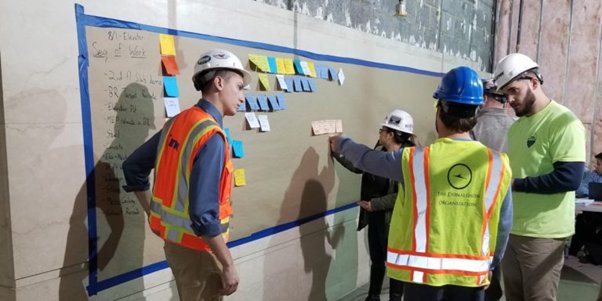
People who work in the construction industry can pull off all kinds of miracles, as long as they have a well-thought-out and well-communicated plan for doing so. The Last Planner System gave us that much-needed structure for managing production on our projects.
Developed by Glenn Ballard and Greg Howell, the Last Planner System is a tool for creating predictability and reliability in project schedules. It also provides a platform for collaboration among the various trades working on a construction project. Teams at Turner Construction Company saw it as a gateway to lean, a way to explain lean principles and techniques.
Our view of the Last Planner System has evolved over time. We have come to the conclusion that it is not a requirement of a lean management system, but a tool and a system in itself for managing schedule, production and variability. The Last Planner System allows us to collect data, measure planning and performance, monitor information and manage production on our projects. We have seen the benefits of the system firsthand. It is a great system and it produces great results. However, as we strive to become more lean, we have to separate it from the broader lean discussion. On its own, the Last Planner System does not change the way people think, which is a critical element in any lean transformation.
DEVELOPING LEADERS, SHOWING RESPECT
At Turner, we really want to implement lean. We have found that an ever-deeper understanding and application of lean will truly transform our business and benefit our employees, clients, partners and projects.
We are applying lean thinking to our problem-solving activities as a way to deepen our engagement at the point of work and with the team members closest to the work - the subject matter experts. We are using the A3 problem-solving methodology to support this work.
The Lean Enterprise Institute (LEI) has helped us along the way. LEI first helped us visualize our procurement process. With their guidance, we put together a visual board that maps the different steps of the process and the problems we encounter along the way. The result was increased process efficiency, team alignment, increased cross-functional collaboration and process transparency. We now have teams using and improving the tools they learned. More importantly, the teams are displaying the thinking that underlies the tools.
One example is a new team member at Turner who identified 1,255 scratches and dents in one section. He categorized them and went to observe and engage with the subcontractor. Together, they came up with a list of five countermeasures, which led to an 82% reduction in the number of scratches and dents in the next phase of the work. Our project engineer was coached through A3 thinking by his general manager - without necessarily knowing what an A3 was. As a result of the process, he was empowered to solve a specific problem and will no doubt use the A3 methodology for future problems. Coaching and mentoring people to think differently about problems can be challenging, but it is worth it. Simple, specific and measurable problems that get solved can translate into huge improvements across a business unit, region and company.
As our leaders were exposed to new aspects of lean, they began taking the initiative to visualize their own work. Our business unit leadership, under the guidance and commitment of our senior vice president, Charlie Murphy, took the next step in our lean journey and embarked on a leadership development program focused on using lean thinking in problem solving. As part of the initial course, 10 leaders - general managers and department heads - were asked to select a specific project/department problem, go to the gemba to collect current-state data through observation and engagement, and use the A3 structure and thinking. Each leader was given his or her own coach to guide them through the process and the associated learning. The goal was both to introduce them to the A3 methodology and to develop their coaching skills. A second cohort of leaders is now being coached by participants from the initial cohort.
Having our senior leaders work on frontline problems generates very important learning - the most important, perhaps, being that frontline people become better at what they do, since they deeply appreciate their work. We definitely see a direct correlation between developing lean leaders and our people's ability to succeed. In fact, people are approaching problem solving in a different way, typically starting with multiple rounds of observation at the gemba. This is possible because we, as leaders, are walking the same learning path and setting the right example.
Engagement in root cause analysis is having a dramatic impact on safety. We had incidents on one of our projects involving drywall dollies. We asked questions and dug a little deeper, trying to understand at what point in the material handling most of the incidents occurred. We found that most occurred during what we call “tertiary delivery” - this is the stage at which materials are moved out of the way after use. The people handling the materials at this stage are not as familiar with them as the people who move the materials off the truck or those who do the “secondary delivery,” who are the people who move the material from storage to where it will be installed. It was also found that the carts carrying a material had often not been designed to carry the material in its current configuration, resulting in a weight distribution problem. We dug even deeper and found that we had no process for knowing which dollies were rated for which weights, or what condition they were in. We implemented countermeasures, including condition assessments, taking carts out of service and creating learning opportunities around these carts. These actions resulted in improved safety performance.
This approach reinforced for me the importance of going to the gemba and observing. Time spent at the gemba is transformative, as we support and engage with the frontline providers of value. That is the essence of respect for people.







