

Why so much technology?
"In a world awash in computerized logistics, Toyota says its colored cards - kanban - are managing the supply chain very well."
Lindsay Chappell, Automotive News, August 2001.
Someone sent an e-mail to the office at Toyota Motor Manufacturing North America in Erlanger, Kentucky, proposing a meeting between the general manager of business management and a vendor of software and electronic solutions.
Toyota could be one more customer. The company had just announced construction of its third U.S. engine assembly plant, the fourth to be built in the U.S. and Canada. Toyota's suppliers are spread along the U.S. East Coast and need to deliver their components just-in-time to one or more assembly lines.
The manager reads the e-mail and sends a "thanks but no thanks" to the software vendor. In his reply, he explains: "Toyota really isn't looking for that kind of solution". Toyota prefers to do things through TPS (Toyota Production System), he explains. He tells the journalist: "I go to logistics conferences at least once a year and it seems to me they're all dominated by people talking about technology, technology, technology. That isn't who we are. We don't need a technical solution. We already have a system that works well. It's our well-established kanban system."
Toyota moves billions of dollars' worth of materials and components over the highways, across thousands of kilometers, to be delivered just-in-time, relying only on small laminated colored cards and on transportation scheduling reports, also color-coded.
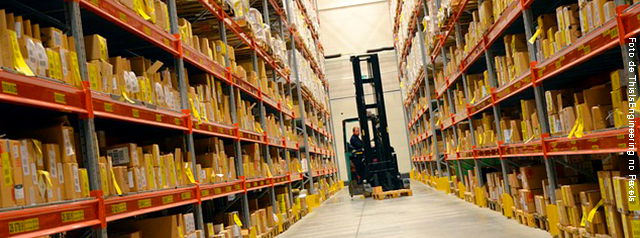
Inside the warehouse-like consolidation center (cross-dock) in Knoxville, the company's philosophy translates into practical solutions. The building clearly has nothing more "technological" than a printer and a telephone, the author states.
As components arrive, sometimes every hour, most of the 20 employees are in the warehouse unloading boxes from the trucks and arranging them correctly on the floor to be shipped later.
The cards
The colored cards, the size of an airline ticket, hang neatly on the wall. Rubber bands hold the invoices that allow each supplier to be paid for the shipment. When parts arrive by truck, the drivers unload their deliveries, take the new cards from the racks and hit the road again in search of others.
Warehouse employees keep the boxes of parts together with the kanban cards, attached by a piece of wire. The driver who carries the products to an assembly plant uses the same card to know which plant to take them to. Once they are delivered to the plant, Toyota team members use the same cards to move the parts through the final assembly process and also to signal the need for more components to the supply chain. It is the continuation of the same Toyota pull system that sets the pace of the assembly lines.
Pull is one of the principles for quality and efficiency. If a given assembly line is not ready to receive components, no components should be delivered. Excess materials generate their own quality problems and their own complications. They lead to wasted human energy and physical space.
Managing the flow
The Knoxville warehouse is one of the four facilities that make up Toyota's cross-docking distribution system (consolidation center) in North America. The other three are located in Battle Creek and Romulus, in the State of Michigan, and Georgetown, in Kentucky. Toyota launched a cross-docking project in 1993, when its first plants in North America, located in Kentucky, Ontario and Canada, began producing in more significant volumes.
Toyota began producing cars in the U.S. in 1984 - and in large volumes only from 1990 onward, so the flow of materials was not a critical factor until then. Previously, each plant sent its own fleet of trucks to each supplier's facilities to pick up materials (milk run). But things changed.
As production volume grew, truck traffic, fuel costs and logistical complexity increased greatly. A Toyota study on cross-docking showed that, even taking into account the growth in manufacturing activity, using this solution could reduce truck traffic volume by 25%.
Half of all the material used by the North American plants passes through the four centers. There, components coming from more than 370 suppliers are gathered, temporarily stored, reorganized and shipped to one of the assembly lines or to another center. The Knoxville center is a joint venture of two Toyota "affiliates", Toyota Tsusho America and Ryder Logistics.
Nobody sleeps there
What is most surprising is the simplicity with which high complexity and high volume are handled. Every day, 38 trucks leave the Knoxville center to take components to an assembly line. "What is most amazing and should be remembered is that this is not just a storage warehouse.", said Phil Barfield, another employee. "Nothing stays here. The longest a component stays here is 23 hours."
In the shipping area, pallets with bins from various suppliers are quickly distributed by forklifts, which line up the boxes in narrow rows. The contents of each row are destined for specific Toyota plants. Whatever a kanban card tells the forklift operator, he simply follows what the card says.
As the author walked through the Knoxville facility, a forklift operator notices an error: in the middle of the receiving area, a pallet of boxes destined for one plant has been placed on a stack that should go to another. The forklift operator then goes over and separates the two. He was able to detect the error thanks to the differences in the cards: they have different colors. The mistake would not have been undone if he had received a computerized order or if it had been only a difference in the bar code. It is the cards. It is people trained to look at and understand the cards. It is visual control: simple and unmistakable.





