Lean thinking: ingredients, incubation and diffusion

Editor's note: As the LGN members prepared for our week-long study mission to Toyota last September, we decided to get ready by holding a few webinars for ourselves. Jim Morgan led a session on the Toyota New Global Architecture (TNGA) - Jim surely knows this subject better than anyone outside the company - and Toyota had promised to explain TNGA in depth during our visit. Beyond technical matters such as TNGA, we also wanted to dig deeper into cultural questions. To help us with that, John Shook gave a webinar on “Toyota's double funnels”. I am excited to share this illuminating reflection with Planet Lean readers in this article. What follows is a transcript - lightly edited for readability - of John's presentation.
It has long been accepted that lean thinking is not “uniquely Japanese”. For me, this has been a personal mantra since 1984, when I began teaching Toyota's production and management systems to American General Motors employees and UAW members.
But what does it really mean to say that lean thinking is not uniquely Japanese? First, it indicates that not all Japanese companies are “lean” - as shown, for example, by the deep trouble companies such as Sharp or Toshiba have found themselves in over recent years. Second, we have successful examples of lean applications all over the world - not just in Japan (in fact, the belief that lean practice applies everywhere is what unites us as a Lean Global Network). We know these things to be true.
However, saying that lean is not uniquely Japanese does not mean there is nothing Japanese about it. So let's explore that second, little-explored idea. And let's do it in true Toyota style... by asking more questions. A critical question we can ask ourselves is: “Could TPS have emerged anywhere other than Japan?”. And finally: “What, if anything, is Japanese about lean thinking?”.
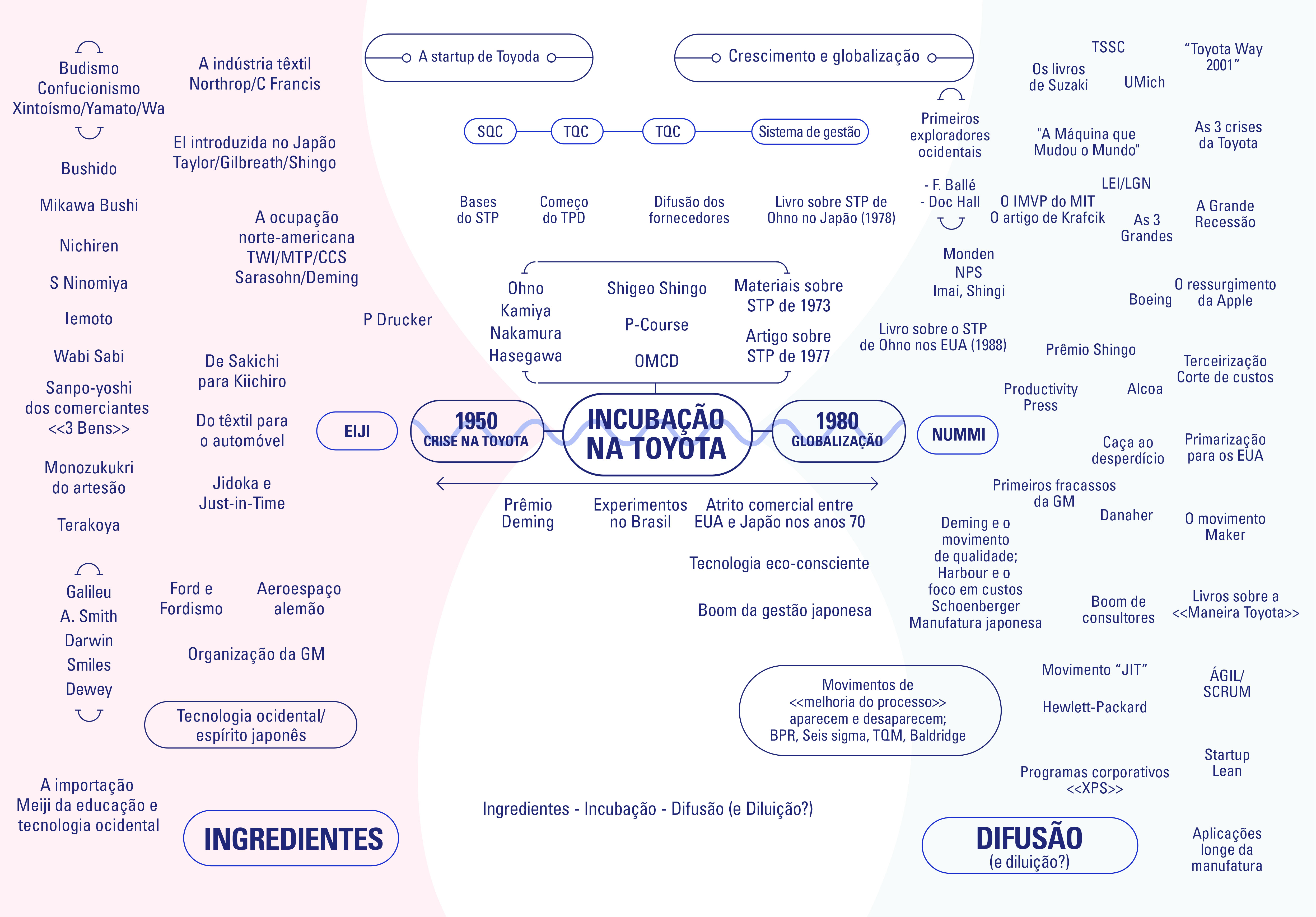
My attempt to address these questions - an effort that keeps changing as I reflect further and the world around us keeps evolving - has taken the form of the chart you see below, which illustrates what I call “Toyota's double funnels”. There are three main sections in the chart:
- The left funnel represents a selection of key ingredients that, combined, led to the creation of Toyota's way of working.
- The spiral in the middle of the chart represents the true genesis of the Toyota Way, TPS, TPD, TMS, and lean thinking, which can be traced back to a 30-year incubation period between 1950 and 1980.
- The right funnel represents the diffusion of this body of knowledge throughout the world, which began around the time of the NUMMI experiment in 1984.
As you explore this chart, remember that the individual items are less important than the three phases. I had to make choices, and my selection is essentially subjective. More importantly, it keeps changing! For example, in the ingredients funnel, I included John Dewey but not Max Weber. Elton Mayo, but not Mary Jo Follet. I chose Galileo, but could just as easily have chosen other experimental and experienced scientists. Dan Heller, professor of operations management at Yokohama University, noted that I had left out Peter Drucker. My intention is to be concise in the interest of fitting “everything” into one graphic illustration. I will defend the choices I made, although that is best done over drinks in a bar. The important takeaway from the left funnel is that Toyota's system did not appear out of nowhere; rather, it was a synthesis of many influences (not just Ford, not just TWI, and not just Japanese culture). As I hope the chart shows, each piece of the Toyota puzzle has many antecedents.
Probably more than the items in the ingredients funnel, the items I have chosen to include (so far) in the diffusion funnel will be controversial. People often ask me why I didn't include this or that. The chart is also quite US-centric (sorry about that, although, in my defense, it was the Japan-US relationship that dominated developments in Japan for most of the last century, and that extends to business matters in general and to Toyota in particular). A lot has happened in the years since Toyota's way of working met the world, with small adaptations occurring every day and major mutations occurring roughly every decade. In the chart I talk about diffusion, but I also wonder whether we are facing the dilution of Toyota's core message. Are the various schools of thought and interpretations of the Toyota Way and of lean thinking a positive evolution of the system, or are they an aberration? Is lean startup lean? Toyota doesn't do it, but does the fact that Toyota operates differently automatically mean that a practice is not lean? I don't think so. The more relevant question to ask here is whether the practice (lean startup, TOC, scrum...) holds critical views that are incompatible with Toyota's fundamental views - remembering, too, that you don't know whether a mutation of any organic system is good or bad until it is too late. I believe the spread of lean has been as much a matter of diffusion as of dilution. I would add that, along with dilution, there has been more than a little delusion, aided by consultants who sell things under the name “lean” but that are far from the original intent of the thinking, the system, and the application (solving specific, fundamental business problems) that were developed in Toyota City during the incubation period between 1950 and 1980.
As for the incubation spiral, it would be quite easy to add more things to it. The main message of this section is, in my opinion, that Toyota got off to a good start in 1950, with a good foundation that had already been laid in the 1980s (I have benefited from countless hours of discussion with many longtime Toyota people, who never failed to recall 1950 as the crucial moment for the company to become what it became), but then worked very hard to improve - kaizen, failures, problem solving, innovation, and hard work - until it all turned into something unique and powerful. Toyota's system was quite mature by the mid-1970s (some say as early as the mid-1960s, but saying so means defining many critical parts of the success in a very narrow way). You could say that the 30-year incubation period is like a microcosm of Japan's 300 years of isolation from the rest of the world, when many aspects of Japanese culture were born - with numerous influences imported from outside - and refined.