
How “Lean Startup” can help new companies and ventures in Brazil: Digital Startups
The “lean startup” management methods and practices were developed to help digital startups with several specific challenges of the high-uncertainty environment that characterizes these companies. In practice, however, digital startups have used “lean startup” in an unsystematic and very sparse way. That is, they use only a few tools, use the tools without much rigor, or use them only for a while and then give up. As a result, they do not consistently reap the benefits of “lean startup”.
On the other hand, there has been on the market – for 25 years – the traditional lean management system, based on the Toyota production system, which has a long track record of success with “old economy” companies and which can also bring great benefits to digital startups – especially if used together with “lean startup”.
In this article, we call “startup lean” (be careful not to confuse it with “lean startup”…) the confluence of the new “lean startup” management system with the traditional lean management system – in a consistent, permanent and synergistic way, under the same philosophy. “Startup lean” makes it possible to get the best of these two worlds.
“Startup lean” can be defined as a temporary organization set up to create a new product or service in search of a business model of high added value for customers and low waste for the venture. It normally operates under conditions of extreme uncertainty.
Startup lean happens in the creation of companies “from scratch”, but also when “old economy” companies with lean practices use, in an intelligent and targeted way, some “lean startup” methods and practices for their initiatives to create new businesses.
The objectives of this article are:
1. To present the movement of creating digital companies – startups – and of adopting the “lean startup” management model in Brazil in its fundamental characteristics, and how this model has been used by traditional companies.
2. To present the potential and the limitations this model may have given the superficial way it has often been adopted by digital startups.
3. To present the benefits that combining the concepts and tools of the traditional lean movement with the “lean startup” movement can bring to the success of the startup – throughout its life cycle – as a sustainable company.
There is a strong and growing movement of development of “internet-based startups”
THE MOVEMENT OF DIGITAL STARTUP CREATION IN BRAZIL
There is a strong and growing movement of development of “internet-based startups” in the country, resulting from the following causes:
- Consolidation of a communication infrastructure and the creation of new information and communication technologies, which make possible new services for consumers – individuals and businesses – and better quality and lower cost of the services offered.
- Access to mobile devices and cloud storage, and consumer education regarding the use of these devices, are growing at very high rates, making access to smartphones practically universal across all social strata and expanding the potential demand for information services.
- The availability of capital and of entrepreneurial ecosystems has also become widespread, in an economic environment with relatively low barriers to entry for competitors.
The movement of startup creation is an important social movement for the country, with great potential to contribute to its economic and social development.
As a larger number of startups thrive using – from their very first steps – lean concepts and practices, this learning may condition them to continue with lean practices in the next stages of their existence, making the companies more effective and efficient also at the stage of being a mature company.
Lean startup concepts can also be useful for mature companies in information technology functions or in new product development functions.
Potential and limitation of digital startup management inspired by the “lean startup” model
To identify the potential and the limitations of the management practices adopted by digital startups in Brazil, a sample of 50 companies in the Campinas and São Paulo region was interviewed in search of any trace of more professional and consistent management, and it was found that most of the companies were aware of the “lean startup” concept.
This concept is associated with Eric Ries's book of the same name, but also with the ideas and recommendations of the following authors: Steve Blank (Customer Development Model), “4 Steps to Epiphany” and “The Startup Owner's Manual”, and Alexander Osterwalder (Business Model Generation). These concepts and recommendations are discussed – albeit superficially – fairly frequently by members of digital startups in relevant discussion forums.
Next, 12 startups were selected from the initial 50 in order to identify what these practices consisted of.
In these companies, practices and methods focused on the customer, on process improvement and on work organization were identified that are strongly related to the traditional lean management philosophy – as described below:
-
Use of experiments for the systematic improvement of products within the company's strategic vision, through the refinement of incremental improvements in the context of preliminarily defined strategies – iterations – up to the point where the increase in benefit per unit of effort allocated to improving them begins to diminish.
That moment is then the inflection point, where the relevance of the current strategy is questioned and the advisability of a change to a more promising one is tested, or – in the extreme – of abandoning a product or service if it proves unviable.
This mechanism of exploring strategic improvement alternatives for the product within the same strategic vision is called “pivoting”. The purpose of this product development logic is to accelerate the development, or the rapid and necessary discarding, of alternatives for the future. - Testing hypotheses as experiments and, once the result is validated, seeking to quickly scale the process to the universe represented in the sample: more qualitative research methods are used in the preliminary stages of the experiments and more quantitative ones to scale up the successful initial practices. The validated learning cycle is practiced: “follow/measure/observe/interact” with customers, and “build/prototype/measure/learn” for the product.
-
Minimum viable product (M.V.P.). It consists of rapid prototyping of the product so as not to waste effort building products before testing the primary elements most relevant to customers – which define its success.
In this case, one avoids continuing the effort on something doomed to failure or even wasting time developing features that are not yet mature for the product's current stage. - ? Information technology management tools and practices very close to the lean management philosophy – such as the agile method and the programming workflow tracking tool kanban.
- Use of product development practices and tools through strong interaction with the customer, as advocated by the customer development model.
As for management practices, the most prevalent and relevant are the following:
An environment of extreme uncertainty and “explosive” growth requires an obsessive approach to the timing of decisions and actions, and to agility and speed of execution, in order to reduce waste of time and of quality in products and processes.
Also as a consequence of the need for great agility and speed, the natural and healthy organizational aversion to bureaucracy becomes even more exacerbated – in this case, however, with the harmful side effect of making it harder to combat the organizational chaos and the workflow of this environment!
Another management practice is minimizing the waste of time on work that does not add value. It is a general orientation of the startup culture toward minimizing waste of time and working focused on predefined priorities.
Monitoring key performance indicators – KPIs – to track facts, data and targets allows greater focus on priority actions and the possibility of objectively assessing processes and results in terms of cause and effect, so as to enable progress in the effectiveness of the work done and in learning for future development.
The problem that often occurs in startups is the lack of consistency and persistence in the use of lean tools and practices
All these tools and practices greatly leverage the development of startups. The problem that often occurs, however, is the lack of consistency and persistence in the use of the tools and practices, which greatly reduces the effectiveness of the result achieved.
Benefits of combining traditional lean with lean startup: startup lean
One of the traditional lean practices and methods for mature companies is the lean product development system.
The concept is that the product and the process for producing it are developed concurrently.
As shown in the figure below, it includes some basic ideas, such as:
- Focus on customer-defined value and on the knowledge generated for the operational flow.
- Entrepreneurial leader – the chief engineer –, ultimately responsible for the product under development and for the process to develop it.
- Simultaneous engineering based on the systematic, concurrent exploration – from the beginning of the product development process – of multiple alternative solutions for the features.
- Visual management; teams of functional specialists; full involvement of suppliers.
- Pulled, cadenced and leveled flow of resources and standardization of processes, parts and components – whenever possible – to reduce variability and create flexibility and predictable results.
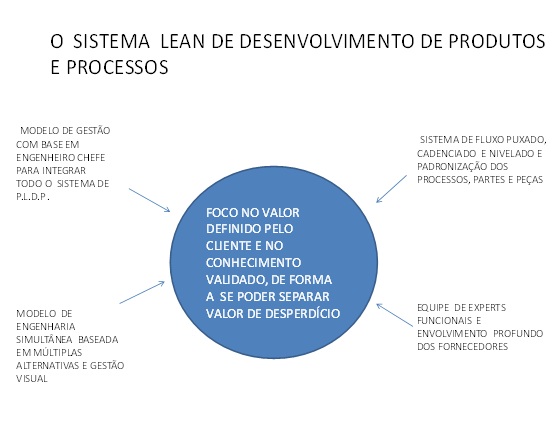
The L.P.D.S. has been successfully applied in complex environments of traditional companies, with basic to moderate degrees of technological innovation and of speed and radicalness of product change.
In situations where a traditional company sees the opportunity to develop revolutionary products, with high growth potential and also a high degree of uncertainty, the L.P.D.S. can be adapted to incorporate lean startup management tools and practices, already used successfully by startups.
Among the startup tools and practices already mentioned with potential for incorporation into the lean product development system, the following stand out:
1) The customer development model (customer development model – Steve Blank): testing whether the product solves a customer problem or need (customer discovery) and – in a second stage – validating it through greater interaction with customers and developing a sales model that can be replicated (customer validation). This is the phase of searching for an excellent business model. The following phase – executing a business model – focuses on scaling the winning business model identified.
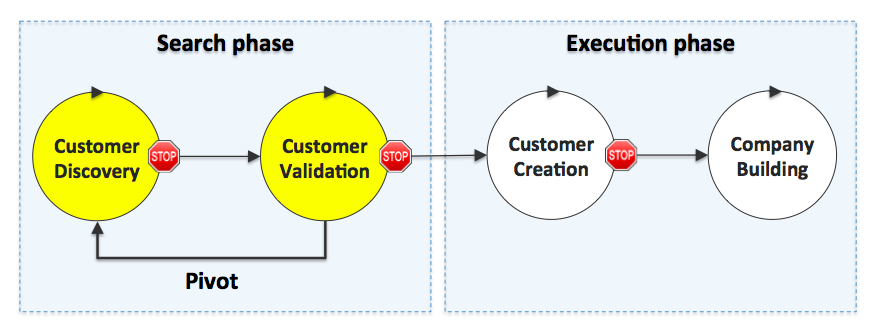
2) Structured experimentation, using more qualitative market research methods at the beginning of product development and more quantitative ones to scale up the successful initial practices, accompanied by a validated learning cycle: “follow/measure/observe/interact” for customers and “build/prototype/measure/learn” for the product.
3) Development of the minimum viable product (M.V.P.).
4) Strategic pivoting to decide between refining products through incremental improvements or seeking new strategies.
On the other hand, an interesting option for the traditional company facing an opportunity of great added value, growth and heightened uncertainty may be to incorporate a digital startup through acquisition or to “spin-off” an opportunity by creating a digital startup.
In these cases, even though the issues of product and customer development are the vital essence of the digital startup, there is at the same time a whole set of issues concerning the venture as a whole – and these conditions need to be addressed in the management system for the good of processes, people and results.
In the first case – acquisition – the challenge is to integrate the new initiative into the traditional management system, leveraging synergies and avoiding the loss of vital energy. In the second case, the spin-off, the challenge is to equip the digital startup with management tools for a solo flight with a high probability of success.
In both cases, there is a basic roadmap of systemic lean management topics to be implemented, which may be as follows:
1. Lean management system for the digital startup: LEAN TOOLS
- Value stream mapping.
- Problem-solving methodology.
- Hoshin – strategy deployment.
- Managing to learn.
- Daily management.
- Obeya – indicator monitoring room.
2. Management of finite resource capacity for product development.
3. Visual management of the workflow.
4. Event-focused product development:
- The market requirements and customer development event.
- The project planning/risk mitigation event.
- The rapid learning cycle events.
- The cost optimization events (production preparation process – 3P).
- The review, design freeze and pivoting events.
The transformation model called “lean transformation dimensions” can be useful for companies that are starting their activities, as it helps them think about the most important dimensions of a company...
5. Execution:
One finding from lean interventions in traditional companies is that the application of lean tools, or even the generic adoption of the lean philosophy, can have a good targeted and momentary impact, but with a high probability of near regression afterwards, if there is no continuous and structured intervention such as that developed in the transformation model called “lean transformation dimensions” (LTF) – as shown in the figure below.
LEAN TRANSFORMATION DIMENSIONS TO DEVELOP MORE AND BETTER DIGITAL STARTUPS
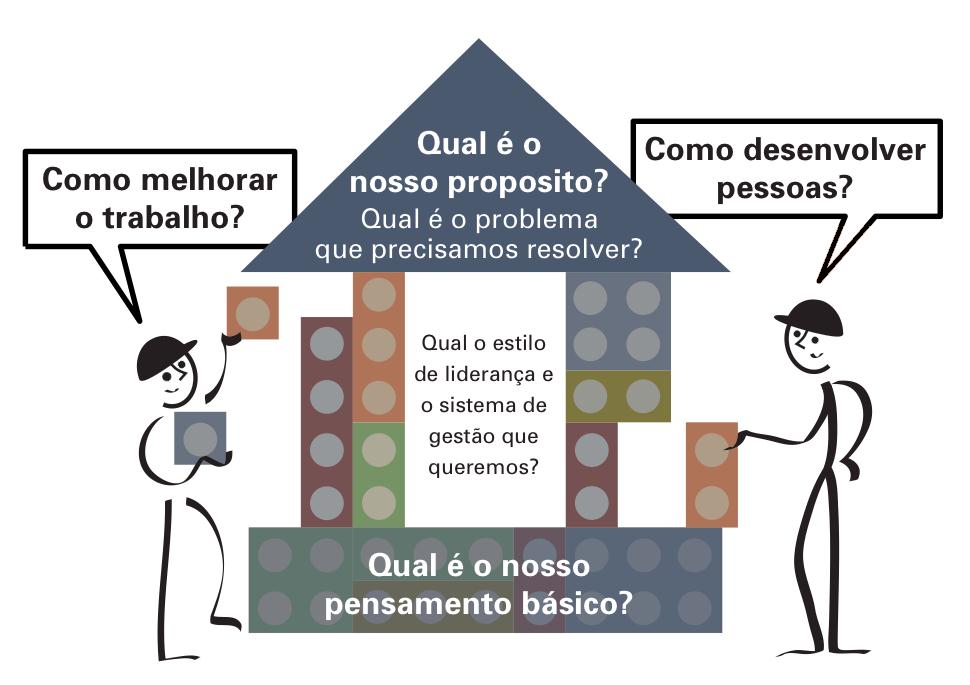
This articulated way of thinking anticipates the need for an integrated intervention focused on the elements related to the purpose of the TRANSFORMATION and the problem to be addressed, on improving the work and on developing people, within a desired leadership style, management system and mental model.
It can be useful for companies that are starting their activities, as it helps them think about the most important dimensions of a company.
...And it also contributes to companies that are advancing on their lean journey and seeking to incorporate some “startup lean” practices and methods
And it also contributes to companies that are advancing on their lean journey and seeking to incorporate some “startup lean” practices and methods.
The recurring nature of the problems and challenges of Brazilian digital startups suggests a great opportunity to improve the management method through lean practices and tools
The recurring nature of the problems and challenges of Brazilian digital startups suggests a great opportunity to improve the management method through lean practices and tools, so as to achieve better and faster results for everyone involved – starting with customers!