

How a traditional company revolutionized an industry
Revolutionizing an industry as a startup is one thing: a small, agile group of inventors identifying and attacking the weak link of a sector frozen by decades of stable and seemingly lasting growth. Doing so when you are a large, established market leader, comfortable with your success and attached to your business model and the internal systems that sustain it, is another story. In the business world, startups tend to come out on top.
Moreover, adopting lean thinking and practice is not the first solution business leaders turn to in order to innovate and capture market share. Unfortunately, many still see lean management as a slow, incremental method focused on small improvements in production, rather than on achieving significant competitive advantages or transformational, disruptive change.
But one company in the offshore and subsea oil and gas services industry, TechnipFMC (formerly FMC Technologies), challenged these stereotypes. Prepared for change because of market instability, the company sprang into action. This response was triggered by the 2014 OPEC oil war, which caused the benchmark price of a barrel of oil to fall from more than $100 to less than $60, making the traditional business model unviable.
So the company invested in lean thinking, specifically in Lean Product and Process Development (LPPD), embarking on a transformational journey. This effort reshaped TechnipFMC's business strategy, reinvented its new product development process and, ultimately, revolutionized the subsea oil and gas industry.;
The initial results, obtained after about 16 months, included a completely redesigned product platform, called Subsea 2.0, made up of six core products that offer the same or better functionality than the previous system, with a reduction of up to 50% in size, weight and part count.
More significantly, the redesign standardized the products at the component level to enable the company's shift from an engineer-to-order business model (Engineer-to-order or ETO) to a configure-to-order model (Configure-to-order or CTO), the first of its kind in the subsea and offshore oil and gas industry. For TechnipFMC, the CTO approach reduced manual activities during the production process by 70% to 90% and, consequently, drastically shortened hardware delivery times to customers.;
When the company presented the innovative product platform and the new business strategy, analysts upgraded the company's stock rating from "hold" to "buy", and the share price immediately rose 3%.
This story reveals how TechnipFMC, a company with 20,000 employees and revenues of 10 billion dollars, applied and continues to use LPPD principles to create a competitive advantage and revitalize the future of the industrial segment — and the lessons they learned along the way.
The challenge
TechnipFMC's formal lean journey began, like many others, driven by a "burning platform". Instability in the oil industry led the company and its competitors to strive to find ways to speed up time to market, reduce variability and costs, and ensure quality. Most companies serving the subsea industry agreed that product standardization would be at least part of the solution — that a shift from a project-based model (engineer-to-order) to a product-based model (configure-to-order) was necessary. In fact, many had tried and failed.
Their path to transforming their product development process, thereby creating a new paradigm in the industry, was traveled in three phases:
- Create a pilot project to align the organization and observe the results.
- Spread the learning by influencing parallel value streams.
- Transform the company systematically.
Go deep: achieving success with a hands-on LPPD approach on a key project
Establishing the vision
One of leadership's critical early moves was to appoint a chief product developer (Chief Product Developer or CPD) for the Subsea 2.0 program, giving him responsibility for defining and overseeing all aspects of development. Subsequently, the appointed CPD took an additional step by selecting individual chief product developers for each specific product within the Subsea 2.0 suite, ensuring focused, specialized oversight for each component of the project.
The CPD's first responsibility was to write a concept paper. This essential document captures the voice of the customer and aligns that voice with business objectives. In addition, it unifies the organization around what must be delivered and serves as a contract that commits the development team to delivering performance exactly as described. With the project objectives listed in writing for all stakeholders, the document also protects against scope creep, requirements deficiencies or corporate redirection — all problems faced by traditional development teams.
In the concept paper, the Subsea 2.0 CPD, working with the team leaders, established a vision for the new platform, communicating the general principles and the specific objectives the new system was to achieve, with a detailed explanation of why achieving those objectives was vital to the company's future.
Synchronizing the work
Early on, the teams set up an obeya. The term "obeya", translated from Japanese, means "large room." It is the way teams make a project's work visible and enable the collaboration needed to solve problems as they arise.
Inside the obeya, the teams created and posted the master schedule, which visually shows the timeline and deadlines for all subcomponents. Reviewing the schedule helped the team determine the work that needed to be done and the order in which it should be carried out.
To set up its obeya, the TechnipFMC team adopted an idea from a gemba visit to a member of the LPPD Learning Group, MillerKnoll. During the visit, team members saw an obeya where everyone worked full time, rather than a meeting room, the more traditional obeya format. They concluded that having the teams physically co-located would allow more efficient collaboration among the component teams — information would flow faster and problems would be identified more quickly with everyone in the obeya.
Previously, the various departments worked in separate office areas — the manifolds group, the connectors group, the drafters, etc. The change is similar to the one traditional manufacturers must make to create flow in production, moving production departments out of separate areas and installing them in a single location. Notably, this also highlighted the relationships between various design elements on which the teams should collaborate more closely.
At first, the TechnipFMC team struggled to set up its obeya, debating which information and how much of it to track and how often to meet. However, they worked through the problems and eventually realized that learning to set up an obeya is mastered the same way as any lean practice: by doing.
The team also learned that the obeya is more about establishing new behaviors and a culture focused on collaboration and problem solving, according to John Drogosz, Chief Engineer and Senior Coach at LEI LPPD. “To truly get value, the obeya needs to become the andon system for the project team, where they can make problems (technical and business) visible to everyone and get help from the right team members (and from management, if necessary) to solve them quickly, so that the project can keep moving forward,” he says. “When people meet frequently in the obeya, it helps everyone stay on the same page and understand the big picture of how their work fits together and how they can help each other.”
Applying other LPPD practices
Among the LPPD practices the team adopted early on, during the study (concept) phase, were set-based concurrent engineering (set-based concurrent engineering - SBCE), trade-off curves and rapid prototyping. These practices involve simultaneously developing multiple design options for product components, filling knowledge gaps and discarding weaker alternatives to converge on the best system solution based on test results. The TechnipFMC team chose to adopt these practices first because it could clearly see how they would help make better design decisions, reducing the risk of rework in later phases of development.
In contrast, traditional design processes, such as iterative and waterfall (and sometimes agile), lead teams to decide on a single design solution early, before moving on to the next step with limited knowledge, increasing the risk of failure later in the process — and rework.
With set-based engineering (SBCE), developers work on several concepts that meet specific targets instead of choosing only the one that initially seems best, allowing them to keep learning and optimizing the design throughout the entire development process.
For example, the compact connectors team applied these practices to solve a complex multidimensional problem. First, using set-based engineering (SBCE), it developed several concepts. Then, to gain knowledge quickly, it created simple mock-ups of its design options to discuss with the cross-functional team. These early mock-ups helped engage and align the team to more fully understand the complexity and functionality of each option and eliminate weaker alternatives earlier, without the need to do detailed design work on each concept.
Go deep: spreading the learning by influencing parallel value streams
Once the teams working on the configure-to-order (CTO) project had learned several LPPD methods, they set out to share their learning with others who would complete the engineering of the remaining Subsea 2.0 products. In addition, they worked to fully involve every function in the product value stream, including manufacturing, supply chain, logistics, delivery, administration and the like.
LEI's LPPD coaches call this idea of including all functions at the start of a product's design “designing the value stream”, a fundamental principle of LPPD thinking. Jim Morgan, Senior Advisor in LPPD at LEI, explains: “In LPPD, we focus on creating a value stream, which means intentionally designing every step needed to create and deliver value to the customer, steps such as manufacturing, logistics and maintenance, which are all critical when you think about the total value proposition.”
While the designers concentrated on developing the product, TechnipFMC's global director of manufacturing and her team focused on designing the future value stream to deliver the product. Their focus was on the business operating model and the organizational changes needed to support the CTO model.
Applying LPPD practices to the value stream
The value stream design team used many LPPD practices to redesign the value stream of the Subsea 2.0 platform and make the CTO model viable. First, the team created a product development value stream map, a variation of value stream mapping that helps cross-functional teams see how their work fits together. Creating the map helps each function align its understanding of the current state and identify the knowledge gaps that would need to be filled to move the stream from the current state (ETO model) to the future state (CTO model). With the gaps identified, the team began using the A3 problem-solving methodology to help close those gaps and implement some countermeasures to achieve the objectives.
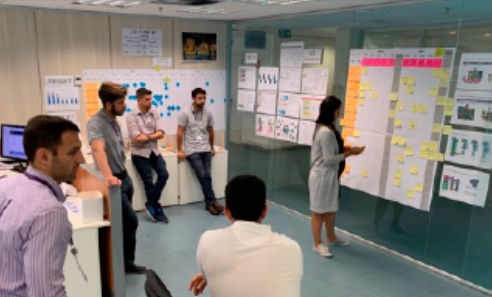
Obeya room at TechnipFMC
Throughout the process, the team asked itself: “How can we ensure that people from across the value stream are fully integrated and involved from the start of development?”
As a countermeasure to potentially answer these questions, the value stream design team adopted readiness levels, a concept they learned through LEI, to create the cross-functional collaboration links needed to generate flow from customer order to delivery.
The readiness levels addressed the technical questions to verify whether each function was ready to meet the development targets. An LEI LPPD Learning Group event led to the idea of creating readiness levels for each critical function. Adapting the idea to its needs, TechnipFMC created a standard way to measure progress and ensure that the evolution of development did not focus only on the product itself, but also on the readiness of the rest of the organization.
Before adopting LPPD, development teams had no clear deliverables or event criteria to determine whether things were going well within the development process. Instead, the team's measure of success was limited to designing a more technologically advanced product.
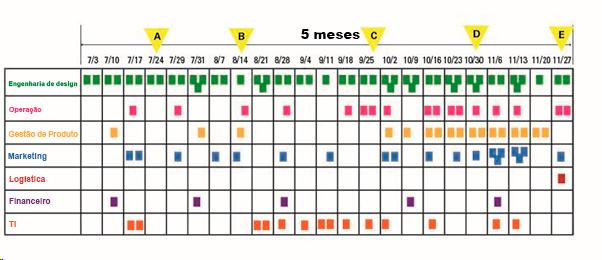
A product development value stream map details the work of each function along the value stream, so that everyone can see how their work fits together.
This is not surprising, according to Morgan. Most traditional product development works this way — without considering the implications of the design for downstream functions — which causes the problem most organizations accept as inevitable: rework. Delaying the involvement of other functional teams in the design usually causes rework because their testing and validation processes often identify problems with the product. For example, manufacturing may not be able to produce it economically, or a supplier may not be able to reliably deliver a crucial component, so they request design changes.
To avoid this rework, Morgan says that designers need to achieve “compatibility before completion” (compatibility before completion), which means that the product design must be compatible with all downstream steps. To achieve this, the team needs to understand the design interdependencies and synchronize the development of each value-creating step.
Working through the problems with the cross-functional teams inside the obeya, step by step, the value stream design team transitioned the Subsea 2.0 platform to a CTO business model in six months, even with the Covid-19 pandemic forcing everyone to work from home.
In the end, the value stream design team credits its ability to execute the CTO business model to the LPPD practices it applied.
Transform the company systematically: defining the future of the business
Many companies — especially those that see LPPD as a project rather than as a constantly evolving development system — would have celebrated the successful product launch and moved on to the next fashionable approach. However, TechnipFMC is part of a select group of leading LPPD practitioners that have continued to use LPPD principles and practices to innovate in the way they run their business in the years that followed.
And it keeps doing so.
Continuing the never-ending journey
Building on its successes, TechnipFMC's development team continues to use and advance LPPD to design new products and the value streams to manufacture them, deliver them and provide services. Through experimentation and overcoming obstacles using the process, the team learned the purpose — and the value — of using the LPPD practices and tools it had initially dismissed.
This systematic approach of learning and applying LPPD methods to solve problems as they arise — and as they develop new products and their processes — step by step created the innovation system that continues to evolve to this day.
And, ultimately, they used these efforts to create a development system that not only guided the company through a crisis, but also transitioned a thriving, large global company to a new business model that changed the industry.;
Perhaps most significantly, the company is adopting LPPD across the entire organization. “We keep saying that [adopting LPPD] is a journey that has a beginning but no end”, says Paulo Couto, Senior Vice President of Global Engineering and Development.;
TechnipFMC has an ambitious goal: to use LPPD in a different dimension. Couto says the company is now exploring how “the product of LPPD can be an enterprise transformation”.
We keep saying that [adopting LPPD] is a journey that has a beginning but no end.
Paulo Couto, Senior Vice President of Global Engineering and Development
This new focus highlights the most critical understanding of lean thinking and practice: adopting it is not a project. Rather, it is the way an organization carries out its work, creates a competitive advantage and, ultimately, moves forward to achieve its mission and vision.







