

8 steps to radical quality improvement

When he first walked into a US forklift plant acquired by Toyota Logistics & Forklift (TL&F), internal quality consultant Sadao Nomura recalled that the facility "was overflowing with so many things that I couldn't see what was happening and where". Defective forklifts sat waiting for repair. Employees were rushing around "confused" to build new forklifts.
The plant had been trying to solve its quality problems since TL&F, formally known as the Industrial Vehicles Division of Toyota Industries Corporation, acquired it in 2000. Nomura visited the plant in 2006, but it had made little progress. A quality improvement ninja with vast experience in other functions in the company, Nomura was chosen by Toyota Industries to improve quality at the acquired US plant and at troubled acquisitions in Sweden and France.
Improvements were expected, but their radical nature (dantotsu in Japanese) was not. In fact, Toyota's main operations in Japan adopted the methods developed by Nomura. He reveals exactly what he did through detailed text and graphics in his new book.The Toyota Way of Dantotsu Radical Quality Improvement.
“Improvements were expected, but their radical nature (dantotsu in Japanese) was not. In fact, Toyota's main operations in Japan adopted the methods developed by Nomura.”
For example, one of the first actions he took was to implement an eight-step procedure, relying heavily on team leaders taking measures to prevent the recurrence of defects. It is an urgent, standardized process that emphasizes investigating the causes of defects and implementing countermeasures immediately. The procedure, which was easy for managers and associates to understand, meant that every part of the company pursued the identification and prevention of defects in a uniform way.
Within two years, the US plant reduced the number of defects found in finished-vehicle inspection by up to 90%. And the effort raised the company to new levels of business performance. In the book's foreword, the company's president notes that one facility increased output from 4,000 units shipped in 2008 to 22,000 units shipped in 2019, a 450% increase in the same production area.
The following excerpt from pages 46-47 of Chapter 3 concisely describes the eight steps used by Nomura:
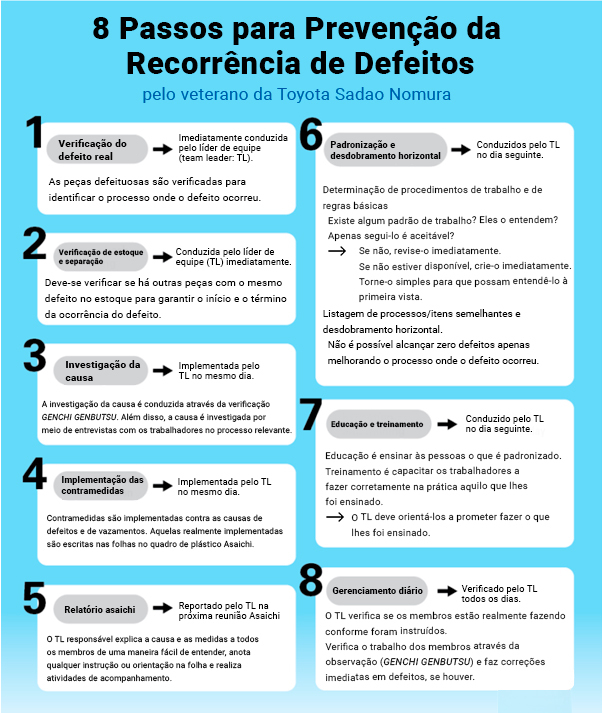
The procedure is a kind of standardized method that allows anyone to understand how to prevent the recurrence of defects. This procedure allows every department of the company to carry out the activity of preventing the recurrence of defects in the same way, and also makes it easy to assess how far it has gone or where the problem lies, so that mutual learning in the organization becomes very easy.
- Verification of the actual defect
- Inventory check and segregation
- Investigation of the cause
- Implementation of countermeasures
- Asaichi report
- Standardization and horizontal deployment
- Is there a work standard?
- Do people understand it? If not, revise it immediately.
- If there is none, create one immediately. Make it simple so that people understand it at first glance.
- List similar processes or items in order to implement the standard horizontally across the company.
- Education and training
- Daily management
Performed by the team leader (TL) immediately. The actual defective parts are checked to identify the process in which the defect occurred.
Performed by the TL immediately. Inventories are checked to determine whether other parts have the same defect and to determine the start and end of the defect's occurrence.
Implemented by the TL on the same day. The investigation is carried out through a check via genchi genbutsu, going to see the problem where it actually happened. In addition, the cause is investigated through interviews with the workers of the relevant process.
Implemented by the TL on the same day. Countermeasures are implemented against the causes of defects and of outflows. They are written down and entered on the "asaichi" or morning meeting board.
At the next morning meeting, the responsible TL explains the cause and the measures to all team members in an easy-to-understand way, notes any instruction or guidance on the sheet, and carries out follow-up activities.
Conducted by the TL the next day to determine work procedures and basic rules:
It is not possible to achieve zero defects just by improving the process where the defect occurred.
Conducted by the TL the next day to teach people the standard, so that they can follow it correctly in actual work.
Checked by the TL every day. Through observation via genchi genbutsu the leader checks whether team members are actually working according to the standard and makes immediate corrections if they are not.







