

Breaking the silence
At Constructora Bolívar, silence is our worst enemy. While certain kinds of silence are good, others are worrying – especially those that stem from people's reluctance to discuss problems.
As human beings, we tend to think of problems as something we don't want, something we need to hide. Whenever someone in our organization says “we'd better fix this problem right away, so the boss doesn't find out”, what we are really hearing is the fear of the consequences of raising a problem, of being blamed for it, and so on.
As such, we want to focus on the emotions that problems create in people within our organization. Despair, worry, fear, panic, unease, sadness, uncertainty, stress… these are just some of the words people might use to describe how problems make them feel, and the worst part is that these emotions are usually caused by leaders.

How many of you have had a boss who told you “you are paid to bring me solutions, not problems”? In traditional management thinking, the person who identifies a problem is considered “confrontational”, “troublesome” or “difficult”. For leaders who think this way, it is much better for someone to solve the problem creatively and immediately, so we can get back to work.
We had exactly this situation at Constructora Bolívar. Before our lean transformation, people described problems as “a situation that got out of control”, “something that kept us from reaching our goals”, “something that kept us from doing our job” or “something that blocked and frustrated me”. Of course, problems hinder our performance and can delay us in achieving our goals, but if we see them this way, we can't be surprised if people want to hide them.
Our challenge was that we didn't have a clear idea of what a problem was and, as a result, we treated all problems the same way. That went on until we decided to embrace problems instead of fearing them (as Taiichi Ohno said, “problems are treasures”). Our lean transformation began at that moment. That was about two years ago.
Our journey can be divided into three phases: conceptualization, adoption and diffusion (although, in reality, we see it more as a cycle than as a linear progression).
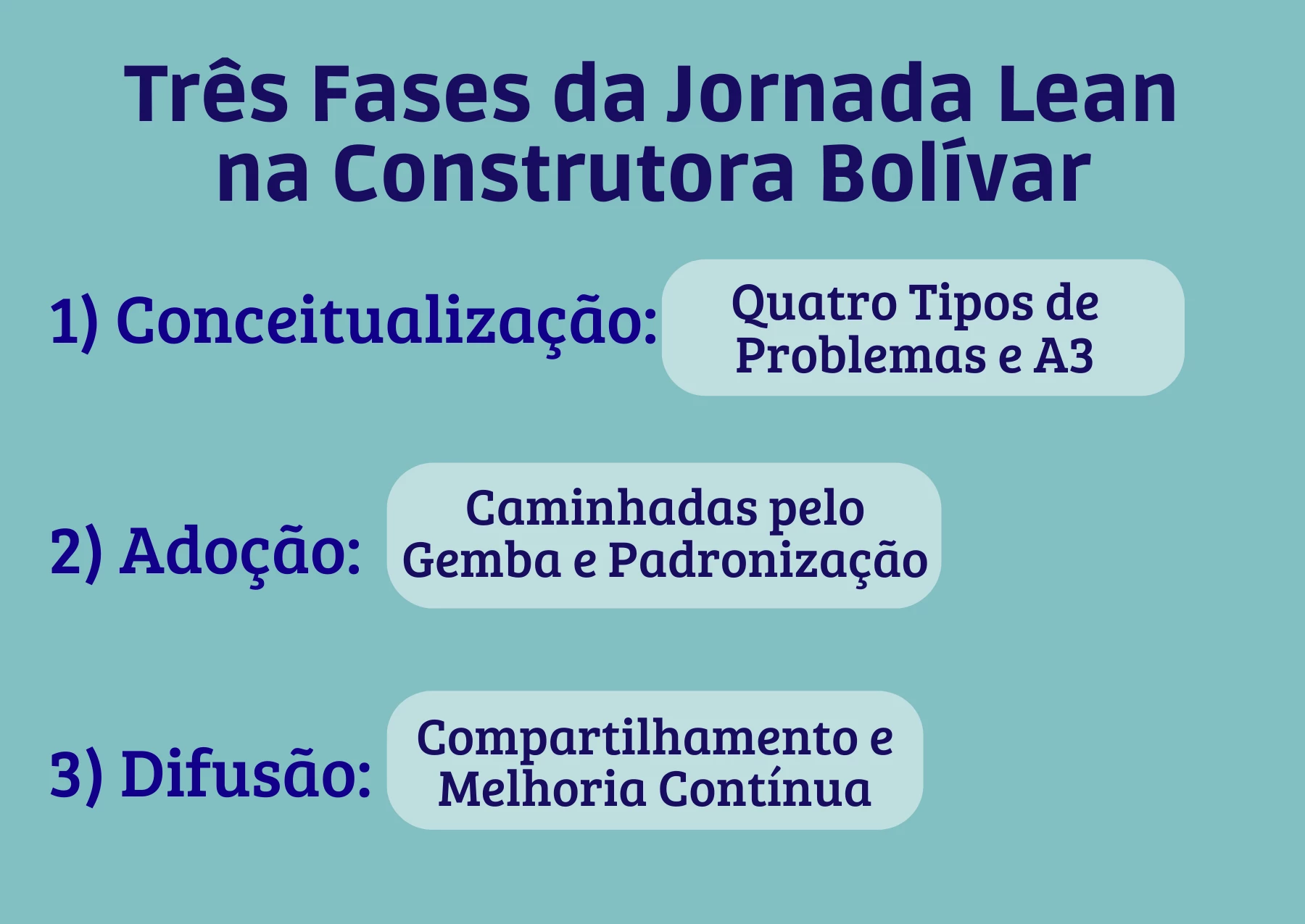
Conceptualization
This is where we laid the foundations, as we worked hard to unequivocally define a problem as a gap between where we are and where we want to be, based on a clear standard.
Realizing that not all problems are the same was eye-opening for us. In fact, the introduction of Art Smalley's Four Types of Problems framework was a turning point that transformed our company's culture forever. It helped us distinguish between caused problems that we face every day to allow value to flow (types 1 and 2) and created problems that enable continuous improvement and innovation (types 3 and 4).
We live in a culture of “here and now”, where problems are expected to be solved on the spot. Our antidote to this was the A3, which forces us to take the time to analyze the problem in depth and identify its root cause to prevent it from happening again.
The training sessions we organized allowed us to take this fundamental knowledge to all our people throughout Colombia, and we keep encouraging them to put these lessons into practice in the gemba. This is what ended up transforming their definition of a problem. Today, our people consider problems as “a gap”, “a situation that is not as it should be”, “the difference between where we are now and where we want to be” or “an opportunity to find different ways of working”.
Adoption
After developing our team's problem-solving capabilities, we moved on to the next phase – adoption. We started by going to the gemba to observe and ask questions. We investigated the work, engaging with value creators to learn what their problems were. At this point, waste became visible as a source of problems – a connection we had never seen before (we thought waste was just part of the job).
That was when we made one of the biggest discoveries on our lean journey to date: data always beats opinion. Nowadays, we talk about exact numbers and percentages, not estimates (“a little too high” or “lower than we thought”) and, when we can't, it is clear to us that the standard doesn't exist or isn't clear enough. Together with the introduction of standardized work and results tracking, this made a huge difference.
As people began to understand what a problem is, A3s started popping up all over the country, focusing on all kinds of problems, from waiting times to material waste. We also held “problem-a-thons”, which are problem-solving marathons during which we involve the team from a construction site and other areas involved in the process. That is how we began to connect the dots and develop an end-to-end view of our work.
Diffusion
Problem solving and the knowledge it generates belong to everyone. There is no value in having one person or one team make an improvement on their own. Once we started sharing everything we learned about problems, we saw an acceleration in the pace of change and improvement across the organization. We are proud to have solved more than 70 problems with the A3 methodology, involving more than 14 areas and more than 600 people. From a financial standpoint, problem solving has saved us an impressive one and a half billion Colombian pesos (which comes to more than one and a half million Brazilian reais).
Final remarks
We feel we have learned a lot about ourselves and about what it takes to drive lean change in an organization. So we would like to share some final considerations that, we hope, will help you in your own reflection.
- Shifting the organizational culture toward transparency about problems leads to better process flow. The easier it is to identify problems, the more problems we can tackle, with positive results in productivity and efficiency.
- Addressing problems in a structured way and identifying their root cause leads to effective solutions that enable continuous improvement and speed up innovation.
- Once the problem is solved, it is essential to share the lessons learned and standardize them, to ensure the problem does not recur elsewhere in the company. This is fundamental to ensuring the sustainability of any change initiative.
As we look back on the last two years, we realize that none of this would have been possible if Constructora Bolívar had not decided to “break the silence”. In fact, change can only happen when we talk openly about problems.







