

A company-wide cultural transformation
“The only true wisdom is in knowing you know nothing,” said the Greek philosopher Socrates. This well-known mantra embodies our company culture at SKC. At a time when the word “transformation” is on everyone's lips and so-called experts swear they have found in digitalization the answer to everyone's problems, we decided to base our own turnaround on the important concept of humility.
Our need for transformation became clear five years ago, when we started asking ourselves what kind of business we wanted to be and how we could adapt to a changing world. At that time, we decided to revisit our company's mission and defined a strategic intent with five pillars: end customer, manufacturers (of the machines and equipment we sell and service), business model, people and technology (recently, we added a sixth idea, sustainability – understood as financial, social and environmental).
We see technology as a way to support processes in delivering more value to customers and stakeholders, not as an end in itself. We also believe that you cannot digitalize what has not gone through the filter of a cultural transformation, which is why our True North from the very beginning was to change our way of thinking.
Once we had defined the core ideas underpinning our strategic intent, we began looking for a framework that could embody them. We already had a few people with some experience in lean, and it didn't take long for us to realize that, of all existing methodologies, lean thinking is the only one that could lead to the change in mindset we were looking for (we refer to it as Kaizen Lean, to further emphasize the importance of continuous improvement). Knowing that we knew nothing and armed with a good dose of humility and curiosity, we started out as self-taught learners to study and learn as much as we could about Toyota and lean thinking.
At the end of 2017, we chose an area to run a pilot project, a limited experiment to test the new business idea we had created. It was the first time we tried to redesign an entire process, taking logistics services that were scattered across the business and integrating them. The concept was basic: the traditional centralization of administration with distributed processes. Of course, centralizing was not a way of dictating how to work, but rather the creation of a standard that could be replicated in different scenarios without compromising process stability.
In the first months of 2018, the project was completed and we achieved a 54% reduction in spare parts import time. This generated considerable interest across the company and led to more experiments in other departments – including our workshops. To achieve the long-term transformation of the business, we have to make sure everyone thinks and acts lean. That is why we opted for a bottom-up approach, looking for the processes that are deeply rooted in the company's core operations and trying to get some quick, visible results that would make it easier to spread the lean culture.
The main lesson we learned from that first experiment, however, was that (as Socrates taught us) we knew nothing. That is why we asked the Lean Institute to support us in the new challenge of making lean thinking part of our company's ecosystem. They have supported us ever since as we spread lean throughout the company (today, they even work directly with senior management on hoshin). Their help with lean, together with the great learnings about kaizen we gained from our study of Toyota's practices, allowed us to develop our unique approach to continuous improvement.
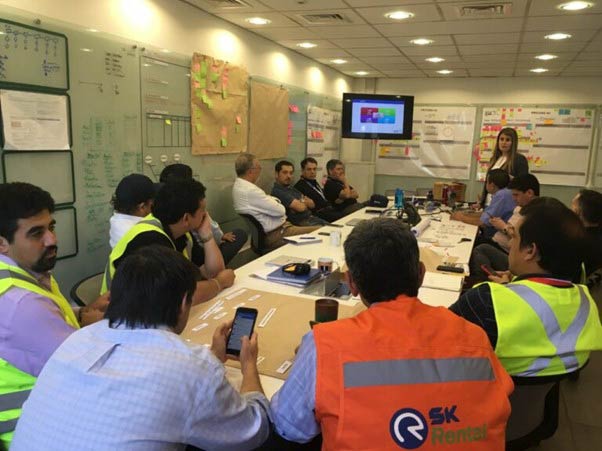
Some of the things we did
As mentioned, one of the main things we focused on was connecting processes that were previously disconnected (and often physically separated). We brought together, for example, the purchasing area, the international factory, the comex (foreign trade) department, the logistics department, accounting and the distribution center, creating end-to-end process visibility. The result was a significant reduction in parts delivery lead times for our customers.
When we opened an A3 on the quality of our service, we also gave people visibility of the entire value chain. For the first time, people sitting at their desks in different offices were becoming aware of one another's work and of their contribution to delivering value to customers.
Thanks to our Kaizen Lean approach, we also reduced the percentage of obsolete spare parts in our inventory and improved the productivity of our workshop (which we previously didn't even measure). We defined a standard, identified the right performance indicators, created a project team that opened an A3 on the process, and reviewed the way we do the work. We started measuring how long equipment stayed in the repair bays, for example, to understand how much capacity we were using at any given time. As we eliminated waste in the process, we gained speed and, with it, more revenue.
An accelerator of change
As we started more lean projects, we discovered how basic tools (such as 5S, daily management or spaghetti diagrams), together with discipline and determination, can help us transform the way people think. Little by little, the business became more inclusive and horizontal. In the teams working on lean improvements, there was no place for traditional hierarchy: we were all people trying to contribute to reaching a consensus around improvement opportunities, which we then turned into countermeasures for our problems.
The most interesting thing is that people became autonomous, started owning the processes and understood the importance of standards and tools. They no longer needed the boss breathing down their necks and asking them to “do 5S” and keep their desks tidy, for example, because they were aware of the impact of tidiness on productivity and of the importance of productivity for the health of the business.
Not everyone came on board immediately, of course, but when we encountered resistance, we could count on another powerful lean tool: visualization. Anything that becomes visible becomes manageable, and then it is up to the people. In other words, lean makes you capable of tackling a problem, but the decision to step out of your comfort zone and internalize its principles and techniques is entirely yours and depends on your attitude.
We know that lean transformations are a long process, but in practice we found that lean turned into an accelerator of change. In fact, over time, our efforts to establish a lean culture became the main driver of SKC's transformation, with continuous improvement and learning at the center of what we do.
For example, when we decided to obtain three ISO certifications (9001, 14001 and 45001), we managed to do so in just six months – a process that normally takes four years. This is entirely due to the lean culture we have worked hard to establish: our workshops were already organized to work efficiently, we already had solid safety protocols, we already had the practice of routinely listening to people to learn about problems in the gemba, and so on. We were so successful with the ISO certifications at our headquarters in Santiago that we decided to do the same at our branches as well, which we achieved in three months.
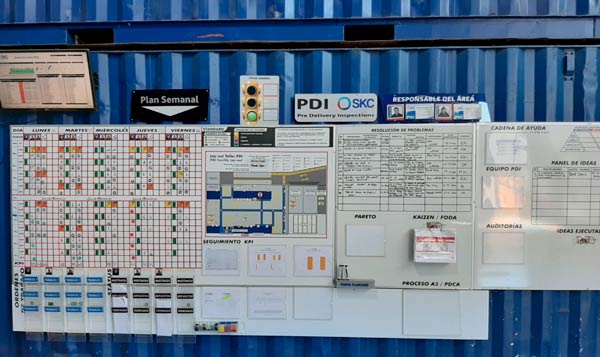
A business model for competitiveness
There have been countless lessons for us on this journey. We learned, for example, that by humbly listening to our people, we can always find a path to success. We learned that PDCA must be the foundation of all problem-solving efforts. We learned that accountability is everything, which is why every countermeasure we decide to try has someone's name written next to it, to ensure a sense of ownership. We learned that the company's traditional hierarchy works against delivering value to customers, because it creates barriers between departments and management levels. We learned that the speed you need in today's world requires everyone to have clarity about the end-to-end process and to be humble enough to flag errors and problems. We learned that when people who stay humble and see the results of their work have problems, they move ever closer to a better version of themselves.
I believe the only way to take a step forward is to accept that sometimes you take steps backward. Lean teaches us to try new things and make mistakes quickly and cheaply. Transforming our culture involves an endless effort, and it is up to us leaders to hold our ground until people become autonomous thinkers and problem solvers.
Since we made the conscious choice to institutionalize lean in our company, I would say that about 75% of the 1,100 people who work at SKC are now participating in lean in one way or another. We have already had more than 50 A3s in various business areas (this is one of our main tools for problem solving and, interestingly, a large share of these A3s were developed during the pandemic as a way of being together even while apart) and improvement activities constantly in the gemba. We are determined to continue on this path until lean thinking permeates every aspect of our company's life. We see lean as a business model founded on transforming people's minds and as a framework that can set us apart in a competitive market. It is fundamental to ensuring that SKC's future is bright.







