

Lean Inception: How to adapt quickly and save your business
Lean Institute Brasil: Amid so many changes happening ever more quickly, customer needs fluctuate very frequently. What allies do we have to help us adapt to change?
Fábio Trierveiler: Many people think of creative work as something loose and disorganized, as if structure killed creativity. However, the creative process can and should be structured; this is an important point. Contrary to the scene in a stereotypical creative workplace, this process does not just involve a few people sitting at a table sticking sticky notes on the walls; it is much bigger than that.
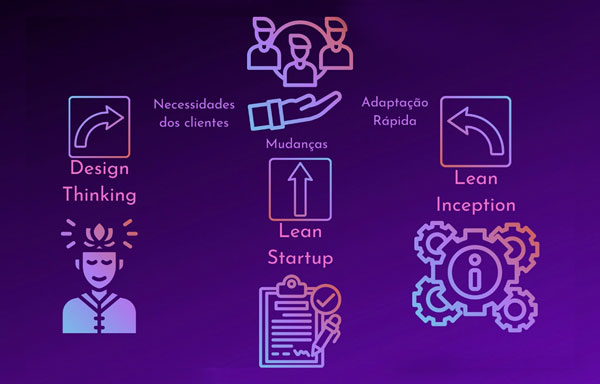
In this effort to structure the creative process so as to respond to these changes and keep the company always up to date with customers’ needs, there are some methodologies, frameworks and ways of thinking that aim precisely to create this necessary adaptability; among them are design thinking, lean startup and lean inception, which we will discuss at our next event.
LIB: What are these concepts of design thinking, lean startup and lean inception?
FT: Well, let’s start with design thinking. I like to compare it to an umbrella: when it starts to rain, we open the umbrella to protect ourselves from the water, and when it stops raining, we close it, because we no longer need it at that moment; so an umbrella gives us the ability to adapt to different weather. In the same way, design thinking gives us the foundations to think outside the box and unleash all our creativity, but it gives us the security of being able to return to the basics when necessary. In this way, it allows us to diverge and converge thoughts and ideas in a structured way, focused not only on delivering the product, but on always feeding back, testing and learning together with the customer.
Moving on to lean startup, it starts from the premise that it is from our mistakes that we learn. However, the frenetic world we are living in does not give us much time to learn. So, when we talk about lean startup, we are talking about failing and learning faster. Lean startup brings in many concepts of the MVP, or Minimum Viable Product. In other words, with it, you can deliver value faster in a, let’s say, reduced version, but one that is essential and delivers value (which is the real focus: delivering value). In addition, it allows us to learn quickly from customer feedback and improve the product quickly as well.
Finally, lean inception brings all these concepts together in a highly structured process, which can take anywhere from four hours, if it is something very simple with few steps, to forty hours, if it is something more complex. So lean inception is a very structured way of allowing us to use all these techniques.
LIB: Tell us about a case in which lean inception brought some insight or discovery that without it we might not have reached those conclusions.
FT: The first thing that comes to mind is a case in which we were running a forty-hour lean inception for a health plan management app. We were analyzing the app, and when we got to the part about registering people, which lets us understand the niche we can serve, there was a persona called “João, Family Man”. We looked at the characteristics of this profile and found out that he had two children.
At that moment, someone came over and said: “Wait a minute, if the child is two years old, does she have a health plan too?”. The answer is yes, of course. The person went on: “So will the child have to have a login and password to get into the app?”. “With their little kid’s finger…”, someone even joked. But the answer is clearly no. So we came to the conclusion that we needed to create a dependent registration module.
No one had thought of this until then, and we were already on the third day of the five-day inception. So, through one of the techniques, we created a whole new module for registering dependents, in which the father or mother could create and register their children. This is just one of the examples we have in which lean inception manages to help ensure the right product for the right person and with the best possible quality.
LIB: What can we expect from the event? What can a participating company gain from it?
FT: More than understanding what the customer needs, we often have the opportunity to create the need before it even exists. Since the world’s rapid changes demand even faster solutions, lean inception gives us that agility. However, it is not just about agility: we cannot focus only on being fast and then not deliver the right thing or deliver without quality. That is basically what we are going to teach: how, through lean inception, we can deliver solutions faster and ensure that we do the right thing for the right person, with quality.







