

A transformation fueled by a successful kaizen week
Brazilian notebook and planner manufacturer Tilibra achieved, in just five days, improvements of more than 50% in important business indicators, such as reduction of failures, adherence to the production plan, reduction of losses and OEE improvement, by holding its second kaizen week, a concept that comes from lean thinking. See below the main results they achieved in just one week:
Main results
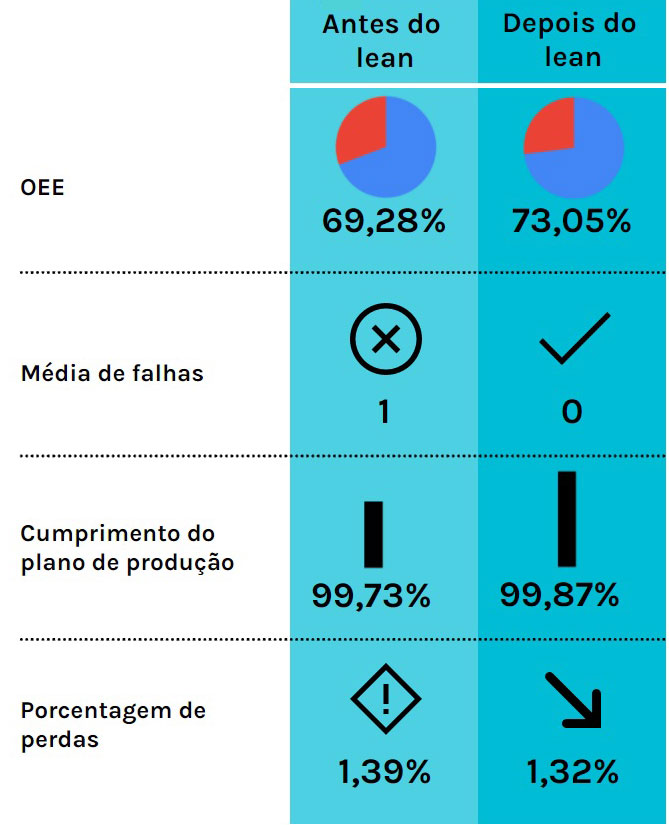
All these results had a direct impact on the smoothness of production, reducing the number of interruptions to machines and operators, on safety and on the improvement in the quality of its products. All of this was possible thanks to the commitment of everyone involved in building the VSM (Value Stream Mapping), identifying the main obstacles and improvement opportunities aligned with a results matrix and a focus on executing these actions during the Kaizen Week. During this week, 71 actions were suggested, and 52 were implemented immediately. The actions aimed at improvements in equipment, process, quality, safety, 5S and planning.
The company operates in an extremely seasonal market niche – notebooks and planners are bought very little from March to November, but their sales rise astronomically at the end and beginning of the year, when we are in the transition from one school year to the next. Tilibra therefore needs to be prepared for this market seasonality in order to meet peak demand. For this reason, they were looking for conceptual and technical alternatives to overcome their push production and serve their customers better. Lean emerged as an option for this more assertive management.
In its first contact with the philosophy, Tilibra was introduced to the concept of lean office, that is, the application of lean in administrative environments. The prospect of using lean in the office made the company president's eyes light up. However, they decided to start with a pilot in manufacturing and only afterwards apply the mindset to the office. One of the initial focuses of their journey is kaizen (more specifically, holding a kaizen week, seeking improvements for the company).
Before moving on to the office, they sought maturity in manufacturing, holding two kaizen weeks at different times: the first was a pilot kaizen , whose good results raised everyone's spirits to move on to the second stage. The second showed the maturity the company had developed after a few months of working with lean, with an even smoother week that resulted in the impressive achievements mentioned at the beginning of this article. So we have gathered some tips and lessons learned that Tilibra would like to share with the lean community on how to hold a successful kaizen week.
Tip #1: The kaizen week requires discipline
Taking part in a kaizen week requires everyone involved to be completely dedicated and committed. It is vital that everyone be focused on achieving the objectives and targets defined in the A3s, always getting fully involved in the discussions and in the possible solutions to be implemented. For this, everyone needs to be available and, above all, open to the changes (Lean Thinking) that will occur in the work after the improvements are implemented. A good gauge of people's engagement in the kaizen week is adherence to the schedule: how are we carrying out the actions compared with what was planned? Are the times being kept? Pay attention to these details to make the most of the potential of the kaizen week.
Tip #2: Everything starts with Leadership
Before expecting everyone to be engaged in the kaizen week, it is essential that leadership be at the forefront of the entire project. Without active, participative leadership bringing everyone on board, engagement will be severely compromised. Leaders are responsible for planning and, more importantly, for sharing the results and publicizing the week. Everyone needs to know that we are in a kaizen week.
Tip #3: The secret is objectivity
The essence of the lean philosophy and, above all, of a kaizen week lies in simplicity. We often get stuck on complex actions and held back by bureaucratic issues when making improvements. This hinders all the work and prevents us from achieving the objectives we are pursuing. What makes the kaizen week so efficient is its objectivity. When presenting improvements or changes to be made, always try to be as direct as possible, making clear to everyone what needs to be done and when. Using images and few words makes everything simpler to understand and implement.
Tip #4: The kaizen week is a reflection of lean culture
The kaizen week cannot be thought of simply as a week of improvements. It goes much further. Working an entire week with a focus on kaizen should be a unique experience that promotes total immersion in lean culture. In this way, it is possible to ensure that all possible replications and extensions of the projects are carried out in the future and as quickly as possible, the heart of yokoten. Don't forget: the foundation of lean is thinking before investing and going to see. The kaizen week should involve minimal investment and expense and as many hands on deck as possible. Practice “Trystorming”, that is, sweating over the thinking and getting your hands dirty.
Tip #5: Have fun
At the end of the day, the kaizen week should be fun for those involved. They can forget about personal problems, setting aside cell phones, e-mails, WhatsApp and the like, and truly connect with the work and with their colleagues. If the kaizen week is a burden for people, and they are complaining about having to do it, something is wrong. Create a positive environment so that they can enjoy themselves during the week, celebrate each result achieved and look forward eagerly to the next one.
Always keep learning
Tilibra has already held two kaizen weeks in its efforts. Although the first week had already been a great success, the progress they made from the first to the second was remarkable. They learned the importance of teamwork: together, they gathered 71 problems with actions to solve them, something no human being could do alone. Of the actions listed, 73% have already been implemented, with 94% of the lower-effort ones (after an analysis using the Impact vs. Effort matrix) in place.
They also learned the importance of planning, publicizing and engaging people during the week. They divided the week into three stages: on the first day, the focus was on training people and starting the process of looking for improvements; on the second, third and fourth days, they carried out the improvements in the Gemba (a Japanese term meaning where things happen, where the work is done); finally, the fifth day was dedicated to celebration, an important moment to recognize all the achievements they had made. In this way, they integrated all departments (production, maintenance, operational efficiency, warehouse and PPC) and ensured everyone's dedication, all with a low capital investment.
Living with the problems and seeing them through the VSM (Value Stream Map) gave them a clear view of the processes and made it easier to point out more problems, ensuring alignment between production and shutdown planning. Finally, they managed to implement the actions without bureaucracy, adopting the true spirit of kaizen. Holding a kaizen week is not synonymous with simply holding a week of improvements; it is synonymous with diving deep into a new culture, a culture of continuous improvement: the lean culture.







