How a focus on people accelerated a lean transformation
When Halfway Toyota acquired Ngami in 2013, our people were scared and angry: the same owners had run the car dealership, and suddenly a big change was on the horizon.
I had seen acquisitions before, with people fighting them and wanting only to keep their old habits. That never worked. Halfway wanted us to introduce lean thinking, and I was determined to do our best to try to change.
At first, there was distrust and militancy: people felt let down and did not understand the new system we were trying to implement. The context around us certainly did not help. Life in Botswana is hard: many people in our district live in poverty; those who are better off take care of (by working) up to eight family members – an important role in Botswana society and a part of our culture of respect. People often live in single-room houses, without electricity or water. Many have sick relatives to care for (our country is facing a severe HIV/AIDS epidemic, with the third highest adult HIV prevalence rate in the world).
Everything seemed to be against us, and it took a lot of work, pain and tears to overcome the obstacles we faced. However, it was by recognizing that life is hard that we found the key to our transformation.
Overcoming resistance
When Terry O'Donoghue, COO of Halfway and former vice president of Toyota in South Africa, and Dave Brunt, CEO of the Lean Enterprise Academy, first came to Maun to help us start the dealership's transformation, Ngami was very difficult to control. I often compare it to a dragon, which generates a lot of gold but does not release it willingly. The previous management was convinced that the only way to tame the beast was to be assertive and say “no”.
We decided to try a different approach, one that recognized the difficulty people were facing at work and at home – an approach that would make their work easier to understand and carry out. Work does not need to be complicated. We want our people to be able to do it on bad days as easily as on good ones, even when the antiretrovirals they take are causing side effects or when they have spent the whole night awake caring for a sick relative. They need the job and they need to do it right, no matter how they feel.
The real transformation at Ngami began when we started to respect everything our people were going through. Why would we want to make someone's work and life harder than they already are?
Desperate to get our people on board, we decided to have one-on-one conversations with each of them; each of these 86 individuals is valuable to us in their own particular way, and not merely as a “workforce”. We discovered that their complaints were also individual. It took weeks to explain to them what we wanted to do, but listening to their concerns and problems – one by one – built trust between us and, in the end, convinced everyone to give lean a try.
Introducing lean thinking and practice at Ngami
The time we took to lay the foundation for change made a big difference in the resistance to implementation. We knew from the start that Ngami would be different – and it really was. As the books tell us, lean implementation is situational. Our culture on the edge of the Kalahari is unique, and introducing lean tools and principles required a unique approach based on simplicity and fun.
Time, for example, seems to have a different meaning in Africa, so we had to work hard to explain to our people that fast and efficient service is something our customers value. To show them the importance of time in planning our workshop, we used an abacus, assigning 10 minutes to the white beads and 60 minutes to the red ones. We made it as visual as possible.
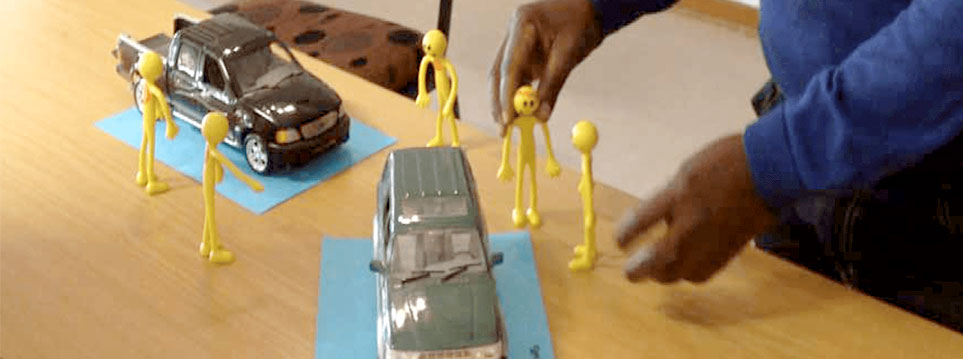
The bottleneck we were experiencing at the wash bay became visible to everyone when we started using small model cars on two shelves with pieces of paper illustrating half-hour intervals. At the same time, we began mapping vehicle movement in the dealership using a vehicle control board with magnetic chips.
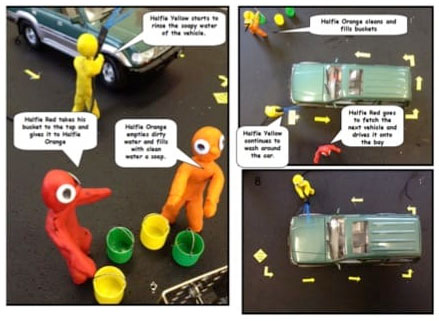 Ngami's leaders used little men made of Play-Doh and model cars to make work processes visible, which helped the team see and understand bottlenecks and eliminate them.
Once they grasped the fundamental mechanism of the process, we introduced standardized work to build quality into our services – another significant way of delivering value to customers. For example, we used little men made of red, orange and yellow Play-Doh (which we nicknamed Red Halfie, Orange Halfie and Yellow Halfie) and model cars to divide the work at our wash bay and assign specific tasks to each of the people there. You can see an example of this in the comic strip below (in English).
Ngami's leaders used little men made of Play-Doh and model cars to make work processes visible, which helped the team see and understand bottlenecks and eliminate them.
It is all a matter of communicating in a way people can understand: using toys to explain purpose, movement and directions made all the difference for people who are not familiar with diagrams and schematics. It also unleashed their creativity and problem-solving ability. Once people were allowed and enabled to participate, energy and engagement exploded. Team members began explaining the thinking and the changes to other team members, which took on a completely different dimension when they used the toys.
We do very little classroom training at Ngami, focusing more on learning at the gemba. What people see in a PowerPoint slide presentation they forget; what they learn with the toys will stay with them forever. When you speak to people in the right way, the desire to learn is almost irresistible.
Soon after standardized work, we introduced the concept of kaizen, aware that it can only be done after fully observing and understanding the work. Over time, Dave filmed dozens of hours (it is so easy with phones these days): the videos allow us to see together, learn together and act together. When you can see the work, real learning happens. Watching a car wash, for example, highlights problems in the process, and once we know what the problem is, we can start thinking about possible countermeasures.
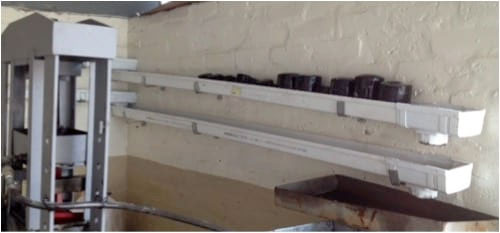 The Ngami team discovered that solutions to problems can be simple; in the example in the photo, they used plastic gutters to drain the oil filters.
Improving is not that hard, and kaizen can be as simple (and cheap) as using plastic gutters to drain the oil filters, as shown in the image below. Want another example? We used to pack wheel bearings by hand, but after we started using lean, our team designed our own tool (using plumbing supplies) to pack them, which resulted in a 20-minute saving in the time needed to complete the process. The critical lesson we learned here is that kaizen must be done by the people who do the work: when they are involved, they thrive; when they are not, they simply nod and keep doing things their own way.
The Ngami team discovered that solutions to problems can be simple; in the example in the photo, they used plastic gutters to drain the oil filters.
Later, we taught them about flow, introducing important changes in the way we work. With the batch logic we had used for so long, it took us an average of 31 minutes to wash a vehicle, and the quality of service was poor. Today, we wash cars in a single lane around the wash bay, completing a wash every 16 minutes with consistent quality. We learned that simple automation can take precious time out of the process when we built a drive-through water and soap station (using cheap components bought at a hardware store), which saves us five minutes for every vehicle we wash.
There is more. To deal with the unpredictable work that often interrupted flow in our service and repair processes, we created a pre-diagnosis, in which we inspect vehicles before the formal process begins. Vehicles leave the station with a checklist indicating all the problems detected, which allows us to secure quotes, parts and approvals in advance. As a result, we eliminated all the stagnation that previously occurred at the lifts; technicians can now do the work from start to finish, without any interruption or delay; in addition, we saw a 20% efficiency improvement across the entire workshop. We do not know of any other dealer who has tried it, but it has dramatically improved the productivity of our operation.
Our experiments with flow brought enormous benefits to Ngami, but we hit an obstacle when we reached the 30-vehicles-a-day mark. The reason? Administration could not keep up with the increase in vehicle volume. So we began mapping the skill level of our people in the office and, for each vehicle, assigned tasks to the right people based on their knowledge and the time needed to complete each task. After that, we managed to put administrative work into a single-lane flow (I cannot stress enough how important 5S was) – which had an immediate impact. As a result, we can now process up to 50 cars in a day without a drop.
Our traditional way of working meant we could expect, at best, no more than four or five washes a day on one lift. With the introduction of lean and flow, we can produce up to five times that number with a single lift. The impact on our financial performance was also remarkable: between 2013 and 2015, our average monthly turnover rose 57%, our average monthly profit increased 111%, and our cash grew 161%.
Leading with respect is essential for success
Despite having started its lean journey three years after most of the other Halfway dealerships (most of which are located in South Africa), Ngami caught up with and even overtook many of them in less than two years. We are very proud of what we have achieved.
Ngami's success would not have been possible without the active participation of our people, which, in turn, we could not have achieved without showing respect. Thinking as a leader, lean thinking seemed a natural way to approach change, probably because I too struggle to deal with large amounts of information. I am not a particularly fast thinker and I need to sort and organize information. Early on, something occurred to me: how could I expect my people to understand the work if I did not understand it?
I have learned that lean is often about turning our weaknesses into strengths, but to do that, we must first be humble enough to recognize that we all have our limits. Unfortunately, this is not easy in the traditional business world (in Botswana and elsewhere), which rewards leaders for showing how smart they are rather than for making work as easy as possible for their people.
We are nothing without our people. Make caring for them your focus, and lean will honor and reward them. At Ngami, we constantly see examples of the significant impact of providing jobs. A recent example: a newly hired employee recently completed her probationary period and became permanent, which meant she could afford to bring her son to live with her, since he had previously lived with his grandmother, who lives 500 km away. This, in my opinion, is the kind of thing that really matters.