

Lean and Agile empower “what” and “how” to do

The essence of Agile is not delivering faster, but rather making mistakes and learning more quickly. And in a world of constant change, great uncertainty and low predictability, adapting quickly has never been so necessary.
Accordingly, building on the learning developed by Taiichi Ohno at Toyota and later refined by James Womack at the Lean Enterprise Institute and by José Roberto Ferro at the Lean Institute Brasil, the Lean Institute Brasil's lean digital team developed the Lean Digital Transformation Journey.
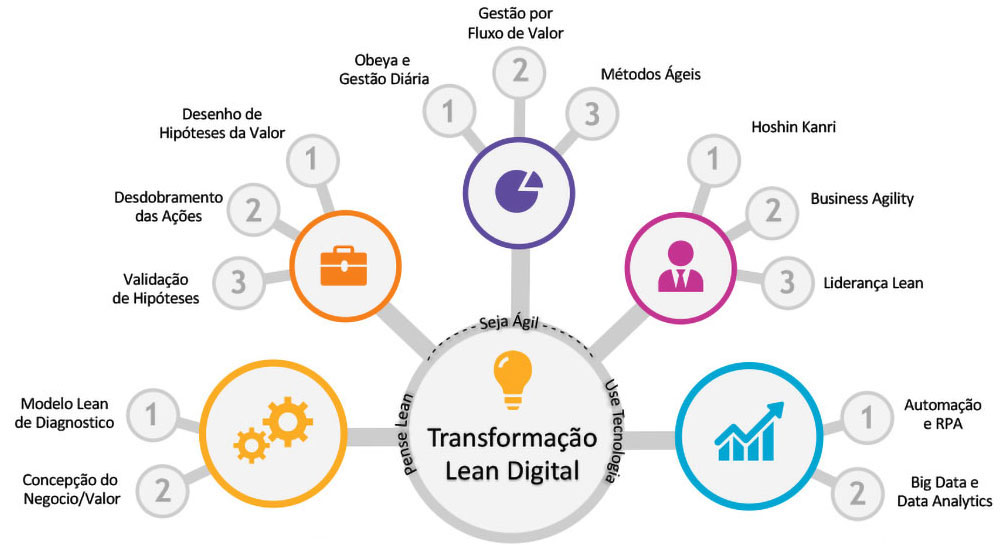
While lean helps solve the right problem, agility supports rapid adaptation, so that the course toward the purpose can be adjusted whenever necessary. Thus, knowing what to do is essential so that, afterwards, one knows how to do it.
Discovering “what to do” through the conception of “business” and “value”
Developing new products and services is important and valuable for companies that aim to grow, transform and evolve. However, many of them sometimes create products or services that are not connected with their customers' wishes. This disconnect is harmful and, as a consequence, wastes effort and time and raises resource costs.
To avoid this disconnect, we use a model based on Design Thinking, Lean Startup and Product Discovery techniques to conceive new lean products or services, oriented toward maximum value creation and truly connected with the customer and their real needs.
We use discovery frameworks and methods that help the company gain a deep understanding of problems and generate solutions that actually add value. The expected result is an understanding of the customer's behavior, expectations and desires, also from the business perspective, providing them with a better experience.
Finding “how to do it” through lean-agile governance
In the context of organizations' current digital transformation, the inappropriate use of agility prevents the expected results from being achieved. Merely creating “squads” does not make a company agile. Grouping people without autonomy, multidisciplinarity, systemic conditions for decision-making and direct contact with the customer generates more waste and invisible silos.
We understand that agile values and principles, when applied with purpose, in all their fullness and essence, ensure the necessary results and the sustainability of the digital transformation. In a structured way, using lean thinking as a foundation, developing lean-agile governance will help the company become truly agile. In other words, it enables a rapid response to the market (time-to-market) and responds to change in a strategic, value-driven way.
It is common to find managers who still work with an outdated command-and-control management model. Lean digital transformation brings about changes in every sphere of the organization. An essential element for sustaining these changes is leadership development, since leaders will be the main forerunners and disseminators of lean thinking.
The foundation of a transformation is building a simple organizational structure that allows response to customer changes, supported by lean leadership that engages, guides and sustains matrix teams autonomously, always with well-defined objectives, targets and relationships, continuously discovering and delivering value.
Lean and agile together
If we look at the concept of the improvement kata , we see that the purpose (1) is always visible to everyone taking part in the journey. To evolve from where you are (2) to the next step (3), you need to lead a journey (4) of solid learning, using lean thinking techniques, and rapid learning cycles, using agility techniques.
Toyota Improvement Kata
Being agile has never been so much in vogue. It is no longer exclusive to IT – although every sector that wants to stay alive needs it. Agility is present in HR, in marketing, in traditional administration and in so many places that need to reinvent themselves at the speed the market requires.
In February 2001, at The Lodge at Snowbird resort in Utah, in the United States, 17 thinkers, professors and professionals who were highly influential in a wide range of fields related to better software development got together and, after a heated weekend of intense debate, arrived at the "Manifesto for Agile Software Development", made up of 4 principles:
- Individuals and interactions over processes and tools.
- Working software over comprehensive documentation.
- Customer collaboration over contract negotiation.
- Responding to change over following a plan.
In the manifesto, the aim is always to make more intensive use of what is written on the left; that is, while there is value in the items on the right, the items on the left are valued more.
However, one thing is essential: notice that what separates what is on the left from what is on the right is ‘over’ and not ‘instead of’; that is, it does not mean we will stop having processes because "now I am agile", or that I will tear up contracts and only make business agreements on Post-its "because I am agile". What matters is always balance.
Agility is a means, not an end
If you have doubts about “how perfectly” you are applying a given tool or practice, or “how agile” your journey is, remember that the purpose always needs to come first. If your organization is adapting at the right speed to move in the right direction, with more satisfied customers, a healthier business and happier professionals, this is the way.
Now, think of a company's journey as if it were a long-distance race: you do not necessarily need a pair of sneakers to run a marathon, right? But let's face it, it is much easier to wear proper footwear than to run barefoot. And agility follows the same path: it does not guarantee better results, but it maximizes – greatly – your chances of achieving them.
The pursuit of agility is nothing new in companies, but many do not truly understand the real meaning of being agile. Being agile consists not necessarily in delivering faster, but in using agility to learn faster and adapt more quickly toward the purpose. And to become truly agile, combining lean thinking and agile is the best way. So, if you want to survive in a world of exponential change, the dynamism of agility combined with the solid foundation of lean thinking is the recipe for success!







