

Lean in car dealerships
Introduction
Taking your car to a dealership is not one of the best experiences we have in life. First of all, when we take our car to a dealership, it is probably because it has developed some problem; second, sometimes it has no apparent problem and we take it in for a periodic service, during which it turns out the car has a few problems; not to mention that sometimes it stays at the dealership longer than expected.
This article aims to question some assumptions that exist in some dealerships and to show how they can be overcome by applying lean concepts, providing more value to the customer. Another important point is to present how it is possible to start a project to begin the lean transformation of a dealership.
What does the customer expect?
Understanding what the customer expects is the first step to beginning the transformation. The first answer that comes to mind is: "they expect the agreed service to be carried out in the expected time". Although this view is obvious, it is not so easy to achieve.
Often the customer does not know what service they need. The only thing they know is that there is usually a problem or that a particular service has to be done on their vehicle. This leads some dealerships to tell the customer that a diagnosis is necessary to define what must be done and that, for this, the vehicle needs to stay at the dealership all day. This estimate is often given even for a simple service and a basic oil change.
What the customer really wants is for their problem to be solved as quickly as possible, preferably before the end of the day. This definition of what has value for the customer is fundamental for rethinking business strategy. Some dealerships assume that the customer wants to leave the car at the dealership all day, so that they can go to work and pick up the vehicle at the end of the day.
This point of view may be valid for some customers. But if we give the customer the option of picking up the vehicle in 1 or 2 hours, they will certainly wait for the repair so they can go to work in their own car, instead of going back and forth by ride service or public transportation.
How can we provide the service at the right time for the customer?
If the customer expects their car to be serviced in the shortest possible time, what prevents us from doing so? Why do almost all services take 1 day to be carried out? Understanding what activities are performed on the car during its stay at the dealership is fundamental for understanding which activities can be improved, or eliminated, so as to reduce the time from 8 hours to 2 hours.
To fully understand what happens to the vehicle, we can use the Value Stream Map, a tool widely used by companies that practice lean — of course, some adaptations will be needed to make its application feasible. Conceptually, the map represents the flow of information, which begins from the moment the customer calls to schedule the service, and the flow of material, which in this case is the car, that is, from its arrival until it is delivered to the customer.
To begin drawing up the Value Stream Map, first of all it is necessary to define the service family, which is nothing more than a classification of the types of services performed at the dealership by execution time and number of services - this definition helps group services together to make it feasible to draw the map with a focus on certain types of services that make it possible to create standardized work in the future.
"Sifting" the Services
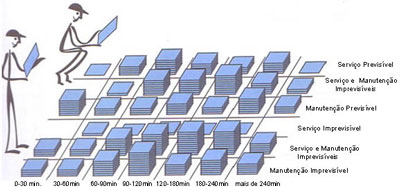
Example of service family selection. Source: “Creating Lean Dealers”, p.15.
After selecting the services with the highest occurrence, we can draw the value stream map, and to do so it is necessary to follow the car's path within the dealership, as well as to draw how service scheduling is carried out. It is important to represent the waits, which are identified by the presence of more than one car standing in some area of the dealership, the activities that are carried out, and to record the time of each activity. Below is a simplified value stream map.
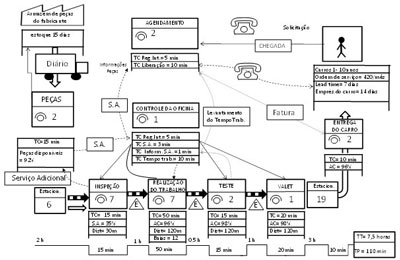
Current-state Value Stream Map of a dealership. Adapted from: “Creating Lean Dealers”, pp. 20-27.
The Map shows some important information: the total time the car spends inside the dealership is TT = 7.5 hours, while the processing time is PT = 110 minutes. This means the car stays for 7.5 hours and the actual service time does not exceed 1 hour (time spent doing the work); the difference up to 110 minutes refers to testing and moving the car.
During a day that the car spends at the dealership, only 13% of the time is used to carry out the activity that actually adds some value for the customer. The other activities are waste, among them: waiting and unnecessary movement.
How can we eliminate waste in the process?
Waste is a symptom, not a cause, so it is necessary to understand what generates the waste before eliminating it. One of the probable causes is the lack of continuous flow in the dealership; continuous flow means "make one, move one". For this to happen, it is necessary to balance the operations, that is, to distribute the work so that it happens in a synchronized way.
How can we make the car move from one stage to the next continuously, without interruption, or in FIFO to avoid waiting? First, it is necessary to identify the activities in each stage of the process and the time it takes to perform each one; then, those that do not add value should be eliminated. After these improvements, the work must be distributed among the people so as to enable flow between the stages.
To ensure that activities are carried out as planned, it is necessary to standardize the work - which is considered a paradigm in the service area, since people's first reaction is to think it is not possible to standardize work in the workshop because each car has its own peculiarities. Are the cars really that different from one another?
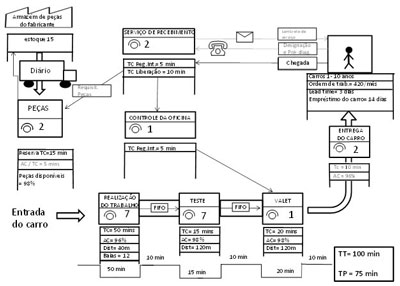
Future-state Value Stream Map. Adapted from: “Creating Lean Dealers”, pp. 40-43.
As we can see in the map above, the total time fell from 7.5 hours to 100 minutes, which makes it possible to deliver the vehicle within 2 hours, and the processing time fell from 110 minutes to 75 minutes, thanks to the early diagnosis and the elimination of the pre-diagnosis.
Since it is possible to deliver the car within 2 hours, it means we are close to achieving what the customer wants: solving the problem quickly and within their expectations. From the customer's point of view, this will be a differentiator compared with other car dealerships.
Controlling the work visually?
To keep the work as planned, it is fundamental to schedule the work well based on the customer's request. This visual management of scheduling is fundamental to give mechanics autonomy to perform their activity without having to wait for the supervisor to distribute the work, which can also be one of the causes of the waste of waiting.
This visual management enables work planning and performance control, which go together with Standardized Work, because once we have the time for each activity, it is possible to predict how much time needs to be planned. There are several forms of visual management that can be used, but the essential thing is that visual management makes it possible to identify whether the scheduled work is behind or ahead of plan, who should carry out the work, and that it allows problems in carrying out the work to be signaled.
Reaping the results of the transformation
By applying the concepts presented above, it is possible to reap interesting results in terms of reducing the time the vehicle stays at the dealership - around a 70% reduction -, reducing the time to carry out activities by eliminating unnecessary walking and activities - from 10 to 20% -, improving service quality by following standardized work, and reducing waiting in the process as a whole.
The biggest result, without a doubt, lies in the customer's perception, because the car is available to them in just 2 hours; that is, they are only without the vehicle for 2 hours and not 8 hours as before. In this way, we build customer loyalty and deliver what they need.
This result in perception often goes against some assumptions widespread in this type of business, that if the customer's car spends little time at the dealership, it is not possible to offer them more services. A different perspective is needed here: if the customer is well served, they come to trust the dealership more and do not suspect that a service is being pushed on them unnecessarily; they come to trust the dealership's people, creating a two-way relationship of trust, which allows more services to be sold according to the customer's needs, pulled and not pushed.
Making a plan to start the transformation
To start the project, it is fundamental to establish a connection between the project and the company's strategic objectives, that is, what is the reason for undertaking the lean transformation? To increase customer satisfaction? To increase the productivity of operations?
Once the objective has been defined, study the types of services performed in the workshop; create service families based on similarity of execution time; based on this, try to define a pilot service family to start the project; draw the value stream map to identify the waste; draw the future-state map; finally, make a plan to achieve it.
You will encounter some difficulties, which should be overcome as some improvements are implemented. Starting is crucial for results to appear; seek knowledge in the literature of Lean Institute Brasil, especially the workbook "Learning to See", which teaches how to map the value stream.
Conclusion
This article is only a beginning of the possibilities for applying lean in dealerships, since it covers only the workshop service. There is a broad universe of application in the parts warehouse, in administrative processes and in sales, which can bring significant results for business owners, employees and, finally, for the customer.
Applying the concepts above depends on the pursuit of knowledge and on the willingness of managers to improve their processes so that they perform more efficiently over time.
Alexandre Cardoso.
BIBLIOGRAPHY:
BRUNT, David; KIFF, John. Creating Lean Dealers. Ross-on-Wye: Lean Enterprise Academy, 2007. 116 p.







