

Building frontline leaders to solve problems at Nestlé
Planet Lean: Large corporations usually have a lot of experience implementing improvement methodologies. Where is Nestlé Colombia Ecuador's T&P in its improvement journey?
Maria Fernanda Avellaneda: We have been working with our internal system – Nestlé Continuous Excellence – for about ten years (globally, the organization has been using it for much longer). As far as our manufacturing operations are concerned, we have two main approaches coexisting within NCE: Total Performance Management (TPM) and lean thinking. Of the two, lean is certainly the “new kid on the block”, having been introduced into our processes about three years ago.
Our ambition at T&P is to carry out a cultural transformation and develop the capabilities of our frontline people, so that they become more autonomous in their ability to solve problems. We have certainly started to see progress in this direction, although most of our lines still have a long way to go before reaching the level of autonomy we want. What we have realized is that for this transformation process to happen we need the consistent presence of leaders on the shop floor, to accompany our people. We have struggled with this: meetings and day-to-day problems get in the way and keep leaders away from the gemba, slowing down the progress of our transformation.
PL: How do TPM and lean interact within NCE?
Fabio França: Every company has its favorite improvement system. Ours has always been Nestlé Continuous Excellence – NCE (TPM in manufacturing and lean for the entire value chain). I remember that when we decided to introduce lean into our plants in Brazil, we initially started by applying TPM at one site and lean at another. When we tried to bring the two together, we realized we had made a big mistake: the people at both sites were happy with the systems they had and were reluctant to accept the other. That was when we realized there was no need to keep TPM and lean separate. Their principles and tools are remarkably similar.
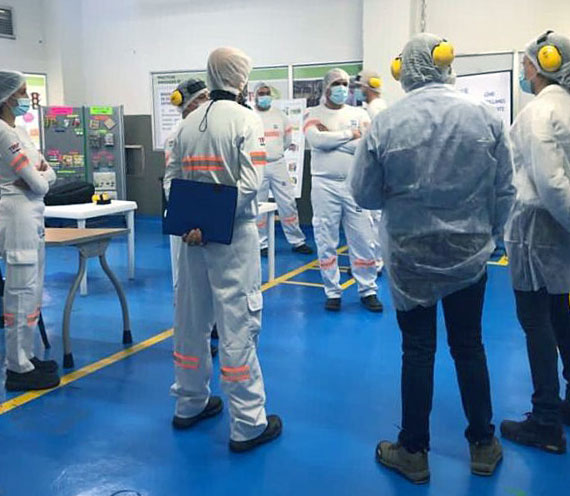
TPM has a strong emphasis on machines, building on the broader concept of eliminating waste. They fit together perfectly. Ultimately, the only thing that matters is the result for our consumers and, at Nestlé, we are trying to think in terms of business opportunities rather than the methodologies we use to pursue those opportunities.
PL: How is lean helping you accelerate the pace of change?
FF: Lean thinking supports our efforts to transform the culture of Nestlé Colombia Ecuador. It gives us a more holistic view of our work and helps us identify business opportunities for improvement across the entire value chain. It is making us better businessmen and businesswomen.
MFA: Although our conversations still focus mainly on TPM, lean is certainly starting to make its contribution. How big is that contribution? During the Lean Summit 2019, organized by Lean Institute Colombia, we heard about the four types of problems described by Art Smalley in his latest book. We saw this as an opportunity to clarify the problem-solving responsibilities of people at different levels of the organization and decided to run an experiment in our six plants.
We on the “improvement team” did not need to be convinced, but we wanted to make sure that people at all sites would join us on this journey of discovery. That is why we created a cross-functional team to work on this experiment.
Our first step was to analyze our management approach using the Lean Transformation Framework. We could see that all the elements of the “house” were there, but we decided to challenge ourselves to have more focused conversations about our management system and how it was influencing our transformation. Talking about different types of problems and who is responsible for them led to constructive conversations and to the identification of countless improvement opportunities.
Lean has allowed us to develop our work with Total Performance Management with a newfound focus on customer value and on achieving autonomy for our frontline teams. In fact, I would say that TPM and lean are fully complementary.
PL: What can you tell us about the role of leadership in the transformation?
FF: Lean is teaching us a different approach to leadership, one embodied by the concept of the gemba walk, which emphasizes observation, active listening and a deep understanding of the work. It is simply not enough to make sure we meet our production targets; it is essential that we find out under what conditions those targets are met, so that we can improve the process and ultimately achieve better results. For this to happen, we need to be humble, servant leaders.
PL: Can you tell us more about your work with the four types of problems?
MFA: Of all the lean ideas we have implemented, this is one of the most impactful. Our analysis revealed that many of our leaders were working on type 1 and type 2 problems (containment and deviation from standard), even though these should be the prerogative of the front line. This was keeping them away from the gemba. In light of this, one of our outcomes now is understanding what we need to provide our people with to make them more autonomous. More training? Coaching? Different and perhaps more challenging objectives?
The categorization of the “four types” of problems was a great addition to our arsenal of tools and techniques and made our management system leaner. Defining problems clearly means making sure the right people take responsibility for the right things. We even designed a training program based on the four types of problems and introduced A3 thinking to give people an extra tool they can use in their problem-solving work.
When we asked the operators to share their feedback, what we learned was enlightening and very satisfying. They told us that leaders now challenged them to raise problems and take responsibility for them. They talked about the closeness of leadership on the shop floor, implicitly challenging us to keep it up in the future. The fact that plant managers spend time on the shop floor and take this part of their job so seriously says a lot about their engagement. I have no doubt that this exercise allowed people in a more corporate position to connect better with the gemba.
We are now in phase two of this experiment, in which we are looking at what we will change in the management system based on what we learned from the experiment. Currently, we are making a big effort to improve the flow of information to the lower levels of the organization, for example.
FF: We are very good at putting problems on the table, but we have to better understand whose responsibility those problems are! That is where the four types of problems help. It makes no sense for operators to deal with large-scale organizational issues, just as it makes no sense for management to fight fires on the shop floor.
This approach to categorizing problems is a great opportunity for us to better manage the information we have and use it to understand how best to tackle difficult situations. Needless to say, our role as leaders is to give frontline employees the autonomy and tools they need to solve any problem they encounter.
PL: What have you learned over the past year about the possibility of driving change when most of us are forced to work remotely? Is it possible to continue a transformation?
MFA: To a certain extent, it is possible, but nothing will change the fact that you have to be at the gemba. That is where a transformation really happens. In our plants in Colombia and Ecuador, we have a position called NCE Factory Coordinator. The NCE Factory Coordinators act as extensions of the department at the different sites, coordinating the improvement work that needs to happen at each of them. Last year, they were instrumental in ensuring the continuity of our efforts.
With the four specific types of problems, some members of the “improvement team” conducted the experiment with the support of the NCE Factory Coordinators, who made an effort to keep people engaged despite the distance and the impossibility of meeting. Combined with the engagement of the management team and the fact that the plant managers supported each other remotely, this allowed us to continue our transformation in the midst of the pandemic.
PL: Where do you want Nestlé Colombia Ecuador's plants to be in the future?
MFA: I would love never again to hear our leaders say that they do not have time to go to the gemba because they are working to solve a problem they should not be working on. And, of course, I would love to see continuous progress in the application of TPM and lean thinking. We are working to integrate a different language into our daily work, one that puts creating value for customers at the center of what we do. With TPM, we are becoming more efficient, and with lean, we are making the connection between our work and the customer clearer. We are looking forward to continuing this experience and seeing where it takes us!
FF: This experiment is already bearing fruit, and we are very excited. If we can generate more growth for the business, we will be able to reinvest part of that revenue in projects that help us contribute more to society. We need to look beyond profits and efficiency and clearly define and communicate the role Nestlé wants to play in the wider community (for example, with regard to sustainability).
PL: And what about your experience working with Lean Institute Colombia?
MFA: The most important thing for us is that the relationship with the institute is not a consultant-client relationship. I do not see them as consultants, but as allies who support us in our development and learning. The work we are doing together is helping us address some of the weaknesses of our system, rather than replace it with a different one.
We thank our experienced leaders for making this transformation possible:
Mery Barbosa – Bugalagrande Factory, Dario Granda – Cayambe Factory, David Bolaños – Manufacturing Strategy team member, Helver Ocampo – Bugalagrande Factory, Augusto Maestre – Valledupar Factory, Juan Ortiz – Manufacturing Strategy team member, Vanessa Arias – Sur Factory, Fabio Ñañez – Bugalagrande Factory, Francisco Coy – Bugalagrande Factory







