

Innovation in Human Resources Management in Logistics: understanding the needs of logistics professionals


Managing operations and human resources in logistics activities means working across a wide geographic area of cities, states and even countries. It also means a need for great mobility of human resources, far greater than in other activities.
Logistics activities in the supply chain require workstations in flow, with human resources moving through warehouses, in vehicles, on the roads, on board various means of transportation and at connection points. Finally, in the dimension of time, these are human resources who work at various hours, forming 24x7 teams or, at the very least, working hours that do not match the traditional business-hour shifts.
In logistics, therefore, human resources have three dimensions that characterize the particularity of managing them:
- Geographic
- Mobility
- Time
These characteristics often materialize as concrete obstacles to the ongoing qualification of teams, as required by the competitive and constantly changing market environment. In today's landscape, there is no logistics and supply chain company that does not include in its strategic plans a necessary action to qualify its teams in the management practices and tools that ensure efficient operations. Among them, we highlight lean logistics practices, recognized as a set of practices for solving logistics problems and achieving goals through the high performance of human resources.
This context becomes even more complex when teams from different companies must be integrated into logistics operations, based on outsourcing models, in which several employees need to be qualified to the same level of efficient, business-oriented activity.
Continuous learning and distance qualification
In this article, we will present the findings and lessons learned for a new lean qualification solution, through a distance learning platform, which makes it possible to overcome the geographic, mobility and time constraints in qualifying human resources in logistics.
It is worth noting that one of the pillars of lean practice is the continuous development of human resources, which, in the case of logistics, means establishing means of continuous learning regardless of the constraints that a 24-hour-a-day, 7-day-a-week operation imposes on extending this qualification to all employees. It is necessary to bring the learning of continuous improvement to each performer in the various workflows: receiving, storage, picking, shipping, transportation, planning, scheduling, document issuing, in short, all the flows that make up value creation in logistics.
Distance qualification, therefore, offers a concrete possibility of integrating gemba workers through qualification in continuous improvement and high performance. As a result, through basic lean qualification, everyone starts to collaborate in eliminating waste and containing problems, preventing them from reaching customers. Building qualified and engaged teams is one of the safest and most economical ways to increase performance.
Thus, faced with the obstacle of bringing this qualification to all logistics human resources, spread across wide geographic areas and various work schedules, there is an opportunity for innovation to deliver a continuous learning solution through distance education.
Human resources management areas in logistics identify the need to innovate and deliver a continuous learning solution through distance education, adding, through a digital e-learning platform, one more value to the quality of lean training: flexibility in learning and the possibility of doing it continuously.
Below, we describe what is worth taking into account when developing distance qualification solutions (e-learning solution) that ensure a tailor-made product to meet the needs of these professionals.
1) Identifying value for the logistics professional (in this case, seen as the customer)
When walking the logistics gemba in various contexts, one notices a difficulty on the part of leadership in bringing logistics operators together for conventional classroom training. Leaders of these operational teams also have the same difficulty, and managers, although most of the time they work business hours, are affected by the lack of available time to reconcile their schedules. Thus, we can consider that there are three main personas in the development of a distance qualification platform (e-learning solution):
- Managers of logistics sectors or functions.
- Operational leaders who directly supervise operations.
- Logistics operators from the most diverse functions, the hands-on crew.
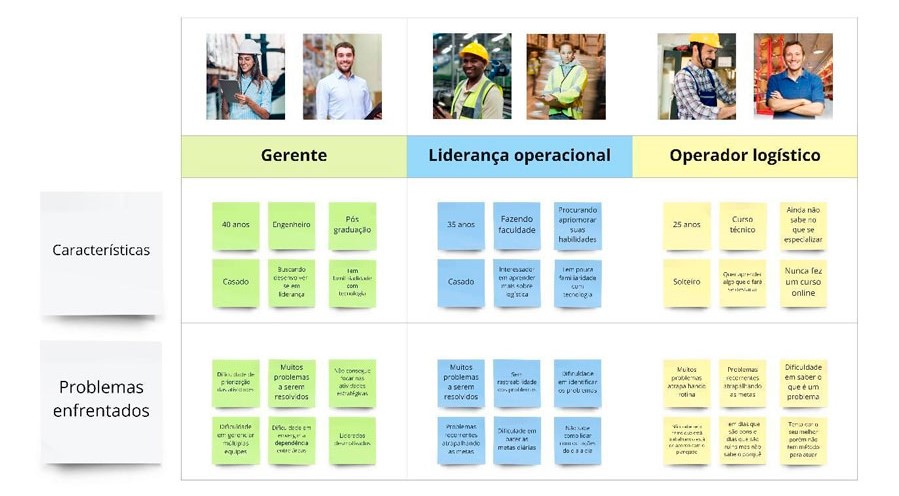
Example of logistics professional personas
Defining the personas, which should be done by going to the gemba and understanding the characteristics and problems faced by each of them, makes it possible to create a product that effectively meets customers' needs. It is important to have this understanding in order to decide on the best model for delivering the content in this solution.
Another factor observed from the creation of the personas was that logistics professionals need content geared toward day-to-day application, providing immediate use to improve the performance of operations. This is because it was observed that content aimed at these professionals is often very theoretical and distant from the problems they face in their daily routine.
2) Establishing the value stream for the customer: the logistics professional's qualification journey
After truly understanding your customer, it is important to define how value, in this case learning, will be delivered. The characteristics of the personas defined in the previous step are essential to define what the content will be and how it will be conveyed to these professionals.
According to Malcolm Knowles, the father of andragogy, there are 6 basic pillars that must be considered for effective adult learning, namely:
- Why know and why learn.
- Learner autonomy.
- Experience matters.
- Engagement in learning.
- Focus on real life.
- Motivation to learn.
Thus, each of these pillars must be taken into account when building a quality e-learning course aimed at logistics professionals.
The course's learning units should be structured to provide short cycles, with videos and activities requiring between 15 and 25 minutes of dedication at a time. These short cycles should provide deliverables and effective learning, which it is recommended that participants self-check through quizzes and guided activities.
With this feature of short cycles of effective learning, at the end of each cycle the participant is ready to apply the knowledge acquired to their day-to-day tasks. These short cycles built into this learning and qualification journey also meet the need for flexibility, by fitting the few minutes of each learning activity into the logistics professional's schedule.
In turn, it is recommended to seek to connect these short cycles with the practical gemba experience that professionals naturally have. Some ways of providing this style of learning to students include blending theory with practice, bringing in real examples, case studies and even creating a character with whom the student can identify through the situations he experiences.

Case created to illustrate a real situation
3) Good practices of technology platforms to define the one best suited to the customer journey
The moment of choosing the platform is very important; after all, everything that was planned for the student to learn during the course will be delivered through the platform. In this sense, two things are extremely important to consider: flexibility in how content is delivered and ease of use.
Below are some important features observed through good market practices, providing an environment that favors the teaching of these professionals.
- a) Possibility of interaction among course participants. During any course, questions arise and, often, these questions are similar among the participating professionals, so this possibility of interaction among them is a powerful tool to enhance learning and make sure no one leaves with unanswered questions.
- b) Several different ways of delivering content. Within the platforms it is possible to create learning units ranging from recorded video lessons, articles and presentations to podcasts and live sessions. This allows all these resources to relate to one another, increasing the power of knowledge transfer. For example, a video of a logistics operation can be discussed in the video lesson and then addressed through a quiz in which participants self-check their learning.
- c) Quizzes with instant assessments and commented questions. To generate learning while doing exercises, the student needs to know which questions they got right and which they got wrong. In this way, the student has the opportunity to redo the exercises until getting 100% of the answers correct and then review the commented questions and consolidate the knowledge.
4) Testing the value hypothesis with logistics professionals
After completing the course planning and development stage, it is necessary to validate the product with the different personas created. This is the phase of validating the value hypothesis through an MVP (minimum viable product), in which professionals are not sampling a prototype, but rather a basic product that already delivers what was proposed for the customer journey, but that still allows for improvements and changes collected at the end of the trial.
This stage adds a lot of value to the product, because after having understood your customer, created personas that represent them with their characteristics and the problems they face day to day, and defined what the content is and how it will be delivered, now it is time to check in the real world whether what was conceived meets their needs and what can still be improved.
At this stage, many suggestions are often collected and incorporated, and problems in the platform's operation are anticipated. Adjustments should then be made and a new round established until the final product is formed: a distance learning platform for the practice of lean logistics.
5) Adjustments and launch of the qualification platform
Based on the suggestions collected in the trial use by market personas, improvements and adjustments to the platform will naturally emerge, both in content and in presentation and usability for the logistics professional.
The great benefit is that, as long as there is a device with an internet connection (from a cell phone to a desktop), the professional can complete their qualification anywhere and at whatever time they wish.
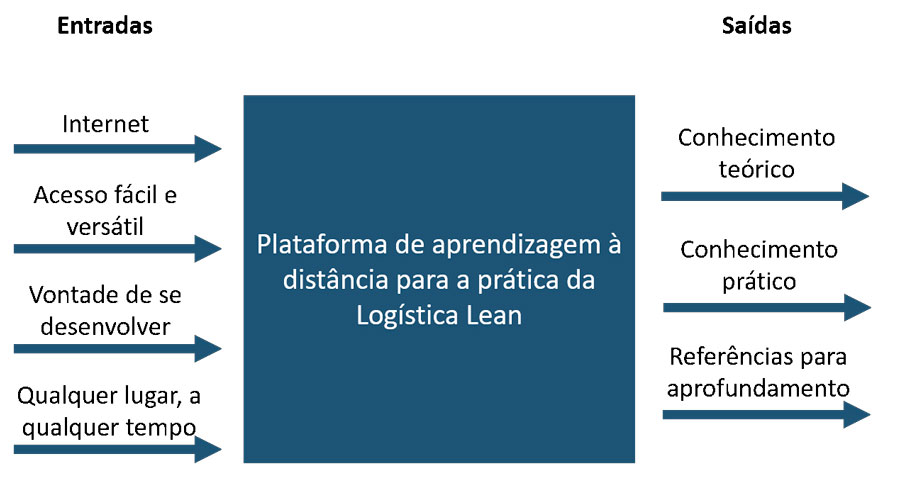
SIPOC of a learning platform for the practice of lean logistics
In summary, in this article we have described the development process of the innovation that meets logistics' need to qualify its human resources in a practical way in the lean approach, especially those who are close to operations, in leadership or execution, and whose qualification in the proposed content aims to increase the performance of operations.
*The principles and steps described in this article were established and followed by Lean Institute Brasil in the development of a new asynchronous distance course (e-learning solution). With a workload of 8 hours, the course was designed for logistics professionals who have scheduling difficulties, since the professional chooses when and where to take the course. All content was specially designed to train them in the basic application of Lean Logistics and the achievement of immediate results.
The course can be found on the website: https://www.leanlearning.online/
Originally published in Revista Mundo Logística.







