Consortium raised productivity by 18% and revenue by 32% with lean in residential gas network installation projects
With the expansion program of a gas distribution company in the interior of São Paulo state, this company's first EPC contract model was tested, aiming to improve the efficiency of the installation of these products.
The consortium of large São Paulo construction companies that won the tender turned to the lean methodology to improve its productivity and delivery quality performance, since its resources were almost all its own labor, and deliveries had long lead times and a large amount of unfinished work in progress.
See how this consortium achieved significant results by applying the lean methodology.
Understanding the problems in the field directly with the end customer
The first principle of lean is “understanding what value is for the end customer”; therefore, as the first step of this project, an analysis was carried out directly with the end customer and the NPS (net promoter score) of the customers who were below the parameters established with the gas distribution company was evaluated.
It was identified that, for the end customer, the perception was of delay in connecting the gas inside their home, since there were several points of contact, with the steps of: 1- Property inspection; 2- Internal branch line in the customer's house; 3- External branch line; 4- Floor restoration and 5- Gas outlet connection.
A detailed analysis in the field identified that only 26% of a workday was being dedicated to value-adding activities, that is, 74% was distributed among activities that do not add value or are auxiliary work.
The main time detractors were:
- Lack of adequate tools to carry out the work;
- Rework due to ruptures of existing pipes;
- Delay in the departure of employees due to lack of organization and, consequently, delays in starting the workday at the front line;
- As there was no adequate resource planning, the lack of a connection, tool or work accessory caused delays, revisions or rescheduling, when the team was already at the customer's home.
After this analysis, a workshop was held to discuss the data collected with the production, planning, scheduling, procurement, engineering, quality and occupational safety teams. As an output of this workshop, several actions were generated to minimize or eliminate some of these problems in the field.
Implementing and monitoring the improvement actions
The main actions to mitigate waste in the field were related to:
- Preparation and separation of kits to optimize the teams' departure to the field;
- Definition of new schedules for a team to do this preparation;
- Teams with staggered schedules, that is, one team going ahead to put up the street signage;
- A strategy of concentrating and working close to the work fronts to speed up the sharing of resources (specialized labor and specific machines);
- Creation of a tool to control and replenish the stock of fast-consumption materials.
A second step was an analysis of the planning and scheduling flow, since, with the long lead time and many installations in progress at various stages, actions were taken to lower the inventory of activities in progress: a) implementation of the takt-time concept = delivery pace pulled by the customer; b) balancing and resizing of work teams by city and by type of activity; c) implementation of Last Planner System routines to evaluate productivity and take action daily and d) confirmation with the customer two days in advance to facilitate the execution of the work.
A diagnosis was also made regarding breakdowns of HDD (horizontal directional drilling) equipment to identify opportunities to improve the productivity of the teams carrying out network installation activities. This analysis identified that a specific supplier had the most problematic machines; in addition, a containment action was taken, which was the rental of a spare piece of equipment in case of breakdown. In this case, a financial study was carried out that showed that it was worth having this machine. Other actions, such as a stock of parts for daily use and a small team of mechanics, were also alternatives that brought good results.
Reaping the results and defining the next steps of the journey
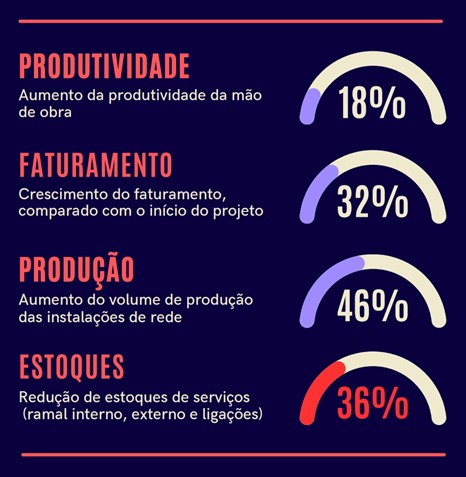
After the applications, good results were generated. The consortium members saw the benefits of the lean project and sought to consolidate the results generated in order to take them to other projects of these companies. Lean construction shows that it is an excellent management model for urban infrastructure works, and can bring greater efficiency and competitiveness to clients and construction companies.