New infrastructure cycle will demand management maturity
In Brazil, the infrastructure sector is giving clear signs that it is entering one of the largest investment cycles of recent decades. After years of stagnation, investment has regained traction. According to the “Infrastructure Barometer” by EY-Parthenon, in partnership with the Brazilian Association of Infrastructure and Basic Industries (ABDIB), released in February 2026, total investments reached R$ 280 billion in 2025, a new nominal record, after R$ 260.6 billion in 2024. The most consistent projections point to R$ 300 billion as early as 2026.
In proportional terms, however, the country still invests about 2.2% of Gross Domestic Product (GDP) in infrastructure, a level below the 4% or more that countries that modernized their logistics sustained for prolonged periods. The current stock of infrastructure investment is equivalent to approximately 36% of Brazilian GDP, compared with a global average close to 60%. To close this gap, investments above 4% of GDP would be needed for at least two decades. The current movement, therefore, does not amount to exuberance. It is a recovery.
The most relevant structural change lies in the origin of the funds. Approximately 84% of the R$ 280 billion invested in 2025 came from the private sector, made possible by concessions and Public-Private Partnerships (PPPs). This figure profoundly changes the logic of execution. When private capital takes the lead, financial discipline stops being rhetoric. Margins are monitored by creditors, rating agencies and institutional funds. Deviations in schedule or cost directly affect the return on investment (ROI) and the future capacity to raise new capital.
The international literature on megaprojects, consolidated in studies led by Professor Bent Flyvbjerg of the University of Oxford, shows that nine out of ten infrastructure projects worldwide experience significant delays or budget overruns. In transportation projects, average deviations exceed 28%; in railways, they approach 45%. In Brazil, recent experiences confirm average deviations above 20% in complex undertakings. At the same time, civil construction remains among the sectors with the lowest accumulated productivity gains in recent decades.
In this environment of high competitiveness, complex projects, demanding clients and squeezed margins, operational efficiency ceases to be a competitive differentiator and becomes a contractual requirement. More than efficiency, the pursuit of strategic effectiveness becomes imperative: delivering not only the physical works, but an economically sustainable asset over 25 to 35 years, with controlled risks, ESG requirements met and ROI preserved.
Before construction: engineering and procurement as an integrated system
It is estimated that between 70% and 80% of the final cost of an infrastructure asset is defined before the construction site is mobilized. Decisions made in the engineering phase, which begin with conception, technical specifications, choice of materials and construction solutions, determine the project's economic viability. When engineering does not incorporate “constructability”, realistic costs and schedules from the outset, problems emerge during execution in the form of rework, stoppages and contract amendments. In contracts structured under a private-sector logic, such deviations directly affect the economic and financial balance.
Practices such as Target Costing and Value Engineering, structured within a lean approach, make it possible to align contracting parties, designers, project management firms and suppliers around technical and financial parameters defined from the bidding notice or the PPP structuring onward.
The focus is no longer simply squeezing the initial investment, but building an economically balanced asset throughout its entire life cycle, considering maintenance costs, energy efficiency, durability and environmental impact. Decisions made in this phase define not only CAPEX, that is, investments in capital goods, but the future trajectory of the undertaking's cash generation.
In the supply chain, the Value Stream Map (VSM) makes visible inefficiencies that often remain hidden in the purchasing cycle: from quotation to negotiation, from contract formalization to approvals at multiple levels of authority. In linear works that cross states with different tax regimes and specific regulatory requirements, administrative complexity introduces significant variability into the flow of materials and services. This variability does not affect only the schedule; it generates indirect costs, unnecessary mobilizations and consumption of financial contingencies, impacting the project's profitability as much as the technical challenges in the field.
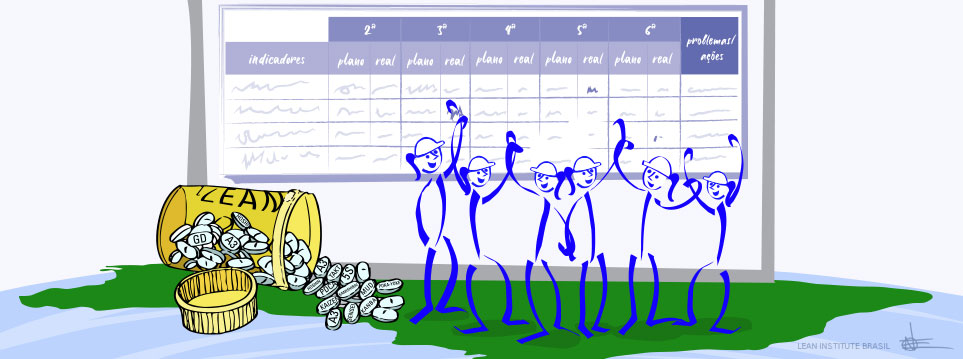
Daily Management (DM), structured in a multidisciplinary way already in the preparatory phase, creates a systematic mechanism for monitoring and rapidly resolving deviations, reinforcing the stability of the flow of critical inputs. In projects with geographically dispersed work fronts, such as highways, railways and transmission lines, small logistical disruptions tend to be amplified. By making problems visible in real time and establishing routines for immediate correction, DM reduces the likelihood of stoppages, preserves the production cadence and protects the contractual schedule.
Operational variability: logistics, climate and territorial scale
Brazil's continental size imposes structural logistical challenges. In highway or railway works, internal travel between sites and work fronts can consume up to 25% of the productive workday, especially in regions with difficult access. When the planning system is fragile, losses from waiting, unnecessary movement and emergency rescheduling stop being isolated events and become part of the recurring cost of the operation. The result is high variability, reduced effective productivity and direct pressure on schedule and margin.
The lean approach does not treat this variability as a geographic fatality, but as a system failure. Tools such as the Last Planner System (LPS) and Line of Balance structure planning based on the commitment of field teams, making it possible to balance resources, reduce conflicts between work fronts and establish continuous flow of execution. More than producing detailed schedules, they increase the reliability of operational promises and raise the Percent Plan Complete (PPC) — an indicator that, in mature implementations, can exceed 80%. The direct consequence is less emergency replanning, greater daily predictability and a consistent reduction in the variability that erodes schedule and margin.
Adverse weather events, such as heavy rains, extreme heat and seasonal floods, introduce additional uncertainty into already pressured schedules. Without structured response mechanisms, isolated interruptions quickly become chain effects on subsequent work fronts. Short-term planning with weekly scheduling and DM act as a containment system, allowing tactical rescheduling, reallocation of teams and prioritization of activities without compromising the undertaking's master plan.
Likewise, applying the just-in-time concept to the management of heavy materials, such as precast beams, sleepers and segments, reduces capital tied up in inventory and lowers exposure to logistical losses. In long-term contracts, lower inventory represents not only operational efficiency, but a direct improvement in the project's financial structure and greater protection of cash flow.
Integration between lean and Building Information Modeling (BIM)
Digitalization broadens the reach of the management system by turning technical information into an instrument of economic control. The integration between lean and Building Information Modeling (BIM) makes it possible to simulate costs, schedules and clashes while still in the design phase, connecting planning to the 4D model and anticipating conflicts before they materialize on site. National studies of linear projects indicate that this integration can reduce rework by up to 30% or 40% and consistently increase schedule predictability.
In long-term concessions, every instance of rework avoided while still in the virtual phase preserves financial contingencies and protects ROI over decades. BIM methodology integrated into a disciplined lean system turns technical predictability into economic stability and consistently reduces exposure to contractual risk.
Productivity, labor and site stability
Recent surveys indicate that about 90% of companies in the sector have difficulty hiring or retaining qualified professionals. The average age of the workforce is approaching 40, without a proportional renewal capable of sustaining the pace of the new investment cycle. This demographic imbalance introduces a structural risk to production capacity. In this context, raising productivity per worker ceases to be an operational objective and becomes an economic imperative to preserve schedules, control costs and protect margins.
Standardized work, combined with reliable planning and the systematic removal of operational constraints, creates more stable and predictable environments. Organizations that manage to anticipate obstacles and reduce daily variability record lower absenteeism and greater retention of qualified professionals. System stability reduces improvisation and episodic overload, factors that often accelerate turnover. In this context, productivity ceases to be merely a technical efficiency variable and becomes a strategic element for attracting and retaining talent.
Leadership and operational discipline
The consistency of a lean system depends, ultimately, on the quality of leadership. More than supervising operations, leaders take on the responsibility of structuring the management system, ensuring coherence between strategic guidelines and day-to-day execution. Techniques such as A3 Thinking, the PDCA cycle and the continuous practice of kaizen bring discipline to scientific problem solving and strengthen fact-based decisions.
In this context, frequent presence in the gemba, the place where value is actually created, becomes a central element of operational governance. This is not about occasional visits, but about a continuous practice of direct observation, technical dialogue and empirical verification of actual working conditions. It is in the gemba that inconsistencies become visible before they turn into delays or consumption of financial contingencies. Proximity reduces information asymmetry, speeds up corrections and strengthens technical accountability at all levels.
Governance, metrics and sustainable value creation
With the predominance of private capital, indicators cease to be internal control instruments and become part of the project's formal governance architecture. Metrics such as the Schedule Deviation Index (SDI), the Cost Deviation Index (CDI) and projected versus actual Return on Investment (ROI) are monitored by investment committees, creditors and, in many cases, independent audit structures. They do not merely record performance; they signal risk and influence future financing decisions.
Process indicators, such as Percent Plan Complete (PPC), serve an equally strategic function. Their deterioration usually precedes significant economic deviations, allowing corrective interventions before financial impacts take hold. Effective governance depends on this integration between operational metrics and economic results.
The systematic reduction of waste of materials, rework and energy consumption connects operational efficiency to environmental, social and governance (ESG) requirements. Lower use of resources means lower emissions, less waste generation and lower regulatory and reputational exposure. In a market in which ESG criteria influence capital allocation and risk pricing, consistent operational performance becomes a direct part of the financial assessment of the undertaking.
Let us not waste this opportunity!
The current infrastructure cycle in Brazil is not just large. It is structurally different. With the predominance of private capital, contracts start to operate under a logic of risk and adjusted return. In concessions of 25 to 35 years, every deviation in the implementation phase compromises the future trajectory of cash generation. Structured management, in this context, is not an internal continuous improvement agenda. It is a mechanism for protecting financial flow, contractual credibility and the cost of capital.
Companies that deliver predictability reduce the perception of risk. And lower risk translates into more competitive financing, greater leverage capacity and sustainable strategic advantage. The new cycle of Brazilian infrastructure will be, above all, one of organizational selection. Managerial maturity will cease to be a desirable attribute and will become a condition for staying in the game.
Infrastructure is a strategic national asset. Making it economically viable will depend, more and more, on organizations' ability to operate with method, discipline and a systemic view. Those who internalize this logic will consolidate their position in the coming years. Those who do not will inevitably face competitive erosion.