


Related term
Cell
A location where the processing steps for a given item take place immediately one after another, so that parts…
View termJapanese term meaning “flexible manpower line”: the ability to adjust operations to production requirements by changing the number of workers as demand varies.


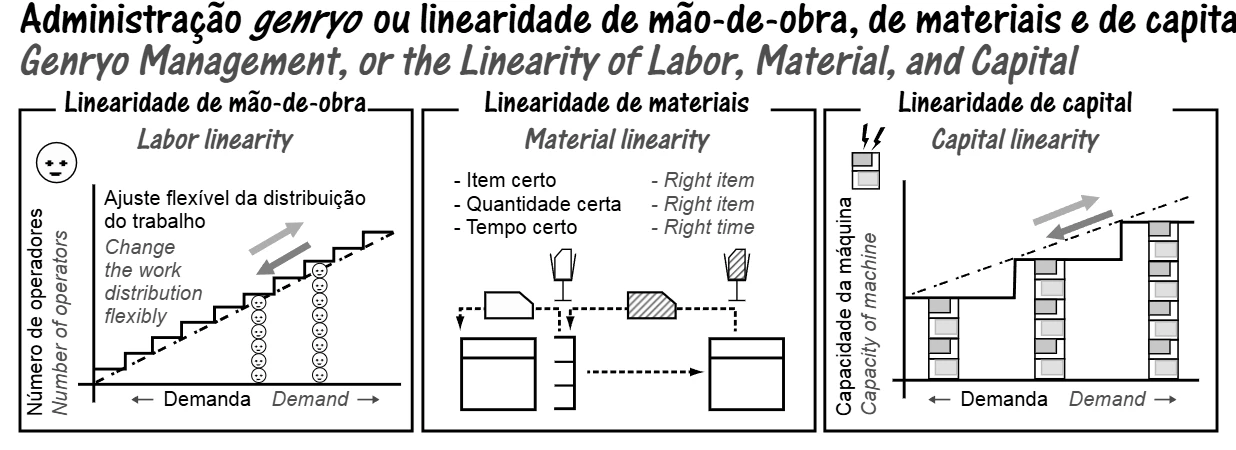
Shojinka is one of three Japanese words – shojinka, shoninka and shoryokuka – that are conceptually related but have different meanings. Shojinka means “flexible manpower line” and refers to the ability to adjust operations to production requirements by changing the number of workers as demand varies. It is sometimes called “labor linearity”, referring to the capability of an assembly line to remain balanced even when production volume fluctuates.
In practice, it is a philosophy of flexibly manning the production process: the number of operators increases or decreases as demand changes. This gives the process an approximately linear variation in the amount of labor per unit (or part) produced. The layout of cells and standardized work are what make it possible to redistribute tasks among more or fewer people.
Common implementation mistake
Adjusting the workforce in only one direction. All too often the number of operators on the line is not adequately reduced when demand declines, and labor linearity is lost.
How to apply it in your organization
In Kaizen Express, shojinka appears as “labor linearity”, one of the three linearities of genryo management – a precept preached by Taiichi Ohno to make profits in periods of both growth and decline in sales by making products at lower cost with limited resources (in Japanese, gen means “limited” and ryou means “amount”). The other two are material linearity (right item, right quantity, right time) and capital linearity, or incremental investment, which designs and purchases machinery so that small amounts of capacity can be added or removed as demand changes.
Key takeaways on the topic
Explore related terms and go deeper with real-world analyses by our industry leads.
A location where the processing steps for a given item take place immediately one after another, so that parts…
View term
See how this concept and management mindset were applied in practice to deliver real business results.
Read the full article
Build leadership and problem-solving skills at the gemba with support from our specialists.
See the training
