
Approaching problem solving more effectively

Last year, the Lean Enterprise Institute published a book I wrote titled “Four Types of Problems” (published in Portuguese this week by Lean Institute Brasil). The book emphasizes the importance of looking at problems from different angles and not getting stuck in just one way of seeing the situation at hand.
The four types described are 1) good containment routines, 2) deviation-from-standard situations, 3) target-condition improvement opportunities and 4) innovation-based routines. There is some overlap between adjacent types, of course, but each has its own purpose and associated methods.
My aim in writing the book was to explain how these four types work in a company like Toyota, where I previously worked, and to help organizations navigate their own problem-solving journey more effectively.
The book has a short chapter on the history of problem solving in the 20th century and covers many of the influential people. As I indicate in the chapter, I think it is fair to say that all problem-solving routines are derived from the scientific method of inquiry. However, I do not think that all problem-solving routines meet the requirements of real science in practice (a side comment: I worked for many years at a national laboratory that was on its improvement journey. As I learned many times from professional scientists, the scientific method is quite complex – for example, you need to conduct blind studies, publish data sets and research methods subject to review to determine whether the results can be independently reproduced, publish in a journal and establish some kind of new knowledge or discovery in the process, etc. OK, we don't go that deep in problem solving, but we do incorporate some of these elements).
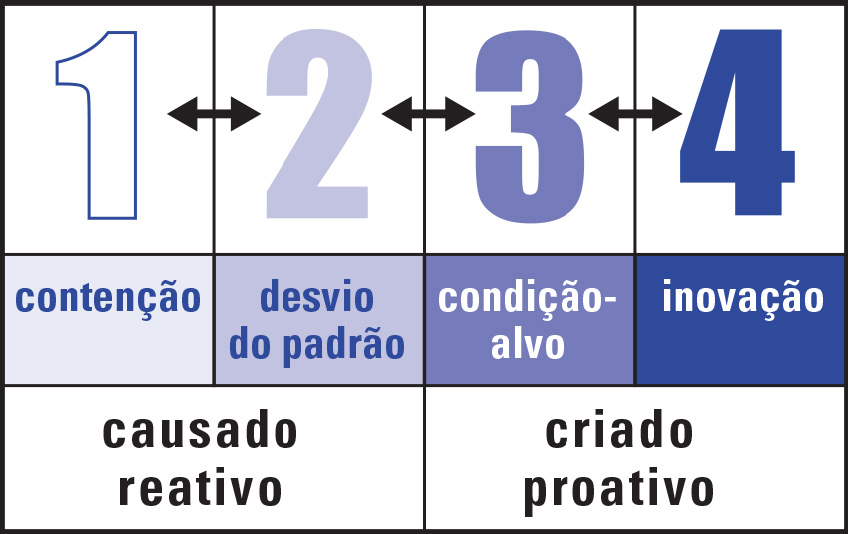
The first two categories of the four-types framework involve higher degrees of critical analytical thinking and look for root causes. They tend to deal reactively with problems that occurred due to some kind of causal factor or error. The last two types are created proactively, and not necessarily caused. In other words, you choose to take something to a higher standard. This generally involves higher degrees of creative lateral or divergent thinking methods, and you look for better solutions even when there is no problem per se.
There is a Japanese proverb that essentially states that “an amateur knows one way to do things, while an expert knows many.” In other words, it is easy to reduce all problem-solving routines to a single approach – whether it is Toyota's current eight-step method, six sigma methodologies, Triz, 8D, Kepner-Tregoe, rapid kaizen, design thinking or any other you feel most comfortable with. And we can, of course, become extremely abstract and say that all of this is science or PDCA. However, that superficial approach really does not provide much in terms of practical advice for moving forward. Unfortunately, I see many organizations stuck in this line of thinking, and they consequently struggle to achieve the desired results. If you are succeeding in your organization, I suggest you continue with what is working. If your organization is facing some problem with improvement or problem solving, changing the point of view or the framework may be helpful.
I am often asked: “Why do you recommend these four specific types, and why are they all necessary?” Let me explain my thinking. First, these four types are essentially the patterns I personally observed with my mentors while working at the Kamigo plant in Japan (Taiichi Ohno's plant). These four types align with my observations and experiences watching various experts at work over many years throughout their careers. In addition, a retired gentleman named Isao Kato, who was an important force in developing problem-solving training at Toyota for decades, asked me to analyze each problem from several angles, not just one. He frequently used the phrase “Kata ni hamaranai” – a common Japanese expression that translates as “don't get stuck in just one way or method.” So this is how I try to describe the types and the needs:
Type 1: Containment
Reactive problem solving based on quick responses to immediate symptoms. Provides immediate relief and mitigation of problems, but may fail to get to the real cause, which can lead to prolonged cycles of firefighting.
Type 4: Innovation
Innovative problem solving based on creativity, synthesis and opportunity. Seeks to identify new problems, solutions and opportunities. Achieves radical improvement, usually a new product, process, system or customer value, far beyond current levels.
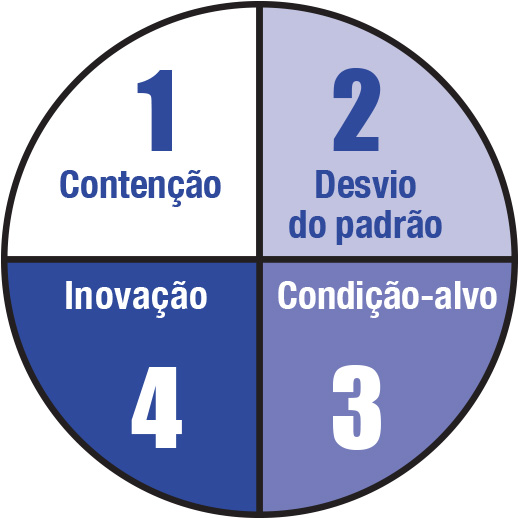
Type 2: Deviation from standard
Structured problem solving that focuses on problem definition, goal setting, root cause analysis, countermeasures, checks, standards and follow-up activities. Its specific objective is to prevent the problem from recurring by eliminating its underlying causes.
Type 3: Target condition
Continuous improvement that goes beyond the existing performance of a stable process or value stream. It seeks to eliminate waste, overburden, unevenness or other concerns systematically, to deliver superior value or performance toward a target condition.
THE FOUR TYPES IN MORE DETAIL
In a perfect world, we would not need type 1 problem-solving routines… but the world is not perfect. Resources are finite and very constrained in the short term. During major vehicle launches at Toyota, for example, data collection indicates that the andon cord, which signals an abnormal condition, is pulled up to 10,000 times in a 24-hour period. Does anyone remember those tweets from Elon Musk about “production hell” and “logistics hell” when Tesla was trying to ramp up production volumes? Small problems are abundant, and not all are equal. Some form of triage is essentially carried out, with the most critical problems receiving more attention and the others less consideration. Some are addressed more deeply with the five whys (ideally, all would be), but many are handled in a safe and convenient way to get production back on track. For example, when the machine is unjammed, the fault is reset, the software is rebooted, the alignment is recentered, etc. How many of you have turned your router off and on again to fix some kind of connectivity problem? Sometimes the short-term fix is allowed under certain circumstances.
There is a tendency to cast what I call type 1 containment routines as not being real problem solving, but I think doing so is ill-advised for many reasons. To begin with, it is not always easy to be a first responder in an organization. Most of my trips to the emergency room, for example, end with pain medication, antibiotics or other reactive treatments. One could argue that these are just problem-solving techniques that deal with the symptoms, not the real underlying problem. There is a movie starring Tom Hanks about Apollo 13 and the famous line “Houston, we have a problem,” when an oxygen tank ruptured during a mission. However, the movie depicts the heroic problem solving needed to get home, overcoming equipment malfunctions, CO2 buildup, low temperatures, lack of food and drinking water and many manual course adjustments. The real problem of the tank rupture and its root cause (a problem with the heater's thermostatic switch) was discovered much later and does not appear in the movie. My point is that sometimes circumstances force you to give type 1 problem-solving responses, and you need to be good at it on a daily basis. In addition, from a “respect for people” standpoint, involving everyone immediately in type 1 routines is a vital concept at Toyota. Most organizations I visit are not as strong at type 1 problem solving as they believe.
Type 2 problems and classic deviation-from-standard problem solving exist because of the inherent limitations of type 1 responses. All problems are different in terms of impact – that is, there is always some kind of Pareto distribution. Of course, sometimes a problem must be addressed at a more fundamental level, even if it severely affects safety or quality. Many of the techniques developed in the 20th century focus on this type of situation. To really fix something, you have to understand the root cause and implement a countermeasure to prevent it from happening again. Penicillin and pain medication, for example, are great… but what caused the infection in the first place? Why did the Apollo 13 oxygen tank rupture? Why are we suddenly having so many defects in the manufacturing department? These problems require more diligent investigation. The thinking pattern must now not only address the emergency condition but also assess the underlying causal factors involved.
Most organizations struggle with type 2 problem-solving routines because they are generally harder. Solving problems requires skill and teamwork, as well as adequate support structures. Generally, heroic individuals cannot solve type 2 problems, because the causal factors cut across several lines or require specific knowledge. We once brought an induction hardening and materials expert from Toyota in Japan to the United States for a startup to deal with a specific problem on a piece of equipment that my team and I had not been able to solve. Most type 2 problems, however, can be solved internally through the proper use of tools, methods and persistence. Some fall into what I call the logical family of analysis (five whys or fishbone), some into the statistical family of one variable at a time (univariate analysis), and some into the statistical category of multiple variables at a time (multivariate analysis). Not everyone needs to be proficient in all of these techniques, but every organization needs some degree of skill in them.
Type 3 routines are critical and different from the two previous types, because there is not necessarily a problem to solve in the classic sense. Everything is stable and within standard, which is great! Every year, however, organizations set higher targets for internal improvement or out of concern about the competition. Customers also expect improvements. Sports are a good analogy here. Regardless of your time in the 100-meter dash or the height of your pole vault last year, you need to think about how much you are going to improve next year!
These types of problems are what we have historically called kaizen, or continuous improvement, within Toyota. The target is raised, and a new performance standard (safety, quality, delivery, productivity, cost, etc.) is aimed for. In these cases, traditional convergent root-cause reasoning is not as useful, because the answer does not lie in the past or in a single root cause. The 20th century also flourished with creativity-based routines for achieving a better combination of existing resources and optimizing the current state. Creative brainstorming is the classic example, in which judgment is intentionally suspended, a quantity of ideas is aimed for, and the set of best methods is identified. This line of reasoning is intentionally exploratory and requires a greater tolerance for trial and error for learning purposes.
Type 4 routines may require the least explanation, but they generate the most debate. Innovation is needed, first of all, to create an industry and some kind of new product or new service. In the grand scheme of things, without type 4 problems, society does not grow or develop new technologies. There are many areas for innovation and opportunities for improvement, but very little agreement on how to produce it. Most type 4 practitioners consider it a special category in itself. Renowned innovation expert Matthew May, while kindly reviewing early drafts of my book, for example, commented that there was “innovation” and “everything else.” Most innovation experts are alarmed by the notion that dogmatically adhering to specific steps or simply answering questions will lead to a specific result. Creativity is often messy and iterative in nature, and not always sequential. Paradoxically, when science is employed, it is not that scientific in practical terms. In other words, similar methods do not always produce the same results, which is one of the hallmark attributes of science. In part, that is why I suspect societies are so enamored of eccentric artists and inventors, such as Da Vinci, Edison, Tesla or, more recently, Steve Jobs or Elon Musk.
If this kind of thinking interests you, or your organization is not achieving the desired results in problem solving, then this book may be valuable to you. At the beginning, it is perfectly acceptable to stick to one way of doing things and have a standard, for example. I can play golf quite well with just one club and a single technique, or play a decent game of tennis with just a good forehand volley. Advanced players, however, employ various techniques depending on the situation. Without direct observation or real data, I do not like to make specific recommendations. You have to be the captain of your own ship, so to speak, and chart your own course and adjust periodically. I personally believe that Toyota is successful because it is flexible enough to recognize various problems and respond to them in various appropriate ways over time. As Isao Kato often told me, “Kata ni hamaranai”.
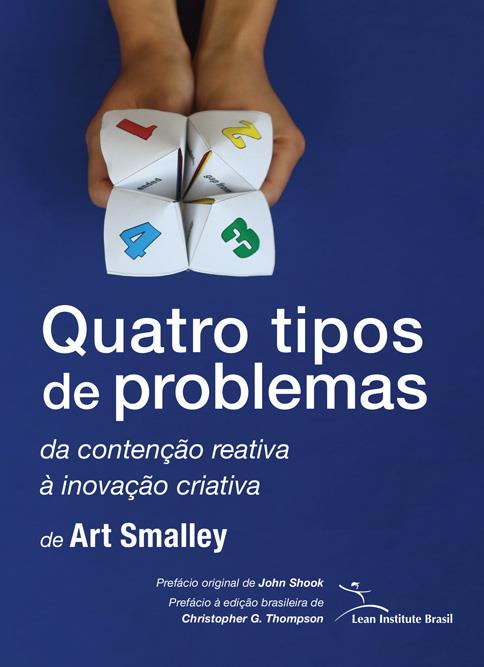
To buy the book (Portuguese edition), click here.