What is the lean approach to quality? Is that what six sigma is about?
Dear Gemba Coach,
I am a regular reader of your columns, and you always seem to stress quality first, but I can't find many books on a lean approach to quality. Is that what Six Sigma is about?
Please! Six Sigma is a (very valid) set of techniques, but not a lean approach. And, yes, you are right. First, there is – without a doubt – a lean approach to quality, and, second, it is our fault that we don't write more about it. I think the reason is that it's hard. Art Smalley and I started a book on built-in quality, but we couldn't finish it – quality is very specific and tied to technical processes, which are hard to describe in generic terms.
Quality is a difficult topic because, as normal human beings, we undermine outcomes by focusing only on output. For example, let's go to the gemba of a doctor's office. When you go for a checkup or when you're not feeling well, you expect a good outcome: you want to be cured as quickly and painlessly as possible so you can get back to living your normal life. You expect from the doctor:
- Accuracy: the most important thing is to make the right diagnosis the first time and then prescribe the right treatment.
- Availability: you want to see the doctor now, not be put on a waiting list, not wait in a room full of coughing, sneezing, irritated people and patients in terrible shape.
- Attitude: you desperately need to trust your doctor, and their attitude really matters. Better a good doctor with a bad attitude than a nice doctor who doesn't know what they're doing, but the way the patient is treated reflects how much confidence they will place in the treatment, how rigorously they will follow the prescription and how well the placebo effect will work.
- Advice: a doctor who has proven to be accurate, available and trustworthy will be able to give you advice you will value (avoid fats, exercise more, wash your hands before eating) and that will improve your level of health beyond the immediate problem that prompted the visit (conversely, you will probably reject perfectly valid advice from a doctor you don't like).
Accuracy, availability, attitude and good advice describe the patient's outcome. The doctor, however, has a somewhat different problem, with a huge queue of patients and bills to pay. So it's easy for their focus to be on output: how many patients are treated in a day, focusing on spending less than 10 minutes with each patient and simply getting the job done. In doing so, the doctor may be seen as efficient, but can easily lose effectiveness. Diagnoses are too fast, prescriptions generic, interactions indifferent, and learning disappears completely.
Achieving quality
Toyota's unique approach to the market is customer satisfaction through better quality, lower cost and shorter lead time.
What does better quality mean in practice? This is often very complicated, because products and services can be seen as:
- What all products and services have in common (a car is a car, which takes you from A to B and consumes fuel).
- What some products and services specifically have that customers really like.
Quality is (1) perfect accuracy on what everyone has in common – and, if you can't get that right, the customer gets annoyed – and (2) offering something special; hard to quantify, but it's what makes customers smile – and makes them loyal to your brand.
I was at the gemba a few days ago looking at the lean engineering efforts of a company that makes sunroofs for cars – inserting the glass into the roof with all the mechanisms to open and close it, inserting the part that will open, and so on. We were looking at a new concept, and the engineer had identified that the mechanisms needed to:
- Work easily and not break – this is the basic value all competitors will offer (to varying degrees).
- Make the right sound – this is a unique insight that, as with car doors, there is something uniquely satisfying about something that closes with the right “sound.” I doubt there's a word for “good closing,” but it's definitely something that makes you feel good and smile.
Only the future will tell whether the engineer is right, but he is trying – accuracy in basic performance and the attitude to deliver something extra.
Quality and kanban
Toyota, for example, in addition to making cars that perform better than any other in their price range, won its market share with, first, “peace of mind” and, second, “fuel efficiency.” On the way back from the airport, a taxi driver told me he now drove a Toyota Prius because his beloved Mercedes spent too much time in the repair shop, whereas he never had to worry about the Toyota and, besides, since he spent a lot of time driving around the city, he noticed a visible difference in fuel consumption. And he felt good about polluting less (by the way, the competitive pressure this puts on the market is real, as the latest VW scandal shows). Other automakers chose style, power or comfort.
Once this is clear in your mind, the question becomes: how do you achieve it? Have you seen the amazing “BBC Top Gear” program on “how to destroy a Toyota”? (https://www.youtube.com/watch?v=xnWKz7Cthkk – in English). It's a fun illustration of how Toyota gives its customers peace of mind. What is lean's unique approach to doing this?
The trick lies in understanding that quality is accuracy and availability. By shortening lead times, Toyota puts pressure on delivering only quality parts at every level. If there is any doubt about the quality of the part or its assembly, the line stops – but the pressure to deliver small quantities at regular intervals continues, so the investigation happens immediately! In other words, we are looking for quality and immediate delivery without excess inventory – in order to be able to focus on each wrong part or piece on the spot (as opposed to inspecting an entire batch of parts waiting in stock).
Built-in quality means that we can draw a mental matrix:
- Of the main functions we offer customers and their expected level of performance.
- Of the delivery logistics of that function (in products, this means not only the module that delivers the function to the customer, but also the one that creates the module).
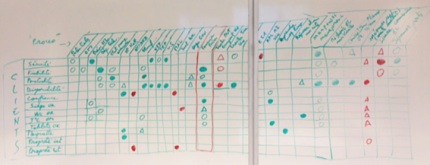
From the gemba, here is an example (above) of a matrix for a train service center. On the left side you'll find the benefits to the customer and, at the top, the processes that are generating those benefits. Filled circles are high interactions; red circles are those where kaizen is happening:
Doing full just-in-time in every basic process will reveal many internal quality problems, which are an opportunity to improve the accuracy of the product or service as a whole while increasing availability as well. No inventory means that the single part (oh, OK, five parts) we have on hand must all be good.
An obsession with few parts that are all good in every process that increases performance for customers has a profound impact on product or service engineering. First, we will take much more care when we change things. Yes, the product needs to evolve and innovate, but not at the expense of quality. The chief engineer wants to put all the most innovative features into the new car, but needs to be careful with standards – this will lead us to define very early what goes forward and what doesn't.
Second, the emphasis on constant training now seems obvious. Few parts of everything all the time means that the five components you have on hand have to be good (there's no inventory to rummage through for good parts to replace the defective one). This means that the effort to ensure that the process that makes them works perfectly is a necessity, not a “nice to have.” On the one hand, we change fewer things; on the other, we work much harder to make the current process work. The key is, obviously, kaizen.
Lean as a quality system
This is another reason we find it hard to separate quality (contrary to Six Sigma and similar approaches) from just-in-time in our descriptions of lean – quality is the prerequisite for kanban; this is very obvious in all the old Toyota books, but quality is also achieved through kanban: the smaller the batches, the fewer parts are in the process and the greater the pressure on quality. You cannot separate them.
If we look at an individual level, how do we expect anyone to master any task?
- Outcome: Can the person deliver the right quality autonomously (without help or correction) every time?
- Output: Can the person deliver the right quality within the target cycle time autonomously (without help) every time?
- Ideas: Does this person have ideas to make the standard easier to follow and, therefore, increase the chances of delivering outcome and output?
- Teaching: Can they teach others?
For a new line, at the start of production, takt time is the main target, and the question is “how quickly can we reach it?”
- Every product needs to be right, so it will take as long as it takes to solve all the problems – as they come up – step by step on the line (which means learning to detect them as close as possible to when they are created).
- When quality problems are under control, we get closer to the target cycle times and therefore closer to delivering at the planned takt time.
- When takt time is reached regularly, we either take resources off the line or add a new product to keep the kaizen spirit alive, and start another cycle of solving the quality problems that come up, then reaching the target cycle time again, and so on.
Toyota has very clearly taught us that, in order to achieve customer satisfaction (better quality, lower cost, shorter lead time), we need to master simultaneously the pillars of just-in-time (takt time, pull and one-piece flow) and jidoka (stopping at the defect and making machines autonomous with regard to quality in order to separate machine work from human work). These two objectives (more just-in-time and more jidoka) drive the real work of kaizen and involve and sustain standards, which will generate quality in terms of accuracy, availability, attitude and, in the end, advice.
Yes, as lean authors, we have been careless in not better explaining the quality dimension of lean thinking. No doubt about it. The only help I can suggest is to try to see the quality aspects embedded in every discussion of just-in-time and, yes – emphatically yes – quality comes first, then delivery, then lead-time reduction and then cost reduction. Even so, this is counterintuitive. The conditions for increasing quality are created by our efforts to improve delivery accuracy, reduce lead times and reduce unnecessary costs. It's a system.
Source: Lean Enterprise Institute