

TSURUBE FLOW (Pick-up and Supply System); Connecting processes with long lead times
TPS (Toyota Production System) seeks to create a pull system and continuous flow, but we know this is not always possible, especially where there are different cycle times between processes, shared processes, long distances, etc. To resolve such problems, a standard inventory is commonly established between processes, in stores (as they are called at Toyota) or supermarkets that connect the processes using the traditional withdrawal Kanban.
The big mistake most companies make when facing processes with a very long L/T (lead time) is to go ahead and size a large supermarket compatible with that L/T and thus end up creating yet another intermediate inventory, bearing in mind that a supermarket is still an inventory. The big problem is that despite all this inventory, the company will still have to live with sometimes a shortage, sometimes an excess of material. And then the following questions arise:
How does Toyota handle the connection between processes with long lead times? How is this obstacle to continuous flow resolved?
My generic answer to these questions recalls that the Japanese at Toyota often say that you have to experience the genba no dorokusai tokoro, a translation that would not make much sense to a Westerner, but literally would be experience the shop floor steeped in the smell of mud , or, interpreting and translating, experience the secrets and knowledge acquired in the day-to-day of the shop floor. And it is one of these pieces of practical knowledge, experienced in the genba no dorokusai tokoro of TMC (Toyota Motor Corporation) and later applied in one of my kaizens at the TDB (Toyota do Brasil) plant, that I will be reporting on in this article.
This is theTsurube Flow, which, despite appearing in the Lean Lexicon, is a system unknown to the vast majority of followers of the lean philosophy, who, by the way, have nothing to be ashamed of, since many of our Toyota colleagues, more acculturated in TPS, are also unaware of it, because the Tsurube Flow is a very specific logistics method within the material and information flow that makes up TPS. Therefore, despite the vast bibliography on TPS, you will rarely find literature on this subject, because few authors have experienced the day-to-day of a Toyota genba. And among the few Toyota people who have experienced that day-to-day, unfortunately statistics have shown that few writers have emerged. Perhaps the explanation for this fact, I believe, is that within Toyota we concentrate on carrying out Standardized Work well and don't delve so deeply into the overall view of the concepts.
My first contact with this type of flow happened at Toyota's oldest vehicle factory, formerly called Koromo Plant and today Honsha Plant of TMC (Toyota Motor Corporation), in 1991. At the time I had joined TDB(Toyota do Brasil) only 1 year earlier and had been transferred to headquarters under an OJT (On the Job Training) arrangement in view of the project for a new plant in South America. I was assigned to this plant's Production Control Department, and one of my first learning experiences was in machining, a place of great stories since it pioneered the implementation of TPS under the baton of then-manager Taichi Ohno.
At Machining Factory No. 4 of the Honsha Plant, my job consisted of controlling the flow of the pinion gear from rough machining, through Heat Treatment, ending at the Phosphating store. There were some failures in this logistics, mainly related to delays in the phosphating process, and I was assigned the mission of carrying out a Kaizen that would remedy the root cause of this problem, but this would be a subject to be explored in another article in the future; our main topic today is Tsurube, so stay tuned for my next article, in which I will tell in detail the saga of a Brazilian engineer doing Kaizen at TMC.
Even within Toyota plants around the world, there is often a need to review and improve the system in place, and that is what also happened at Toyota's first overseas plant, TDB (Toyota do Brasil), the São Bernardo do Campo plant. Despite being a plant conceived by the TPS wizards Eiji Toyoda and Taichi Ohno, who designed a highly verticalized manufacturing process that would enable the concept of production in small lots with a wide variety of items, we had been facing serious difficulty in maintaining that concept. Inventory levels of both internally produced parts and purchased parts were very lean compared with push production standards, but unacceptable by the standards that govern the Toyota Production System. The TPS review work across the entire process (including purchased materials) was carried out over 2 arduous years under the guidance of TMC's dreaded OMCD (Operations Management Consulting Division).
In the review of the logistics as a whole, the Kaizendesigned to improve the flow of machined components that had to go through the heat treatment process, known to be a process with a long Lead Time (10 hours on average), was precisely the Tsurube Flow I had observed and experienced at TMC some years before. Before we continue, let's define exactly what a Tsurube is.
Definition of Tsurube Flow
Literally, a tsurube is nothing more than the old pulley system used in the past to draw water from a well (see figure 1).
In manufacturing, the objective is to connect processes in order to maintain continuous production flow.
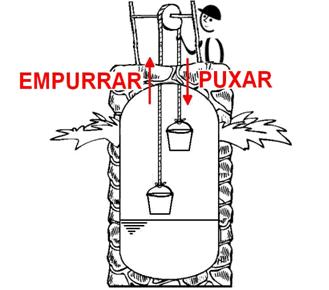
Figure 1. The Tsurube flow concept
It is applied to long L/T(Lead Time) processes located between two other processes. E.g.: Heat Treatment process between rough machining and finish grinding, painting process, galvanizing process, etc.
In the example below, we can see that this is a system in which logistics, before pulling parts to the customer process (Grinding), first feeds the Heat Treatment (HT) process with the equivalent quantities of raw material.
It is a method commonly used at Toyota when there is a shared processing step, physically distant from the rest of the flow, whose purpose is to keep the standard in-process inventory leveled. As a result, naturally, we will also have a material flow with more efficient transportation.
Grinding signals the need for treated parts to logistics which, in turn, instead of the usual process of collecting the treated part and supplying the customer process, will first go to the rough machining store to withdraw the material and place it at the furnace entrance (apparently a trivial operation, but a fundamental one) and only then will it collect the treated part at the Heat Treatment store to finally supply the customer process.
Here is a very typical case in which the Heat Treatment process is the protagonist:
Rough Machining -> Heat Treatment -> Machining (Grinding)
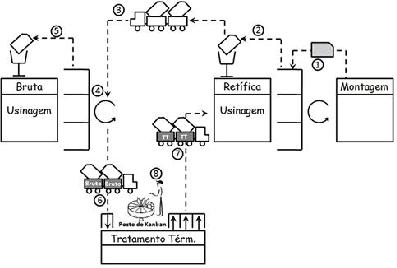
Next, we show how this is done step by step, showing the movement of kanban and parts in packaging multiples.
- The customer process (Assembly) collects a finished part from grinding.
- The Shikake Kanban (Production Order) is lifted and placed at the Kanban Post.
- Logistics takes this Kanban and goes to the Rough Machining store.
- It collects the corresponding rough part and places the Hikitori Kanban (the grinding Kanban that is playing the role of logistics Kanban) on the part.
- It lifts that part's Shikake Kanban and deposits it at the Kanban Post.
- It transports the part to HT (Heat Treatment) and queues it in front of the Furnace (I usually call it the movie theater line); as in any line, FIFO is fundamental to maintain the order of priority.
- Only after this entire operation is the treated part finally collected and transported to Grinding, thus completing the Tsurube Cycle.
- The HT operator, upon inserting the batch of parts into the furnace, detaches the Kanban from the rack and deposits it at the FIFO waiting Kanban Post; this post provides visual management, indicating which material is inside the furnace and also indicating the time it will come out of the furnace.
Interpreting the Tsurube Flow concept
To many it may seem obvious to feed in the raw material and withdraw the processed material. And they may say: We already do that!
I ask: So there has never been a material shortage? Nor has it ended up creating excess inventory?
I am absolutely certain that both have already happened and, I'll go further, repeatedly!
So I say that you do not operate the flow, you simply take and bring materials. Therefore, my certainty is true. There is no FIFO flow in this operation.
And why does this happen? Precisely because there is no systematized standardized work such as Tsurube guarantees. The foundation of the system aims to maintain FIFO throughout the entire production chain in a “disciplined” way, that is, before simply pulling from the supplier process's store, you feed it with raw material, which prevents any link in the chain from breaking in the middle of the process.
Tsurube is thus characterized, even if only at a specific point, as the only push system within TPS, because instead of starting processing after the pull signal, it begins by pushing the material. However, it must be clear that the start of the chain as a whole is always at the pacemaker process.
Conclusion
Any and every tool that supports the JIT (Just in Time) pillar has to be carried out within the rigorous standards of Standardized Work, made up of three elements: Takt Time, Standardized Work Diagram and Standard In-Process Inventory.
It may already seem like an old cliché, but Standardized Work is the foundation of any and every operation. What many people don't understand is that repeatedly carrying out, in an orderly and disciplined way, the sequence of work elements, each with its pre-established time, is what keeps the entire system connected without shortages and, even less, with excess material. We must never forget that those who run the factory are not the “thinking heads” but the operators.





