

Making a government agency's IT agile
Government is made up of independent programs that, because of how they are organized, inhibit efficient value streams. In my experience, government contractors provide inconsistent IT services. This is due to duplicated efforts, uncertain plans and outcomes, and a culture that favors adherence to process over results (and not in a good way). Decades of many initiatives in government agencies have given rise to long, neglected application portfolios. Simply keeping the business running and making the mandatory technology investment consumes a great deal of money and time.
Agencies are facing yet another looming budget cut this year and struggling to balance two contrasting priorities: a) meeting the target of urgent demand with limited capital (because of the high percentage of the budget consumed by operations and maintenance) and b) meeting and exceeding customer support expectations. Many agencies seek to eliminate inefficiencies in IT by focusing on operational effectiveness. In my experience, the best way to do this is through lean practice. Fortunately, I have observed a shift in recent years, as acceptance of the status quo has given way to an openness to lean thinking and a spirit of experimentation. Across all functions – in procurement, program management, infrastructure and cybersecurity –, people are creating learning environments, experimenting and giving back.
Learning from one lean experiment
When I have seen federal agencies and outside organizations form good partnerships, the focus was on helping the business prioritize daily work according to needs, raise the security profile of the portfolio, improve customer satisfaction and – most importantly – free up capital that can be applied to a new initiative (for example, data analytics, mobile IT and cloud storage) by removing other inefficiencies from the agency and from the application portfolio.
I remember working with a civilian agency that had braced itself for further budget cuts. The leadership team proactively consolidated IT support services to address two concerns: cost and customer satisfaction. The senior leadership team selected my team to help them rethink software production. They began by consolidating the operations and maintenance (O&M) function and supporting development of the entire portfolio, turning software production into a single value stream instead of an exercise in navigating functional silos. While the agency's motivation was cost reduction, here was an opportunity for them to fundamentally change the nature of the outdated command-and-control model and adopt one that is aligned with the principles of the agile manifesto and is customer-centered. Together, we also focused on people – emphasizing behaviors of accountability and continuous improvement among the staff.
My team and I worked with this agency to improve the capability of team members through a blend of lean/agile principles and practices, visualizing the work and focusing more on results than on adherence to old processes. These principles became what we now call Agile O&M®. Here are the four main areas of Agile O&M® (and they reinforce one another):
1) Use kanban
When we apply kanban principles to flow-based work, such as IT operations and maintenance, stakeholders see a significant improvement in throughput and a reduction in latency, consequently reducing total cost. Kanban gave this agency complete visibility into the actual work being done, and people were able to prioritize the backlog on a just-in-time basis or according to their organizational needs. Work-in-progress limits make the support team focus on improvements and enable the pursuit of “zero defect” goals. Kanban also allowed the agency to keep up with business demand, spread system knowledge across the whole team (preventing any one person from being a single point of failure), maximize staff capabilities and gain a new perspective to support continuous improvement through the sharing of ideas, best practices and lessons learned.
Government's main task is not to master IT, but unconstrained flow depends on its constant engagement
Government's main task is not to master IT, but unconstrained flow depends on its constant engagement. At this agency, this cultural shift from a command-and-control mindset to one in which decisions are made by those who do the work was the biggest challenge. Those who own IT products must recognize the ongoing modifications and data support – these things make up the “pulley” work of the software present in their business.
2) Adhere to the principles of the agile manifesto for new product development
Government systems are regulatory by nature
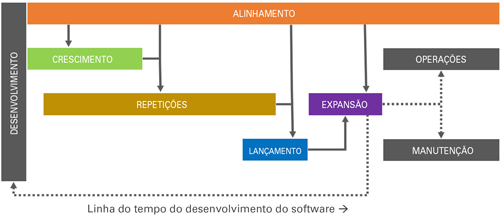
Major enhancements and “greenfield” development involve a progressive elaboration of requirements. Government systems (products) are often regulatory by nature, underpinned by public policy. They involve enforcing business rules, collecting data, processing industry fees and compliance reporting. For this agency, we provided agile manifesto training aimed at those who perform the work and their development teams. And the agile model that evolved after many retrospectives was a pragmatic improvement on the traditional scrum framework. It adopts scrum development activities and expands the framework into five progressive, overlapping stages (to provide a management context for peripheral activities that are critical to successful software deployment).
The five stages are:
• Alignment – This stage ensures that stakeholders and the scrum team share an understanding of the software's ultimate goal. The team focuses on business value rather than on features, and the software's technical decisions are aligned with business objectives.
• Growth – This stage focuses on the team and on scrum tools, skills and processes to achieve a good software outcome. Each member understands his or her role on the team and is able to contribute positively to the software's success. Teams are self-organizing and are coached by a scrum expert.
• Iteration – This stage ensures that the scrum team and stakeholders follow the scrum framework properly, producing the highest-priority features and the necessary scrum artifacts to maximize the benefits of the agile manifesto. The person who performs the work, the scrum expert and the team meet frequently but briefly to continuously correct course in order to deliver the greatest value first.
• Release – This stage focuses on a successful and predictable release as well as successful adoption of the software by its end users. All stakeholders are involved from inception through product release.
• Expansion – This stage emphasizes the major upcoming stages of the software. It focuses on operations and maintenance activities and on the next release iterations. With an IT support contractor, the transition from development to O&M is seamless, and the person who performs the work comes to own the system.
3) Make the work visible
For years, conventional thinking had this agency working with an ever-larger project management office (PMO) that collected data from various vendors. This office would distill the useful information, format the data into a reporting structure and then give presentations to a large audience. This approach to sharing work was disconnected from the facts, time-consuming, expensive and not very relevant to decision-making in different business units.
One of the requirements for taking on the role of IT support contractor was to show progress in taking control of the portfolio, system by system. Our organization adopted a principle that became known as Lean PMO®: reports on project work products generated by drives rather than manually. We collaborated with the agency's contracting officer's technical representatives (COTR) to develop a lightweight dashboard that generated reports directly from the project management artifacts: project schedule, risks, notable events, activities and budget. After that, it was just a matter of improving overall project management and problem solving through coaching and mentoring.
4) Create structures to support highly collaborative teams
Using technology effectively depends on using the right tool for the situation
Using technology effectively depends on using the right tool for the situation (kanban for flow-based work and agile for development), on visualizing data and on frequent communication. This agency chose to buy a set of tools that would help visualize its work. It now has a common point of reference around which meaningful conversations take place. They have transparency into the actual work of the process instead of manufactured artifacts. Senior leadership now observes business/IT engagement focused on individuals and interactions over processes and tools; it works with the software over working with comprehensive documentation, values the customer over contract negotiation, and responds to change over following a plan.
Reflections and results
The biggest challenge was sustaining the cultural change
Looking back on what happened, this project went through many difficulties and obstacles! We found that the biggest challenge was sustaining the cultural change. Each leadership change at the agency required an effort of re-education and re-justification. There seems to be a bias toward the command-and-control structure which, although necessary in the armed forces, is not applicable to software development.
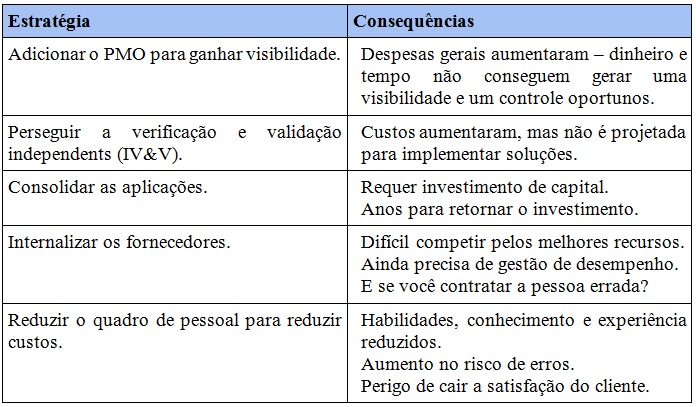
Engaging people in improvement work took time and effort, and both are scarce resources. Many people shared with us that accountability had to become “shared” rather than something that was delegated. And we realized there was still a bias toward traditional cost management strategies, which had been tested and proven not to influence productivity. For example:
Regardless, with senior leadership's commitment to new lean ways of thinking, this agency was able to achieve the following results in nine months:
- A successful transformation from waterfall to agile.
- 100% IT transparency regarding cost, staff, schedule, risk, work items and progress.A successful transformation from waterfall to agile.
- 50% increase in the output of new features with no increase in cost.
- Twentyfold reduction in production errors from the original level.
- 66% decrease in the percentage of the budget allocated to operations.
- Over 90% customer satisfaction according to the Net Promoter Score.
We tend to think of software as the end goal, but it is not. Software is a means used to achieve an end – a way of adding value for the customer.
In IT organizations, software supports the agency's services. Continuous improvement, communication through transparency, cost reduction through greater staff efficiency – these are the main sustainable benefits that can be achieved with lean IT. Seen this way, software development can be considered a process of continuously discovering what is needed, planning before development, executing and then checking the results to adjust it for the next cycle.
Source: Lean Post.







