
What is yokoten?
As we go about our working lives, we learn new things about our jobs and processes, and it is natural for us to share this newly acquired information with our colleagues. After all, knowledge sharing makes business sense. Mistakes and problems flagged today are less likely to happen again tomorrow, because the rest of the organization is alerted to the risk. Similarly, when someone discovers a good way to perform a certain task and shares it with their colleagues, we can expect a ripple effect that will be felt across the whole company.
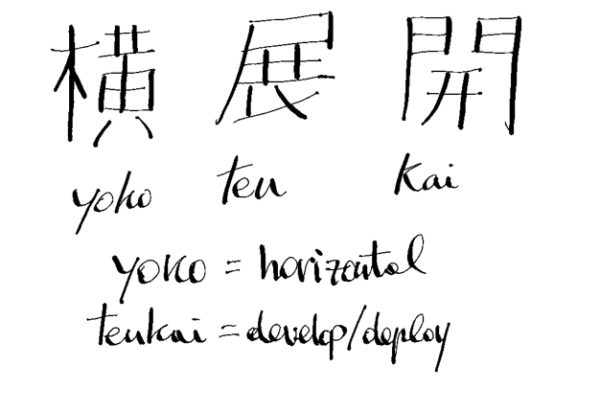
Lean thinkers have a name for sharing knowledge, learnings and good practices with others: yokoten. The term is an abbreviation of the Japanese word yokotenkai, which (somewhat loosely, as is often the case with Japanese) translates as “horizontal deployment”.
It is interesting to think that sharing problems and solutions, which lies at the root of yokoten, will always be a constant at the Lean Summits. A group of companies will share their problems and solutions, encouraging everyone to do the same inside their own organizations.
In a way, Toyota itself taught us that improvements that are not shared are not really improvements. Think about it: when we are asked to record our tested changes and improvements on a Work Instructions sheet, isn't this done with the idea of sharing the good practice with others? Isn't the purpose of a standard to make knowledge accessible to other people who may have to perform the same task? Think about this: by definition, there cannot be a standard if knowledge is not shared among people!
Speaking of Toyota, yokoten was fundamental to its successful transformation into a global competitor. As the company expanded, it needed to find ways to effectively translate its culture (yokoten does not mean copying, but internalizing and adjusting to one's own circumstances) to many different environments around the world, from Kentucky to Europe.
Cross-departmental yokoten, of course, is not just Toyota's prerogative. We see it acting as a powerful enabler of continuous improvement in countless lean transformations. One example I like to cite is the Dreamplace hotel chain in the Canary Islands, Spain. In an interview given to Planet Lean (in English), three of the hotel's directors explain how yokoten works in their organization and how, for example, people are regularly transferred from one hotel to another to “spread the good work” and teach others. Highlighting one of the benefits of yokoten, one of the interviewees said: “I remember how useful it was (and still is) for me to see the A3s [in other hotels] working. I was able to apply some of the ideas in my own hotel, and the excellent problem-analysis work saved us a lot of time. I also think it is always good to look at problems from different points of view”.
Yokoten To The World
By now, you have probably understood that yokoten comes in many different forms. It can happen between individuals and teams, branches and departments. Even between organizations, when open-minded leaders understand the importance of opening the doors of their businesses to others, giving them a unique chance to observe their processes and learn from them.
Yokoten is not carried out for altruistic reasons (although turning your company into a “case study” or success story is a great way to recognize people's efforts in the lean transformation). There is a lot of value in getting an outside view of our work, and that is really what convinces many organizations to open their gemba to the outside world.
Over time, this can create excellent opportunities for mutual learning and drive “lean revolutions” that can transform an entire sector. We saw this in healthcare in Catalonia, where the efforts of a pioneering hospital (in English) over the last decade inspired countless other organizations to adopt lean thinking. Recently, we saw how the city's own Health Department started a project (in English) to improve the work of all primary care units – an effort made possible by the early experimentation with hoshin kanri that took place in a hospital. Also recently, we observed a similar dynamic in Brazil, where the pioneering efforts of the Instituto de Oncologia do Vale are inspiring a citywide initiative to improve patient outcomes.
In another example I came across, the entire city of Grand Rapids (in English), Michigan, acts as a kind of lean laboratory where practitioners from different departments can count on one another for support and inspiration. The city Fire Department's deputy chief of support services, Brad Brown, said: “Within the city, lean practitioners have access to any department. We can call people at any time and go and see. Every few weeks, a different group of people comes to our gemba. Lean is very widespread in Grand Rapids, even outside city government: it is not unusual for me to go to the hospital once a month to see some lean friends there, or to stop by a factory. It's fantastic, and we are very lucky to have so many lean practitioners in West Michigan”.
A few years ago, in neighboring Indiana, Ben Hartman established a lean farm. The lessons he learned there, which received a lot of attention in the lean world, inspired efforts on the other side of the world, in Nigeria, where Ben supported a USAID project (in English) to improve the lives of Nigerian farmers. Ben knows all about the power of yokoten, because that is how he himself discovered lean, as James Womack explains in this column.
Despite being one of the greatest enablers of improvement, when it comes to practices, yokoten is often forgotten. I hope this short article has helped you understand why this is a missed opportunity.
Now take the opportunity to check out the Lean events calendar and discover how to become a reference in lean management in your sector. We have in-person and online events focused on improving the efficiency of your business.