
How to set targets for setup time
"We managed to cut setup from 2 hours to 20 minutes! Great!", "Let's keep reducing it further!" are common phrases heard after day-to-day efforts to reduce setup time.
We know that the faster the setup, the better. But are those "20 minutes" already enough? How do we know whether this time is short, long or sufficient? Is it necessary to reduce it further? What would the target be, that is, the setup time to be achieved?
The ideal is a setup with a changeover time of zero. But this is only possible on a production line with properly sized machines and equipment dedicated to a single value stream. So what do we do when this is not possible?
This article aims to show how to determine target times for setups so that production works in a leveled flow. Starting from a future-state vision of a value stream, the target setup times should be determined, as well as the action plans to achieve them.
The NTL Brushes example
Let's analyze the case of a company that manufactures steel brushes for industrial use. This plant operates 1 shift of 8 hours with two 10-minute breaks. A value stream map was drawn for the circular brush product family, which has 5 models. The two basic processes are the shared stamping area and an assembly cell with three processes (I, II and III), shown below with their respective data boxes (CT = cycle time and CO = changeover time):
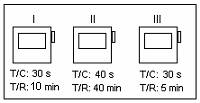
Figure 1 – Assembly cell.
Stamping has a cycle time of 6.5s with a setup of 58 min. Because of the difference in cycle times between the cell and stamping, it was not possible to establish flow between the two processes, so a supermarket was created to pull from stamping, as shown in figure 2.
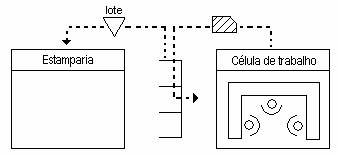
Figure 2 – Flow between stamping and the work cell.
The daily demand for this product family, based on a six-month history, for the five models (A, B, C, D and E), is shown in Table 1.
Table 1 – Daily demand by model.
Model |
Daily demand |
A |
500 |
B |
100 |
C |
50 |
D |
25 |
E |
5 |
Total |
680 |
Analysis of the work cell
Although the machines are physically close to one another, the assembly cell does not work in continuous flow. Inventory accumulates between one process and the next. The cause is the long setup time in process II, which leads to large batches of each model being produced. Therefore, we must reduce it. But by how much? Are the setup times of the other two machines adequate?
The cell's takt time in one work shift is the ratio between the time available for production and customer demand. Knowing that the plant operates 8 hours a day, equivalent to 480 minutes, with total breaks of 20 minutes and machine availability of 85%, the time available for production is (480 min – 20 min)x0.85 = 390 min. Dividing this value by the demand for each model, we get their respective takt times, shown in the table below:
Table 2 – Takt time calculation for each model.
Model |
Takt time (min/pc) |
A |
390 ÷ 500 = 0.78 (47s) |
B |
390 ÷ 100 = 3.9 |
C |
390 ÷ 50 = 7.8 |
D |
390 ÷ 25 = 15.6 |
E |
390 ÷ 5 = 78 |
Total |
390 ÷ 680 = 0.57 (34s) |
Looking at this table, we conclude that every 34 seconds one of the five models should be produced by the assembly cell. But which model should be produced first in this cell? In what sequence? How many in each batch? To answer this, we need to establish rules for scheduling the cell so as to minimize work-in-process and finished-goods inventory; in other words, we need to level production.
Leveling means producing all the necessary items within a time interval (in this case, one work shift). We can represent table 2 graphically in another way:
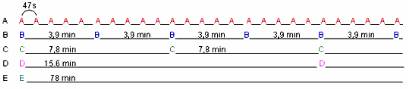
Figure 3 – Production leveling.
In figure 3, each model is ordered and spaced in proportion to its respective takt time. If one model is produced every 34s in the following sequence:

In other words, according to each model's takt, this is equivalent to producing model A every 47s, B every 3.9 min, C every 7.8 min and so on.
Now we can determine the targets for reducing setup time in the assembly cell.
Setup target for the work cell (process in flow)
In the assembly cell, the models manufactured will flow through the three processes according to the sequence presented above, at a takt time of 34s.
In this case, what would be the time needed for the tool changeover?
We observe that currently the setup time in processes I, II and III is 10 min, 40 min and 5 min, respectively. We now know what the production sequence should be. To switch from A to B and maintain one-piece flow ("one piece flow"), the operator of the next process must perform the machine setup while A is still being processed.
Figure 4 represents the production sequence and the moment at which the setups are performed for each model.
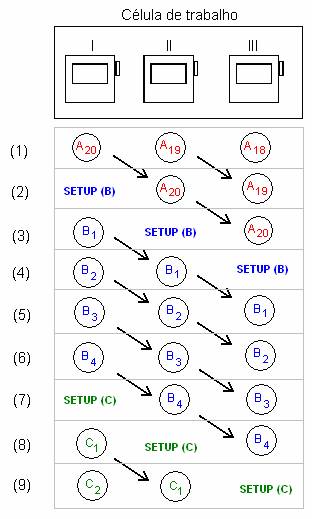
Figure 4 – One-touch setup.
That is, in (1), product A is flowing on the line and being processed. Before the next product, B, enters, "1 empty slot is allowed to flow" just once through machine I, as shown in (2). It is this time interval, when no product is passing through the process, that will be the time available for the machine setup, represented from (3) to (9). With the setup performed in each process within the takt time (34 seconds), the production of only one unit is sacrificed, but flow is maintained in the cell. This tool changeover procedure is called "one-touch setup".
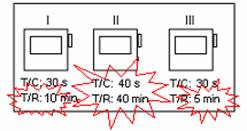
Figure 5 – Kaizen needed in the cell.
We then note that the following kaizen are needed for implementation, as represented in figure 5:
- reduce the cycle time of process II (from 40s to 30s), providing a 10% margin relative to the takt time (34s).
- reduce the setup time in processes I, II and III to 0.57 min (34s);
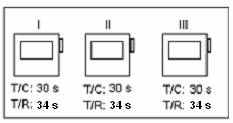
Figure 6 – Future state in the cell.
To reduce the cycle time of process II, a detailed study of each step of the process, or of the work elements, along with the operation times, must be carried out in order to eliminate waste. To reduce the setup time and achieve the established targets, the quick changeover methods originally developed by Shigeo Shingo at Toyota in the 1950s can be used.
Analysis of stamping
The press on which the industrial brushes are produced is shared by several product families. Its cycle time is 6.5s with a setup of 58min. The time used in the daily production of the circular brush is 73.7 minutes, obtained from 6.5 x 680 ÷ 60. The other product families absorb 226.3 minutes of press work, for a total of 300 minutes. With an available working time of 390 minutes, we have only 390-300= 90 minutes available for setup (disregarding, in this case, time for maintenance). But with 90 minutes it is possible to perform only 1 setup of 58 minutes per day.
Setup target in stamping (batch process)
To determine the setup time in this case we must:
- Determine the time available to perform setups (available working time – time spent on production);
- Know the number of setups to be performed;
- Divide the result of (i) by (ii) to obtain the time for the machine setup.
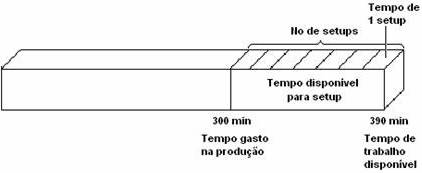
Figure 7 – Determining the time for one setup.
The number of setups needed is obtained once production has been leveled based on demand. If this number is, for example, 7 setups, it currently takes 5 days to perform all the setups (58’x7 = 406’, divided by 90’). This means the supermarket needs to hold at least 5 days of inventory to meet demand.
With the goal of cutting this inventory in half to reduce lead time, we must then cut the setup time in half, that is, to 29 minutes. This will make it possible to perform 14 setups in 5 days, achieving 2 production runs per week. In other words, the 7 setups will be done in 2.5 days. This will double inventory turns and halve the physical space occupied, as well as the size of the batch produced.
If the goal is daily leveling, with 7 setups in the work shift, the changeover time to be achieved should be 12.8 minutes (90’ ÷ 7).
Conclusion
Having a quick setup is one of the fundamental steps to leveling production. It makes it possible to work in small batches and reduce inventory, increase flexibility and respond more quickly to your customers' demand.
When defining the future state of value streams, we must set targets for setup time. After calculating the product family's takt time and leveling production, we determine how many setups will be needed. On an assembly line or in a work cell, "one-touch setup" ensures continuous flow when it is not possible to have a setup time of zero. Whenever there is a process that is not in flow and produces in batches, as in the case of stamping, the setup time should be reduced toward a defined target, whether to level production, increase inventory turns, etc. Making the reduction feasible requires a cost-benefit analysis.
From now on, before starting any work to reduce setup time, determine the target first. "We have to reduce setup on this machine to 'x' minutes. No more, no less!".
References
Shingo, Shigeo. A Revolution in Manufacturing: The SMED System, Bookman, Porto Alegre, 2000.
Smalley, Art. Creating Level Pull, Lean Institute Brasil, 2005.
Toyota Production System, Toyota Motor Corporation, 1987.
Lean Lexicon, Lean Institute Brasil, 2003.